 01635 581 811

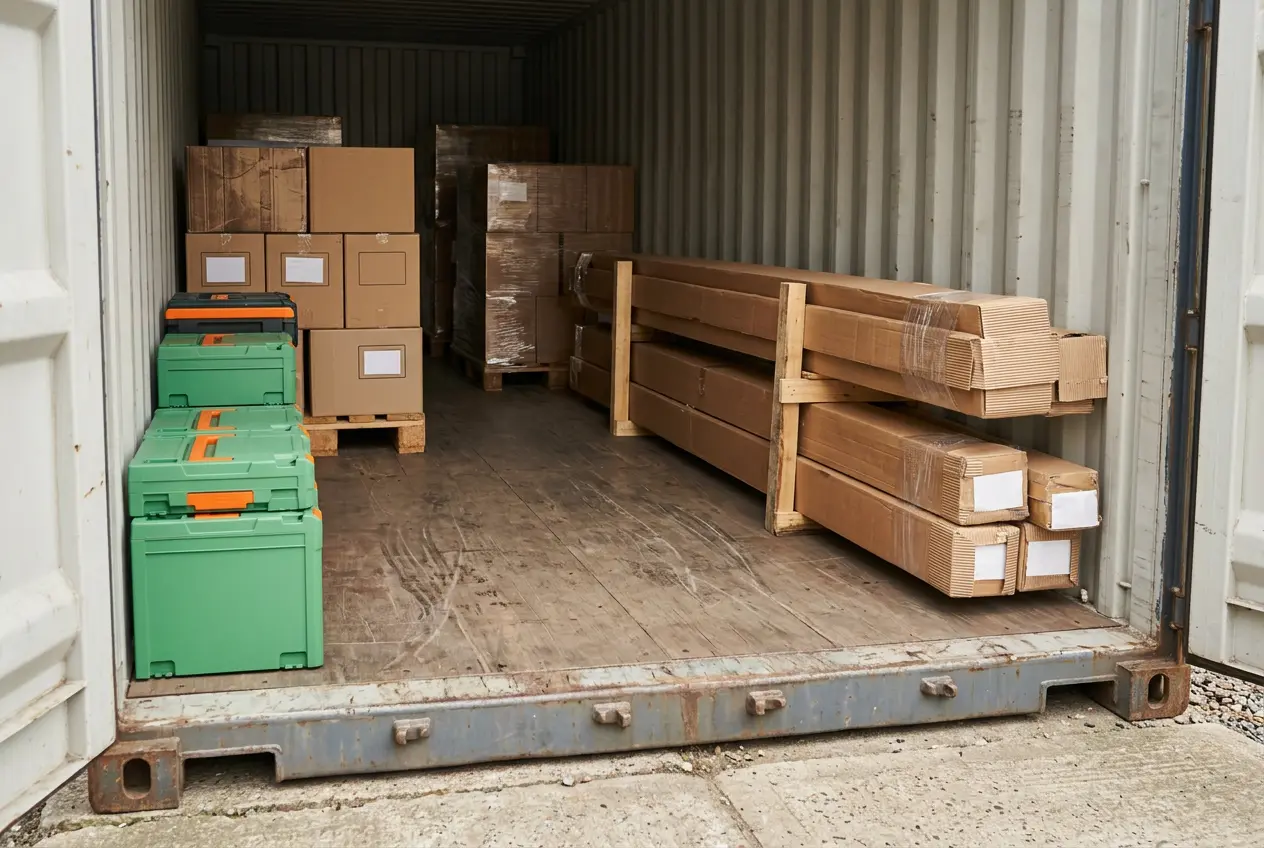
A mixed container needs to work for two different visits: the day everything arrives and the morning you need one tool case or a particular pallet. Plan both before loading. Pallets need room for their handling equipment, long stock needs a clear withdrawal path, and everyday tools should remain reachable when the container is full.
The useful test for 20ft container storage is not simply whether everything fits inside. It is whether the goods you expect to retrieve can come out without first moving unrelated stock. Start with the loaded measurements, then work through the route and arrival order.
Measure the loaded goods, not just the pallets
A pallet footprint is the floor space occupied by the pallet when viewed from above. For planning, measure the complete loaded footprint: cartons, wrapping, projecting handles and anything hanging beyond the base. Record the greatest width, depth and height. A nominal pallet size tells you little about a load with bulging boxes or an overhanging component.
Separate whole-pallet collections from stock picked a box at a time. The first needs a route for the complete load and moving equipment; the second needs access to the relevant carton faces. Record whether each load must stay upright, cannot be stacked or needs support. Do not count space above it as usable unless the proposed stacking arrangement is suitable. If one pallet contains several product lines, decide whether they will leave together before assigning its position. A visible label on the front carton does not make a different product buried behind it accessible. Where orders need individual cartons from that pallet, arrange the picking stock so each required line can be reached, or separate it from the reserve load before storage. Record that distinction so a colleague does not dispatch the complete pallet while some cartons remain allocated to another order.
Measure oversized stock in its stored and moving positions. A long component might sit neatly beside a wall but need substantial clear space in front of it before it can turn towards the doors. Include its packaging and any attached trolley. Keep tool cases grouped by working kit so collecting a drill does not mean opening several unrelated boxes.
Our standard twenty-foot containers provide 160 sq ft inside. That floor area does not establish how many loaded pallets your layout can accommodate. Compare our container storage with your measured goods and the space needed to move them, rather than dividing the advertised area by a nominal pallet footprint.
Trace the complete route through the doors
Follow the proposed movement from the delivery vehicle to the final storage position. Include the unloading method, vehicle stopping arrangements, ground surface, approach angle, door opening and internal turn. Establish where the doors can open fully without obstructing the movement. An item fitting through the opening straight on does not prove it can approach at the angle your delivery requires.
Our outdoor containers are at ground level, but ground-level access does not mean a flush transition. The threshold is the door sill between the outside surface and container floor. Inspect that transition as part of the route: a small wheel catching at the sill can stop a move that looked straightforward on a floor plan.
If using a pallet truck, establish that the particular truck suits the pallet and route. A pallet truck has forks that enter beneath a pallet and raise it for wheeled movement. Allow for the handle, operator position and turning movement, not just the pallet itself. Check the assessed method for crossing the threshold rather than improvising a crossing when goods arrive.
Draw the removal route as well as the arrival route. A pallet may enter an empty container easily yet become trapped once tool cases and long stock fill the surrounding space. The final drawing should show the complete mixed load, with enough room to approach, engage and withdraw the pallet that will leave first.
Set the handling method before loading day
Manual handling includes pushing and pulling as well as lifting. HSE manual handling guidance requires employers to avoid hazardous handling where reasonably practicable, assess unavoidable risks and reduce injury risk as low as reasonably practicable. It also explains that the law does not set specific weight limits. Weight alone is therefore not a safe-movement decision.
Arrange a competent assessment of your load weight, stability, equipment and complete route. Our available moving equipment includes pallet trucks, flatbed trolleys and wheeled stepladders; availability does not establish suitability or make a particular move safe. Adding a second person is not a universal solution either. Resolve unsuitable handling before bringing the goods, including specialist assistance where the assessment requires it.
Give each awkward load a short movement note that the person collecting it can understand:
- Name who will load and unload it, including the delivery handover.
- Record the assessed handling method, equipment and staffing needed.
- Identify which face must remain accessible and any upright or no-stacking requirement.
- Note any delivery or access arrangement still needing agreement before arrival.
Load the vehicle in the container’s arrival order
Items assigned to the rear of the container generally need to come off the vehicle first. Regular-use goods intended for the front come off later. Agree that sequence with whoever loads the vehicle, subject to its safe loading requirements. Otherwise, the first items unloaded can occupy the very space needed to move the remaining goods into position.
On arrival, unlock, inspect the movement route and place the rear-zone items before bringing in the middle stock. Establish the working aisle, then position the regular-use kits. Face labels towards that aisle and photograph the completed arrangement for colleagues. This preserves the original loading plan instead of leaving the next visitor to reconstruct it from memory.
Before positioning the last pallet, pause at its intended resting place. Check that the first outgoing load can still be reached and removed with its handling equipment. If the last pallet closes that route, change the plan rather than treating the aisle as spare capacity. A walking gap alone may not be a usable pallet-removal route.
Give each type of stock a workable position
Keep regular-use tool kits and imminent collections near the doors, stable stock in the middle and genuinely slow-moving goods towards the rear. These are priorities, not fixed divisions. A rear position is unsuitable for a pallet that needs a turn the finished layout cannot provide. Choose a side or central aisle according to the actual withdrawal paths.
Consider a hypothetical business storing reserve boxed stock on pallets, installation tool cases and long packaged display rails. The tools leave regularly, the boxed stock is replenishment stock, and the rails are reserved for a later project. The tools belong within easy reach, but their cases must not occupy the approach needed to remove a complete pallet.
The rails could occupy a supported position along a side only if their removal path remains open. If they must slide forward before turning, reserve that space in the finished arrangement. Put the reserve pallets where their accessible faces and handling approach suit the collection method. This may leave an apparently empty patch that is essential working space.
Give outgoing orders and returned tools defined temporary positions outside the aisle. Returns should not become a pile at the doors while someone decides where they belong. If a return cannot go straight back into its assigned position, resolve its destination before unloading it. Likewise, prepare outgoing stock without blocking access to another collection due during that visit.
Keep an inventory that explains retrieval
Record more than contents and quantities. For each pallet, include its location, date stored, dispatch priority, accessible face and movement-note reference. State whether collection means the whole pallet or selected cartons. Use locations someone can understand from the doors, such as front left or rear right, rather than a private naming system known only to the original loader.
For tools, record kit groups unless individual asset tracking is necessary. For oversized stock, record orientation and the space that must stay clear for removal. Update the record whenever goods change position, not just when they leave. A shared spreadsheet, notebook or phone note can work if every user maintains the same record and can find the movement instructions.
Review the arrangement after the first month of actual collections. Bring frequently retrieved goods forward and reconsider items that repeatedly require unrelated stock to move. Compare the photograph with the current layout: an aisle gradually occupied by returns is a practical fault to correct, even if the inventory quantities are still accurate.
Match the rental arrangements to the load
Our outdoor containers offer 24/7 access if you need to collect stock outside office hours. Delivery acceptance is different: we can accept deliveries during staffed opening hours. Agree the handover and who will move goods to their final position; accepting a delivery does not establish an unloading or stock-positioning service.
If most of the load is boxed stock, office equipment or paperwork rather than bulky mixed goods, compare our business storage before choosing an outdoor container. Discuss the actual goods and their required storage conditions, alongside delivery and collection times. Do not choose solely for out-of-hours access if the stock needs conditions that have not been established.
Choose the layout that survives the final pallet
Commit to the mixed layout only when the next tool collection, whole-pallet withdrawal and oversized-item removal still work with everything in place. If they do not, reduce the load or reconsider the arrangement before delivery. To discuss rental space, get in touch with loaded measurements, handling requirements and your expected collection pattern. Those details are more useful than a pallet count alone.