
 01635 581 811

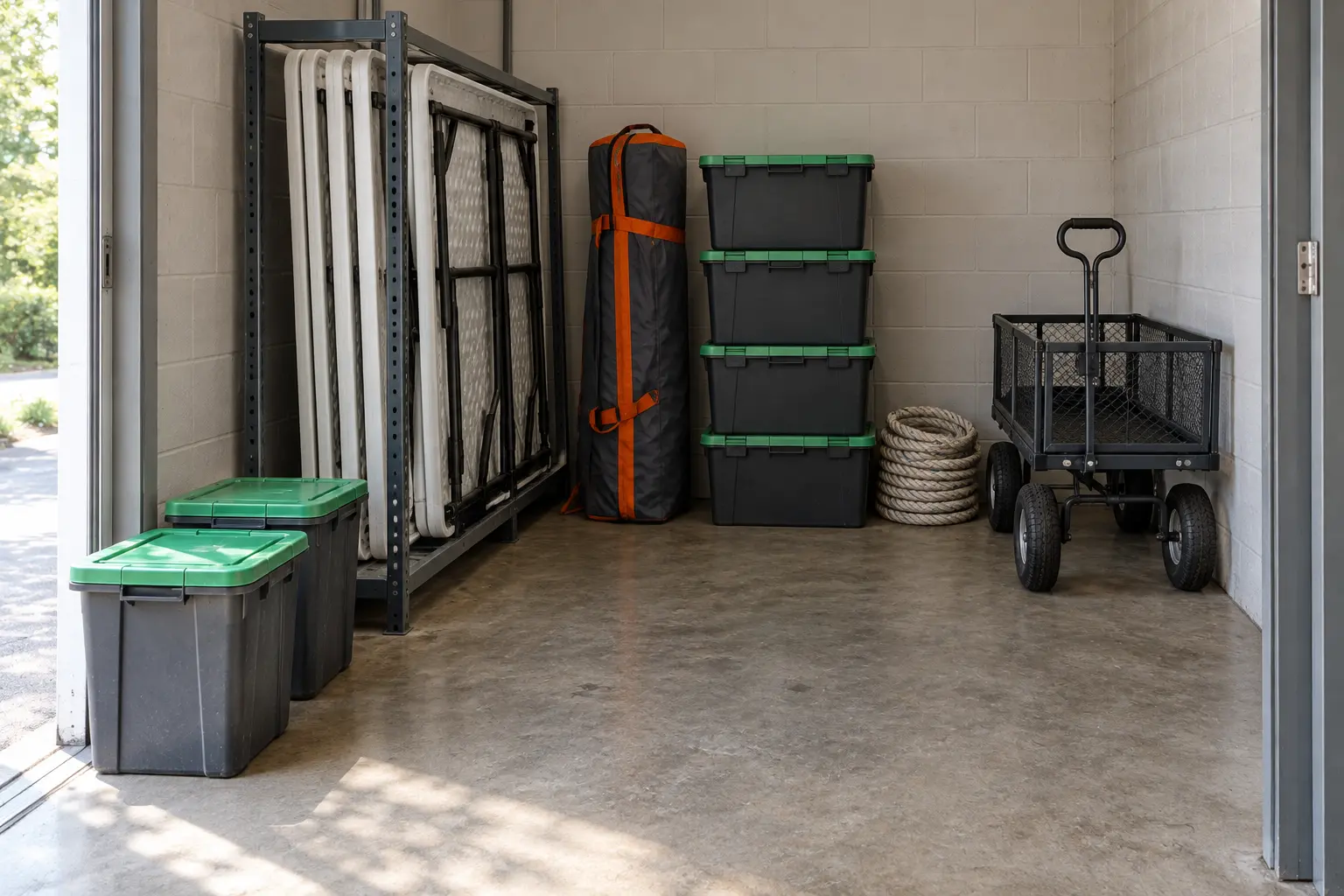
Paying to store a community group’s equipment can be sensible even when a volunteer has offered a garage. The question is whether the group needs a dependable resource of its own, and whether it can fund and use that resource without quietly handing the whole job to another person.
Start with the period you need to cover, not the size of the unit. A committee choosing charity storage in Newbury should be able to explain what the rent preserves, which activities depend on it and what happens when the approved money runs out. Flexible storage helps only when the group has a workable reason to start, continue or stop paying.
Decide What Independence From A Private Garage Is Worth
A private garage is not automatically the wrong answer. If the owner is willing, the equipment fits and collections work for everyone, it may meet the need. But ask what happens during a holiday, house move or change of volunteer. If every collection depends on one household being available, the group has borrowed that person’s availability as well as their space.
Paid space earns its place in the budget when it removes a dependency that matters to the group’s activities. That might mean keeping reusable equipment together after the organiser who bought it steps down. It does not mean nobody has to collect it. Compare the proposed rental with the garage arrangement honestly: who drives, who loads and who can make the journey when the usual helper cannot?
Make that comparison with the people doing the work, not just those approving the expense. A location that looks convenient at a committee meeting may be awkward for the volunteer with the suitable vehicle. If neither the existing arrangement nor rented space has a realistic collection plan, reducing what the group keeps may be more useful than changing its address.
Give The Rental A Funded Purpose And An End Point
Approve a defined purpose and period rather than an open-ended instruction to find storage. For example, a hypothetical committee could approve space from preparations for its summer programme through the final equipment return. The decision should identify the money available, who may arrange the rental and when the committee must decide whether another period is justified.
Price per week is not the total commitment. Compare the rent payable over the intended stay with contents insurance, transport and any equipment or materials genuinely needed to move in and out. Separate money spent from money temporarily tied up in a refundable deposit. Volunteer time is not a supplier’s charge, but repeated journeys still need willing people and available vehicles.
Our minimum stay is one calendar month, with two weeks’ notice when the space is no longer needed, and payment is collected in advance of the month starting. Build those terms into the proposed dates. A short event does not necessarily mean a short rental bill, and a decision made after the final event may leave too little time for the planned exit.
For a registered charity in England and Wales, the Charity Commission’s CC8 guidance explains that trustees remain responsible for financial management and internal financial controls, including safeguarding the charity’s assets. Appointing a storage organiser does not transfer that responsibility. An informal club can still agree a spending limit and responsible contact without treating this charity guidance as a legal rule for every community group.
Compare Seasonal Rental With Keeping Space Between Events
Seasonal rental makes sense only if there is somewhere suitable for the retained equipment during the gap. Imagine a group running a spring event and an autumn event. Ending the first rental may avoid paying for the intervening months, but the equipment must leave the unit, go somewhere agreed and be moved again before autumn. An empty diary is not the same as an empty storage requirement.
Compare two complete plans. In one, the group pays continuously and makes its ordinary event collections. In the other, it pays for separate rental periods and arranges the additional moves and an interim home. Use actual quotes and journeys rather than assuming either plan saves money. If the seasonal plan merely sends everything back to the same overburdened volunteer, it has not solved the original dependency.
Continuous rental can be justified by regular use or by the lack of a workable interim destination. It should not become automatic because nobody has arranged removal. Conversely, keeping a unit through a long gap may be hard to justify if the group could retain much less equipment elsewhere by agreement. The useful comparison is the cost and effort of preserving the activities, not simply the number of months rented.
Keep A Useful Core And Give Overflow A Decision Date
Distinguish the retained core from temporary overflow before choosing space. The core is what the group has a reason to keep available for continuing activities. Overflow is there because of a particular event, interrupted project or unresolved decision. Both may need room now, but only one necessarily belongs in the next funded period.
For an uncertain item, identify the decision that would justify keeping it. A reusable gazebo awaiting a confirmed programme differs from damaged equipment nobody has agreed to repair. Give unresolved items a decision date before the rental review. Do not let a vague possibility of future use turn temporary overflow into a permanent reason to pay for more space.
Our business storage accommodates charities and special-interest groups as well as commercial customers. Assess the space against the equipment you have decided to retain, allowing enough room to retrieve it. Do not size the rental around every box currently scattered across volunteers’ homes simply because bringing everything together would be convenient on moving day.
Test Access Against A Real Event Journey
Check collection and return against a real date in the programme. Our facility is at Unit 2 Hambridge Lane, Newbury. Indoor customer access hours are Monday to Friday, 8:30–18:00; Saturday, 9:00–17:00; and Sunday, 10:00–16:00. Check holiday arrangements for the actual date. A volunteer leaving for a Saturday event before 9:00 needs a plan other than collecting indoor equipment on the way.
Collecting the previous afternoon can work, but it creates another question: where does the loaded equipment stay overnight? Returning after closing creates the same issue in reverse. Test both ends of the journey with the collector. Otherwise, paid storage can still leave a volunteer’s car or home carrying the awkward part of every event.
Our outdoor container storage has 24/7 access; the standard 20-foot containers provide 160 sq ft at ground level. That is a different access option, not an extension of indoor hours. If out-of-hours collection is essential, compare that option with the quantity and suitability of the goods you intend to store. More space is not automatically a better commitment for a small retained core.
Make Responsibility Survive A Volunteer Change
Name a responsible organiser and a backup who can find the rental details and upcoming decision date. You might call the organiser the custodian, meaning the volunteer looking after the practical arrangement, not a legal custodian trustee. Their job is to keep the arrangement understandable, not personally fund it or become the only person capable of collecting equipment.
Agree who is authorised to arrange the rental and which account and access arrangements apply before booking. Keep the agreement, payment contact and insurance evidence somewhere the group can retrieve after a handover. Contents insurance is mandatory with us, and documentation must show that the goods are covered while in storage. Do not assume an existing policy covers this location or arrangement.
Customers supply a padlock and hold the key to their private storage room, so key control needs to be part of the handover. Keep borrowing records proportionate: for equipment taken to an event, a short note of what left, who took it and when it should return may be enough. Plain labels and a brief walkthrough help the next organiser without turning a modest rental into an elaborate inventory project.
Review While There Is Still Time To Leave
Set the review early enough to act on its outcome. Work backwards from the proposed end of the funded period through notice, collection and any decision about the remaining goods. An event return, cancelled programme, reduced funding or organiser’s departure can bring that review forward. There is no single calendar date that makes every group’s arrangement sensible.
Use what actually happened to choose the next step. If collections fitted volunteer availability and the retained core has another agreed use, consider funding another defined period. If overflow has gone, reassess the space required rather than renewing the original arrangement unchanged. If the activity has stopped, identify where the remaining property will go and who has authority to make that decision.
An exit needs people and a destination, not just notice. Assign the final collection, arrange the vehicle and resolve outstanding borrowed items before removal day. If the group cannot yet complete that work, bring the problem to the committee while there is still funded time to respond. Leaving the organiser to absorb another payment is not an agreed extension.
Commit To A Period The Group Can Actually Use
Community group storage is worth paying for when it keeps useful resources available on terms the group can fund and volunteers can use. Approve the period only when the retained goods, collection plan and responsibility fit together. If the money depends on an unconfirmed fundraiser or collection still depends on an unavailable person, resolve that gap before committing.
For rental space, get in touch with the packed dimensions, intended start and end dates, and likely collection times. Those details let us discuss the space required; the group should keep control of its funding decision, volunteer responsibilities and plan for the goods when the rental ends.