
 01635 581 811
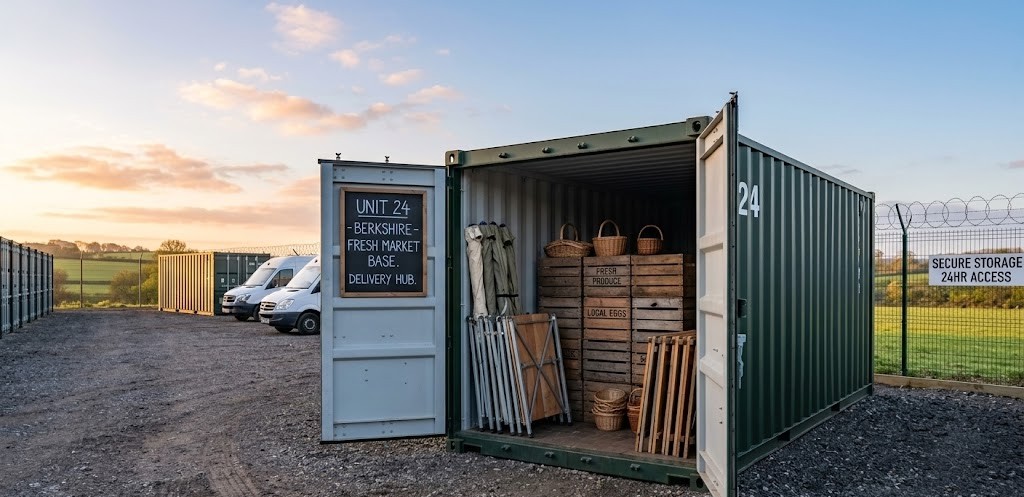
Running a farmers’ market stall means juggling fresh produce, heavy equipment, and unpredictable weather – all before most people have had their morning coffee. You’re up at 4am loading crates, setting up gazebos, and arranging displays that make your tomatoes look irresistible. But what happens to all that kit and unsold stock between market days?
Most vendors start storing everything in garages, spare rooms, or the back of a van. That works for a month or two. Then you’re tripping over folding tables in the hallway, your partner’s complaining about the smell of onions in the spare bedroom, and you’re playing Tetris with crates every single week. There’s a better way to run your operation – one that doesn’t turn your home into a warehouse.
Why farmers’ market vendors need dedicated storage space
The reality of market vending is simple: you need more space than you think. A basic setup includes folding tables, gazebos, weights, signage, cash boxes, card readers, and display equipment. Add in packaging materials, spare stock, and seasonal items, and you’re looking at a substantial amount of gear.
Fresh produce creates its own challenges. You can’t store root vegetables next to delicate salad leaves. Garlic needs ventilation. Potatoes hate light. Onions and apples shouldn’t share space because the ethylene gas from apples makes onions sprout faster. Your garage isn’t designed to handle these requirements.
Then there’s the equipment issue. Market stalls take a beating. Gazebos get damp, tables accumulate dirt, and metal frames rust if stored improperly. Cramming everything into a domestic space means gear deteriorates faster, costing you money in replacements. Proper farmers market storage prevents these issues and protects your investment.
What equipment takes up the most space
Let’s talk about what you’re actually storing. A standard 3×3 metre gazebo folds down, but it’s still bulky and awkward. Most vendors run two gazebos for adequate coverage, doubling the storage requirement. Add the weighted bases (essential for windy days), and you’re looking at serious floor space.
Folding tables seem innocent until you stack four of them. They’re heavy, they don’t nest neatly, and they need to stay flat to avoid warping. Display crates, whether wooden or plastic, multiply faster than you’d believe. You start with ten, then twenty, then suddenly fifty because different produce needs different presentation.
Refrigeration equipment is where things get complicated. If you’re selling dairy, meat, or anything requiring cold storage, you need portable fridges or cool boxes. These aren’t small. A commercial-grade cool box suitable for market use measures roughly 60x40x40cm, and you’ll likely need multiple units.
Here’s a real example: a vendor selling preserves, honey, and baked goods started with a modest setup. Within six months, she had three folding tables, one gazebo, two sets of shelving units, approximately forty storage boxes for jars, a card reader and battery pack, signage including an A-board and banner, plus all her packaging supplies. Her spare bedroom became unusable. Sound familiar?
Seasonal storage challenges for market vendors
Summer and winter present completely different storage puzzles. Summer means lighter produce – salads, soft fruits, herbs – but you need more refrigeration capacity. Your cool boxes work overtime, and you’re storing ice packs constantly. Winter brings root vegetables, squashes, and preserves that need dry, cool conditions but not refrigeration.
Many vendors diversify seasonally. You might sell plants in spring, vegetables in summer, preserves in autumn, and Christmas wreaths in winter. Each season requires different equipment. Plant trays, watering cans, and potting supplies take up space for three months, then sit unused for nine. Christmas stock – wreath bases, ribbon, decorative elements – needs somewhere to live for eleven months of the year.
The worst approach is cramming seasonal items into whatever space you can find. We’ve seen vendors lose entire batches of stock to damp, mice, or simply forgetting what they stored where. A personal storage solution gives you room to organise by season, keeping everything accessible and protected.
Protecting your investment: equipment care between markets
Quality market equipment isn’t cheap. A decent gazebo costs £200-400. Professional folding tables run £60-100 each. Display units, signage, and refrigeration equipment add up quickly. Proper storage extends the life of these investments significantly.
Gazebos need to dry completely before storage. Pack them away damp, and you’ll find mildew within weeks. The fabric deteriorates, zippers corrode, and the frame develops rust spots. Storing a gazebo in a climate-controlled environment prevents these issues entirely.
Metal frames and fittings require similar care. Market equipment gets exposed to morning dew, rain, and mud. If you pile it straight into a damp garage, rust develops rapidly. Tables with metal legs need to stand upright or lie flat – leaning them against walls causes warping and stress on joints.
Think of equipment storage like choosing the right suitcase for a trip. You wouldn’t stuff a suit into a rucksack and expect it to look good. Similarly, quality market equipment needs appropriate agricultural vendor storage to maintain its condition and functionality.
Produce storage: what works and what doesn’t
Storing produce between markets requires careful planning. Root vegetables like potatoes, carrots, and beetroot need cool, dark, and dry conditions. Traditional wisdom says they store well in garages, but modern garages often get too warm in summer or too damp in winter.
Onions and garlic need good air circulation. Storing them in sealed boxes creates condensation, leading to rot. They need mesh bags or crates with ventilation, kept in a cool, dry space. Your living room doesn’t qualify, and neither does most domestic storage.
Apples, if you’re selling stored varieties through winter, need consistent temperatures around 1-4°C. Too warm and they ripen too quickly. Too cold and they freeze. Domestic fridges work for small quantities, but if you’re buying in bulk to sell over several weeks, you need more capacity.
Here’s what doesn’t work: storing produce in your van. Temperature fluctuations destroy quality. Overnight cold damages cell structure. Daytime heat accelerates ripening and rot. Your van is transport, not storage.
How much storage space do market vendors actually need
Let’s get specific with measurements. A basic market setup for one stall typically includes:
- Two 3x3m gazebos (folded dimensions approximately 150x25x25cm each)
- Four folding tables (each roughly 180x75x5cm when folded)
- Twenty to thirty storage crates (standard crate: 60x40x30cm)
- Signage and display equipment (variable, but allow 1-2 square metres)
- Packaging supplies (boxes, bags, paper – at least 1 cubic metre)
- Weights, tools, and miscellaneous items (another cubic metre)
Stack this efficiently, and you’re looking at roughly 8-10 square metres of floor space, assuming you can stack items to about 2 metres high. That’s the equivalent of a small bedroom dedicated entirely to market equipment.
Many vendors underestimate space requirements because they focus on footprint rather than volume. Yes, crates stack, but you can’t stack them ten high safely. Tables lean, but they need wall space. Gazebos are awkward shapes that don’t tessellate neatly with other items.
A 50-75 square foot storage unit provides ample room for a single-stall operation with good organisation. Double-stall vendors or those with extensive produce stock typically need 100 square feet or more.
The real cost of using your home as a warehouse
Beyond the obvious inconvenience of navigating around market equipment in your living space, using your home for storage carries hidden costs. Domestic insurance policies often don’t cover business stock or equipment adequately. If fire or flood damages your market gear, you might find yourself uninsured.
Wear and tear on your property matters too. Tracking mud through your house weekly, storing damp equipment in spare rooms, and the general disruption all take a toll. Carpets get stained, walls get marked, and the constant movement of heavy items damages floors and doorframes.
There’s also the mental load. Your home should be where you relax, not a constant reminder of work. When every room contains market equipment, you never truly switch off. That’s not sustainable long-term.
Setting up an efficient storage system for market vendors
Organisation makes or breaks your market operation. The difference between a smooth setup and a chaotic scramble often comes down to how you’ve stored your equipment. Effective farmers market storage systems ensure everything has a logical place, and you can access items quickly without unpacking half your storage unit.
Start by categorising equipment by function. Keep all gazebo components together – frame, fabric, weights, and guy ropes. Store tables with their associated equipment like tablecloths and clips. Group display items separately from packaging supplies.
Use shelving units to maximise vertical space. Heavy items like weights and tools go on lower shelves. Lighter items like signage and packaging materials go higher. Label everything clearly. When you’re loading up at 5am, you don’t want to guess which box contains your card reader.
Create a loading zone near the entrance to your storage space. The night before market day, move everything you need to this zone. Morning loading becomes a simple transfer to your vehicle rather than a scavenger hunt through boxes.
Climate control: is it necessary for market vendors?
The answer depends on what you’re storing. Equipment alone doesn’t necessarily require climate control, but it benefits from consistent conditions. Extreme temperature swings cause condensation, which leads to rust, mildew, and deterioration.
Produce storage absolutely requires appropriate conditions. If you’re storing root vegetables, preserves, or any perishable stock, temperature stability is essential. A business storage solution with climate control maintains consistent conditions year-round, protecting your stock investment.
Packaging materials also fare better in controlled environments. Cardboard boxes absorb moisture in damp conditions, weakening them. Paper bags become unusable. Labels peel off jars. These might seem like minor issues until you’re at the market with soggy boxes and peeling labels.
Security considerations for market equipment and stock
Your market equipment represents a significant investment, and produce stock has immediate value. Security matters. Domestic garages and outbuildings are relatively easy targets for theft. They lack proper security features, and thieves know many people store valuable items there.
Professional storage facilities offer multiple security layers: perimeter fencing, CCTV coverage, individual unit alarms, and controlled access. Your equipment stays secure between markets without turning your home into a fortress.
Insurance is simpler too. Many business insurance policies offer better rates for stock and equipment stored in professional facilities rather than domestic premises. The improved security reduces risk, which reduces premiums.
Packing and protecting market equipment for storage
How you pack equipment determines how long it lasts. Gazebos should be completely dry before folding. Wipe down metal frames to remove dirt and moisture. Store fabric components in breathable bags, not sealed plastic, to prevent mildew.
Tables need protection from scratches and dents. If you’re stacking multiple tables, place cardboard or foam between them. Check folding mechanisms regularly and apply lubricant to hinges and locks.
Display equipment, especially anything wooden, benefits from proper packing. Wrap items in furniture blankets or bubble wrap if they’re particularly valuable or delicate. The packaging supplies you use for storage don’t need to be as extensive as customer packaging, but they should protect against dust, moisture, and impact damage.
Crates and boxes should be clean before storage. Produce residue attracts pests. Even dried plant matter can harbour insects or mould spores. A quick wash and thorough drying prevents problems developing during storage.
Vehicle access and loading convenience
Market vendors work to tight schedules. You need to load equipment quickly and efficiently, ideally in one trip. Storage solutions with drive-up access make this possible. You back your van up to the unit door and load directly without carrying items across car parks.
Think about your typical market day routine. You arrive at storage at 5am, load equipment, drive to the market, set up by 7am, trade until 2pm, pack down, return equipment to storage, and head home. The easier each step, the less exhausting the whole process becomes.
Container storage offers particularly good access for market vendors. Ground-level units with wide doors accommodate large items easily. You can organise your space so frequently used items sit near the entrance, while seasonal stock goes toward the back.
Sharing storage: cooperative solutions for market vendors
Some market vendors share storage costs by splitting a larger unit. This works well if you’re at different markets or trade on different days. You need clear agreements about space allocation, access times, and shared costs, but it can significantly reduce individual expenses.
Cooperative storage requires good organisation. Each vendor needs clearly defined space, and shared areas (like pathways through the unit) must stay clear. Regular communication prevents conflicts and ensures everyone can access their equipment when needed.
The main advantage is cost reduction. A 150 square foot unit split between two vendors costs each person less than renting separate 75 square foot units. The disadvantage is coordination – you need to trust your storage partner and maintain clear boundaries.
Scaling your market business: when to upgrade storage
As your market business grows, storage needs change. You might add a second stall, expand to multiple markets, or diversify your product range. Each expansion requires more equipment and stock storage.
Many vendors start with minimal agricultural vendor storage, then upgrade as their operation develops. That’s sensible. Don’t pay for space you don’t need. But recognise the signs that you’ve outgrown your current solution: struggling to find items, equipment stored haphazardly because there’s no room for proper organisation, or spending excessive time on loading and unloading.
Upgrading storage is an investment in efficiency. Better organisation saves time. Proper equipment care reduces replacement costs. Adequate stock storage lets you buy in bulk when prices are favourable. These factors quickly offset storage costs.
Making the numbers work: storage as a business expense
Storage costs are legitimate business expenses, fully deductible for tax purposes. When calculating whether storage makes financial sense, consider the full picture. Compare storage costs against equipment replacement expenses, time saved, reduced vehicle wear from not overloading, and the value of reclaiming your domestic space.
A typical storage unit suitable for market vendors costs £80-150 per month depending on size and features. That’s roughly £1,000-1,800 annually. Compare this to replacing a gazebo (£300), several tables (£400), and various damaged equipment (another £300-500) because of poor storage conditions. The storage unit pays for itself in avoided replacement costs alone.
Factor in time savings too. If proper storage and organisation saves you thirty minutes per market day, and you trade twice weekly, that’s fifty-two hours annually. What’s your time worth? Even at minimum wage, fifty hours represents significant value.
Building a sustainable market operation
Running a successful farmers’ market stall requires more than great produce and a friendly smile. Behind every well-organised stall is a well-organised storage system. Your equipment represents a substantial investment, and your stock is your livelihood. Both deserve better than being crammed into whatever domestic space you can spare.
Professional farmers market storage solutions give you the space, security, and conditions to protect your investment and run your operation efficiently. You’ll spend less time wrestling with equipment, more time focusing on your products, and none of your home will smell like onions.
The vendors who thrive at farmers’ markets aren’t necessarily those with the best produce – though that helps. They’re the ones who’ve sorted out the logistics, who arrive calm and prepared because everything they need is organised, accessible, and in good condition. That’s the difference between market vending as a stressful scramble and market vending as a sustainable business.
If you’re currently playing Tetris with market equipment in your spare room or garage, it’s time to consider a proper agricultural vendor storage solution. Your back, your family, and your business will thank you. Contact us to discuss storage options that fit your market operation, whether you’re running a single stall or planning to expand across multiple markets.