
 01635 581 811
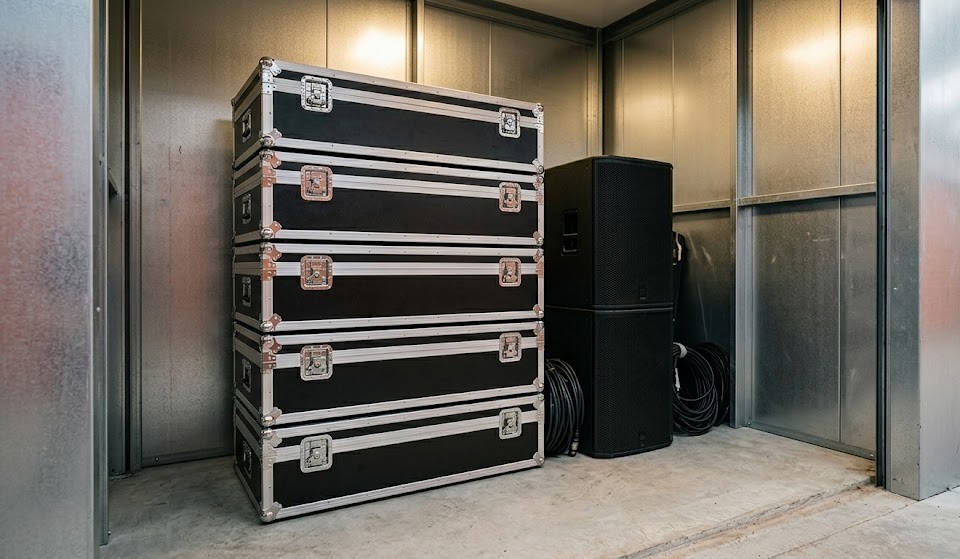
Running a mobile entertainment business means hauling thousands of pounds worth of sensitive equipment from venue to venue. Speakers, mixers, lighting rigs, cables, and controllers don’t just represent your investment – they’re how you earn your living. But what happens between gigs? Where do you keep it all when you’re not on the road?
For many DJs and mobile entertainers, the answer isn’t simple. Home storage quickly becomes impractical when you’re dealing with flight cases stacked in hallways, subwoofers occupying spare bedrooms, and cables tangled under beds. Garages seem like the obvious solution until you realise they’re not secure, often damp, and rarely insured for professional equipment. One condensation-damaged mixer or stolen lighting rig can cost you thousands in replacement costs and lost bookings.
Dedicated DJ equipment storage solves these problems whilst giving you back your living space. It’s not just about finding somewhere to stash your gear – it’s about protecting your business assets in conditions that won’t degrade sensitive electronics, with security that insurance companies actually recognise.
Why Home Storage Fails Mobile Entertainers
Most DJs start by storing equipment at home because it seems convenient and free. It’s neither.
Spare bedrooms filled with flight cases mean you can’t host guests or use that space for anything else. Partners understandably object to living around PA systems and lighting trusses. You’re constantly moving equipment around the house, which increases wear and tear on both your gear and your relationships.
Garages present bigger problems. Temperature fluctuations cause condensation inside equipment cases, corroding circuit boards and connections you won’t notice until something fails mid-gig. Dust finds its way into every crevice, clogging fans and coating moving parts. Security’s often minimal – a standard up-and-over door with a basic lock won’t deter anyone who knows what’s inside.
Then there’s insurance. Most home contents policies either exclude business equipment entirely or limit cover to £2,000-£3,000. When you’re carrying £15,000-£30,000 worth of professional audio and lighting kit, that gap leaves you dangerously exposed. Even if your insurer does cover business equipment at home, they’ll often require specific security measures that domestic properties simply don’t have.
What DJ Equipment Actually Needs
Sound systems aren’t like storing furniture or boxes of paperwork. Electronics have specific environmental requirements that determine whether they’ll still work when you need them.
Temperature stability matters more than the actual temperature. Equipment can handle being cool or warm – it can’t handle rapid changes that create condensation inside sealed components. A storage facility that maintains consistent conditions protects circuit boards, capacitors, and connections from moisture damage that kills equipment slowly and invisibly.
Dry conditions are non-negotiable. Humidity above 60% accelerates corrosion on connectors, potentiometers, and PCBs. You’ll notice it first as crackling through speakers or intermittent faults that seem to fix themselves, then suddenly don’t. By the time symptoms appear, the damage is already extensive.
Security needs to be comprehensive because thieves specifically target entertainment equipment. It’s high-value, easily sold, and often inadequately protected. Your DJ equipment storage solution needs proper access control, CCTV coverage, and robust physical security that insurance companies will actually recognise on your policy.
Accessibility determines whether storage helps or hinders your business. You need to load equipment quickly when a booking comes in, often at short notice. Drive-up access, extended opening hours, and enough space to manoeuvre around your stock make the difference between storage that works and storage that frustrates.
Choosing the Right Unit Size
Mobile entertainers typically underestimate how much space they actually need. It’s not just about fitting everything in – you need room to access equipment without unpacking half your stock every time.
A 50 square foot unit suits DJs with a basic setup: two speakers, a controller or small mixer, a laptop stand, cables, and perhaps some basic lighting. Think bedroom DJ who does small private parties and pub gigs. You can stack flight cases efficiently, but there’s limited room for growth or additional equipment.
A 75 square foot unit accommodates a full mobile disco setup. Four speakers, subwoofers, a proper mixer, CDJs or controllers, comprehensive lighting including stands and effects, all your cables organised in cases, and spare equipment. This size gives you enough floor space to keep frequently-used items accessible whilst storing backup gear and seasonal equipment (like outdoor-rated speakers or weather-proof lighting) towards the back.
100 square feet or larger suits mobile entertainers running multiple setups or expanding into related services. You might store a full wedding package, a separate pub/club rig, karaoke equipment, photo booth gear, or stock for a small equipment hire side business. The extra space lets you organise by event type rather than constantly repacking.
Here’s the critical part most people miss: you need about 30% more space than your equipment physically occupies. That margin lets you walk into the unit, access what you need, and maintain organisation. Cramming everything in might save £20 monthly, but it costs you hours of frustration and increases the risk of damage from handling equipment in tight spaces.
Think of it like packing a van. You can technically fit more by playing Tetris with every item, but then you can’t reach anything without unpacking half the load. Storage works the same way.
Organising Equipment for Quick Access
Professional organisation isn’t about being tidy – it’s about reducing setup time and preventing damage.
Group by event type rather than by equipment category. Keep your wedding package together: specific speakers, appropriate lighting, the mixer you prefer for that work, and all associated cables. Pub residency gear goes in another section. This approach means you can grab what you need for a specific booking without sorting through everything.
Label everything clearly using a system that works in dim lighting. White labels on black flight cases are hard to read when you’re loading out at 2am. Use large, high-contrast labels or colour-coded tape systems. One DJ uses coloured cable ties: red for power, blue for audio, green for lighting. It sounds simple, but it eliminates mistakes when you’re working quickly.
Cable management separates professionals from amateurs. Tangled cables waste time, create trip hazards, and suffer more damage than properly stored ones. Use cable bags or cases with dividers, keep each type separate, and label both ends of any cable over two metres. XLR, speaker cable, power, DMX, and network cables all need their own dedicated storage.
Vertical storage maximises space and protects equipment. Stack flight cases with the heaviest at the bottom, but never stack so high you can’t safely lift items down. Use racking or shelving for smaller items like microphones, controllers, and accessories. Keep frequently-used items at waist height – you shouldn’t need a step ladder for equipment you use weekly.
Create a loading zone near the unit entrance. This is where you stage equipment before loading your vehicle, and it’s the first place you put things when unloading after a gig. A small folding table or sturdy shelf gives you somewhere to set items down whilst you’re organising, which prevents that moment where you’re trying to balance a mixer whilst opening a flight case.
Security Considerations for High-Value Equipment
Entertainment equipment theft’s more common than most DJs realise because it’s specifically targeted. Thieves know the value, know it’s portable, and know where to sell it.
Individual insurance recognition matters more than generic security measures. When you’re getting equipment insurance (and you absolutely should have specialist DJ insurance, not just public liability), insurers will ask specific questions about storage security. They want to know about access control, CCTV coverage, perimeter security, and whether the facility has 24-hour monitoring.
A proper self-storage facility ticks these boxes because security’s built into the business model. Individual unit alarms, CCTV covering access points and corridors, controlled entry systems that log who enters and when, and often security personnel or remote monitoring. This level of protection simply isn’t achievable in a domestic garage or shed.
Inventory documentation becomes crucial if the worst happens. Photograph every item with serial numbers visible. Keep receipts, particularly for recent purchases. Store this documentation digitally (cloud storage, not on a laptop that might be in the storage unit). Insurance claims fail when you can’t prove what you owned or what it cost.
Discretion extends to how you talk about your storage. Don’t post on social media about where you keep equipment. Don’t leave branded flight cases visible through unit doors. Some entertainers use unmarked cases for this exact reason – a stack of cases with “DJ SOUNDWAVE” emblazoned across them advertises what’s inside.
Climate Control: When You Need It
Not all equipment requires climate-controlled storage, but some definitely benefits from it.
Electronics with moving parts – CD players, motorised lighting, moving heads, hazers – deteriorate faster in fluctuating conditions. Temperature swings cause expansion and contraction that loosens connections and accelerates wear on mechanical components. If you’re storing equipment worth over £10,000 or items with sensitive moving parts, climate control’s insurance against premature failure.
Vintage or valve equipment particularly benefits from stable conditions. That classic mixer or vintage compressor you use for its warm sound? Temperature fluctuations and humidity will kill it. Valve equipment especially needs consistent conditions to prevent internal corrosion and maintain performance.
Long-term storage (anything over three months) justifies climate control even for standard equipment. If you’re a seasonal entertainer who works heavily in summer but barely at all in winter, those months of storage in poor conditions will show when you power everything up in spring. Capacitors dry out, connections corrode, and you’ll spend your first few bookings troubleshooting problems that developed whilst equipment sat unused.
That said, standard storage works fine for most working DJs who access equipment regularly. Modern electronics are fairly robust, and flight cases provide some environmental buffering. If you’re gigging at least twice monthly and your equipment’s never stored for more than a few weeks at a time, a clean, dry, secure unit without climate control will serve you well.
Vehicle Access and Loading Logistics
The best storage in the world becomes frustrating if you can’t load your vehicle efficiently.
Drive-up access eliminates the single biggest pain point of equipment storage. When you can reverse your van right up to your unit door, loading becomes a five-minute job instead of a half-hour ordeal involving trolleys, lifts, and multiple trips through corridors. Container storage offers exactly this – you drive up, open the container, and load directly.
Opening hours need to match your working pattern. Entertainment work means irregular hours – you might need to collect equipment at 10am for an afternoon wedding, or at 6pm for an evening club booking. Some gigs require setup the night before, meaning you need access at 11pm. Storage with 24/7 access or at least extended hours (7am-10pm) prevents situations where you can’t accept bookings because you can’t access your equipment.
Turning space matters if you’re driving anything larger than a car. A storage facility with narrow access roads and tight corners becomes problematic when you’re manoeuvring a long-wheelbase van loaded with equipment. Check the access routes before committing, particularly if you drive a larger vehicle or plan to upgrade.
Loading equipment needs a system. Always load in reverse order of setup – the last thing you’ll need goes in first. PA speakers that go on stands should be accessible last because you’ll set them up after running cables and positioning your DJ booth. Cables and small items should be easily reachable because you’ll need them throughout setup. This seems obvious, but it’s surprising how many DJs load their van randomly and then waste time at the venue searching for what they need.
Insurance and Documentation
Equipment insurance for mobile entertainers isn’t optional – it’s a business fundamental. But insurance only pays out if you can prove what you owned and meet the policy conditions.
Specialist DJ insurance differs significantly from standard business insurance. It covers equipment in transit, at venues, and in storage. It usually includes public liability (essential for venue bookings) and often offers options for breakdown cover, loss of earnings, and legal expenses. Providers like Hiscox, Allianz, and specialist music insurance brokers understand entertainment equipment and write policies accordingly.
Storage location directly affects your premium and your cover. Insurers ask specifically where equipment’s kept when not in use. “At home in a garage” typically means higher premiums or reduced cover. “In a secure storage facility with CCTV and controlled access” often qualifies for better rates because the risk’s lower. Some insurers won’t cover equipment stored in non-approved locations at all.
Documentation requirements vary by insurer, but all want proof of ownership and value. Keep receipts for everything, photograph serial numbers, and maintain a detailed inventory with purchase dates and values. Update this whenever you buy or sell equipment. Cloud storage means you can access documentation from anywhere if you need to make a claim.
Security requirements in your policy might specify minimum standards for storage. Read the small print. Some policies require alarmed storage, some specify particular types of locks, others require CCTV coverage. If your storage doesn’t meet these requirements and you need to claim, you might find you’re not covered.
Making Storage Work for Your Business
The right storage setup does more than just hold your equipment – it supports better business operations.
Inventory management becomes simpler when everything has a dedicated location. You know exactly what equipment you have available, what’s out on hire (if you do equipment rental), and what needs maintenance or replacement. This clarity helps with booking decisions – you can confidently accept multiple bookings because you know you have enough equipment, or you know you need to hire in extra speakers for a larger venue.
Maintenance scheduling improves when equipment isn’t scattered between your house, your van, and a mate’s garage. You can dedicate an afternoon to checking and testing everything, cleaning contacts, updating firmware, and replacing worn cables. Regular maintenance prevents mid-gig failures that damage your reputation and cost you rebookings.
Business growth becomes possible when you’re not limited by domestic storage space. You can invest in additional equipment, stock different types of setups for different markets, or expand into related services like equipment hire or production work. The DJ who started with a basic mobile disco setup can gradually build towards providing full production services for larger events, but only if they have somewhere to keep the additional equipment.
Professional image matters more than many entertainers realise. Turning up to a venue in a properly sign-written van, unloading organised flight cases with professional labelling, and working from equipment that’s clean and well-maintained sends a message about your standards. Storage that lets you maintain this level of professionalism supports your reputation and justifies premium pricing.
Cost-Benefit Analysis
Storage costs money, but so does the alternative.
A 75 square foot unit typically costs £120-160 monthly depending on location and whether you need climate control. That’s roughly £1,500-£2,000 annually. Sounds like a lot until you compare it to the alternatives.
Using your spare bedroom costs you rental income if you could otherwise let that room (£400-600 monthly in many areas), or it costs you domestic harmony and the ability to use your home properly. Garage storage seems free until dampness damages a £2,000 mixer or thieves take £15,000 worth of equipment because security was inadequate.
Insurance savings often offset a significant portion of storage costs. Better security typically means lower premiums – sometimes £200-400 annually. Equipment that’s properly stored also lasts longer, reducing replacement costs. That £3,000 lighting rig that might need replacing after five years of poor storage could last eight years with proper care.
Time savings have a real value. If proper storage saves you 30 minutes per gig on loading and organising (and it often saves more), that’s an hour per week for a DJ doing two events. Over a year, that’s 50 hours you could spend on marketing, learning new skills, or simply not working. Value your time at even £20 per hour and that’s £1,000 annually.
Business opportunities you can accept because you have the equipment organised and accessible also have value. If better storage means you can confidently take last-minute bookings or larger events because you know exactly what equipment you have available, those additional gigs quickly pay for storage costs.
Practical Steps to Get Started
Transitioning from home storage to a dedicated unit doesn’t need to be complicated.
Audit your equipment first. Make a complete list of what you’re storing, measure the flight cases and items that don’t pack away, and calculate the total volume. Be honest about what you actually use – this is a good opportunity to sell equipment that’s been sitting unused for two years.
Visit facilities in person rather than booking based on website photos. Look at access routes, check the actual unit sizes, and assess security measures yourself. Talk to the staff about access hours and any restrictions on what you can store. A facility that looks perfect online might have narrow corridors that make moving large speakers difficult.
Consider location carefully. The cheapest storage might be 30 minutes further away, but if that means an extra hour of driving for every gig, you’ll regret it. Storage that’s 10-15 minutes from your home or on the route to where you typically work makes more sense even if it costs slightly more.
Pack strategically from the start. Moving into storage’s the perfect time to reorganise everything properly. Group equipment logically, label clearly, and set up your space with accessibility in mind. Quality packing materials help protect equipment and keep everything organised from day one.
Review after three months. Once you’ve used your storage through a typical cycle of bookings, assess what’s working and what isn’t. You might need to reorganise, upgrade to a larger unit, or adjust how you’re using the space. Most facilities offer flexibility to change unit sizes, so don’t feel locked into your initial choice.
When to Upgrade Your Storage
Your storage needs change as your business grows, and recognising when to upgrade prevents frustration.
You’re accessing equipment daily. If you’re running back and forth to storage every day, the location might be wrong, or you might need to keep some frequently-used items elsewhere. Storage should support your business, not create extra work.
You can’t find things quickly. If you’re spending 20 minutes searching for cables or digging through stacked cases to reach what you need, you’ve outgrown your current space or need to reorganise. Time spent searching is time you’re not earning.
You’re turning down work because you don’t have room for additional equipment. If business growth’s being limited by storage capacity, upgrading isn’t a cost – it’s an investment that pays for itself through additional bookings.
Equipment’s getting damaged from being packed too tightly or handled too much. Scratched cases and bent corners are cosmetic, but damaged equipment costs real money. If your current storage situation’s causing wear and tear, it’s time to change something.
Building Your Entertainment Business
Professional mobile entertainers treat storage as business infrastructure, not an afterthought. Your sound systems, lighting rigs, and equipment represent years of investment and your ability to earn – they deserve better than a damp garage or cluttered spare room.
One DJ described the difference proper storage made to his operation like switching from a chaotic toolbox to a professional workshop. Everything has its place. You can find what you need in seconds. Equipment stays in better condition. The time you save on every single gig adds up to hours every month – hours you can spend building your business instead of searching for cables.
Proper business storage protects your assets, supports your equipment insurance requirements, and gives you the space to run your business professionally. It’s the difference between scrambling to find equipment before every gig and confidently accepting bookings because you know exactly what you have and where it is.
The cost’s modest compared to what you’ve invested in equipment, and the benefits extend beyond simple storage. You’ll work more efficiently, maintain equipment better, and present a more professional image to clients. Most importantly, you’ll reclaim your living space and eliminate the stress of working around equipment that’s taken over your home.
Whether you’re a bedroom DJ building towards professional work or an established mobile entertainer looking to expand your services, proper DJ equipment storage enables growth. You can invest in better equipment knowing you have somewhere appropriate to keep it. You can take on larger events knowing your equipment’s organised and accessible. You can present yourself as the professional you are, not someone working from a garage full of tangled cables.
Newbury Self Store understands that entertainment equipment needs specific conditions – security that insurance companies recognise, access hours that match your working pattern, and space that lets you work efficiently. We know that your gear isn’t just equipment – it’s your livelihood.
Contact us to discuss storage solutions that support your mobile entertainment business. Your equipment deserves protection that matches its value, and your business deserves storage that makes every gig easier, not harder.