 01635 581 811
Managing multiple kitchen installation projects at once demands more than skill with a saw or an eye for level worktops. It requires a level of logistical precision that separates successful fitters from those constantly scrambling to find the right unit or explaining delays to frustrated clients.
When you’re juggling three installations across different postcodes, each at varying stages of completion, the challenge isn’t just keeping track of what goes where. It’s about having the right materials available at the right time, protecting expensive stock from damage, and maintaining enough working capital to take on new projects without your garage resembling a hazardous obstacle course. Poor stock management doesn’t just cost you time – it costs you reputation, repeat business, and profit margins that evaporate when you’re making emergency trips to suppliers or paying premium rates for rushed deliveries.
The reality for most kitchen fitters is that residential storage simply doesn’t cut it once you move beyond single-project work. Your stock needs space, security, and accessibility that lets you operate efficiently without turning your home into a warehouse through proper kitchen fitter stock storage.
Why Kitchen Fitters Need Dedicated Stock Storage
The materials for a single kitchen installation can easily fill a double garage. Multiply that by three or four concurrent projects, and you’ll quickly understand why kitchen fitters face unique storage challenges that other trades don’t encounter to the same degree.
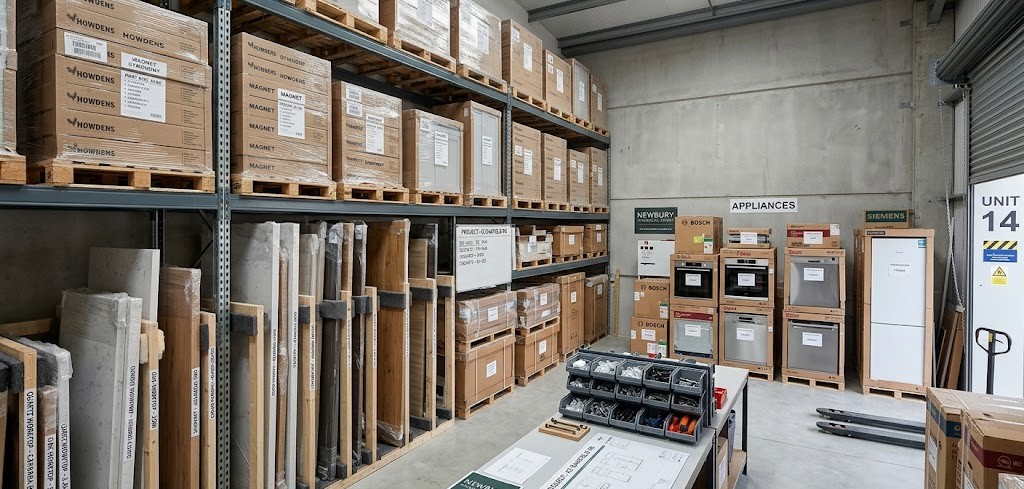
Cabinet units arrive in large, awkwardly shaped boxes that stack poorly and damage easily if stored incorrectly. A single scratch or dent on a visible surface can mean the difference between a satisfied client and an expensive replacement order. Worktops – particularly stone or composite materials – require flat, stable storage away from temperature extremes that could cause warping or cracking. Then there’s the smaller components: hinges, handles, lighting systems, splashbacks, and appliances, all of which need organised storage so you’re not wasting billable hours hunting for specific items.
Consider a typical scenario: You’ve quoted for three kitchen installations starting within a fortnight of each other. The first client chose a contemporary handleless design in matt grey. The second wants a traditional shaker style in cream. The third’s opted for a high-gloss finish with integrated appliances. Each project requires different cabinet sizes, worktop materials, and finishing touches. Storing all this stock at home means your family can’t park their cars, your insurance premiums increase, and you’re constantly moving boxes to access the items you need for today’s job.
The financial implications extend beyond inconvenience. Kitchen units represent significant capital investment. A mid-range kitchen installation might involve £8,000-£12,000 worth of materials sitting in storage before you’ve completed the work and received final payment. Damage to that stock directly impacts your bottom line, particularly if you’re responsible for replacement costs rather than passing them to your supplier.
Organising Stock by Project and Installation Phase
The difference between chaos and control often comes down to how you organise materials. Random storage – where items get stacked wherever space exists – creates problems that compound throughout a project – like the difference between a professional filing system where everything has its designated place versus a cluttered drawer where you’re constantly rummaging.
Kitchen fitters who implement a project-based organisation system reduce time spent locating materials by roughly 60%. This approach divides your storage space into clearly defined zones, with each active project allocated its own area. Within each project zone, materials are further organised by installation phase: first-fix items like base units and carcasses in one section, worktops and wall units in another, and finishing materials like plinths, cornices, and handles in a third.
This system mirrors the installation sequence, making it intuitive to gather what you need for each day’s work. When you arrive at your storage unit knowing exactly where Tuesday’s materials are located, you’re not wasting the first profitable hour of your day rummaging through boxes.
Labelling becomes critical when you’re managing multiple projects. Each box or pallet should display the client name, project reference, room (if it’s a multi-room job), and contents. Colour-coded labels add another layer of quick visual identification – green for the Henderson project, blue for the Martinez installation, red for the Williams kitchen. This might seem excessive until you’re working against a deadline and need to load your van in ten minutes rather than forty.
Think of your storage organisation like a kitchen itself. You wouldn’t store saucepans in the bathroom or plates in the garage. Everything has its logical place based on when and how you’ll use it. The same principle applies to your stock – base units near the access point because they’re installed first, delicate glass splashbacks in a protected area, heavy worktops on reinforced shelving at a height that doesn’t risk back injury when loading.
Protecting High-Value Materials from Damage
Kitchen materials represent some of the most damage-sensitive stock any trade professional handles. A plumber’s copper pipes can withstand knocks. An electrician’s cable reels are robust. But kitchen units, worktops, and appliances require careful protection throughout storage.
Temperature and humidity control matters more than many fitters realise. Solid wood components can warp in environments with fluctuating moisture levels. MDF carcasses absorb humidity, leading to expansion that affects door alignment. High-gloss finishes can develop surface defects in extreme temperatures. While you don’t necessarily need climate-controlled storage for every item, understanding which materials are vulnerable helps you make informed decisions about where and how to store them.
Cabinet doors and drawer fronts deserve special attention. These are the visible elements that clients scrutinise daily. Store them vertically where possible, with protective material between each door to prevent surface contact. Never stack them flat with weight on top – this risks pressure marks or warping. Purpose-built door racks solve this problem elegantly, allowing you to store dozens of doors in minimal floor space whilst keeping them perfectly protected.
Worktops require flat, stable support across their entire length. Leaning a laminate or solid surface worktop against a wall might save space, but it risks bowing that becomes permanent. Invest in proper worktop storage racks or create a dedicated flat storage area. The cost of replacement worktops far exceeds the inconvenience of storing them correctly from the start.
Appliances present their own challenges. Integrated fridges, ovens, and dishwashers aren’t cheap, and they’re your responsibility until installation’s complete. Keep them in their original packaging where possible – manufacturers design this packaging specifically to protect during transport and storage. If you’ve discarded the original boxes, ensure appliances are covered and stored where they won’t be knocked or scratched by other materials.
One kitchen fitter in Reading had been storing materials for a luxury kitchen installation worth £18,000 in his garage – the client was a surgeon who’d specified premium appliances including a £1,200 range cooker with brass fittings. The fitter stored the cooker unwrapped in the garage for six weeks whilst waiting for the worktop fabricator to complete their work. During that time, he moved other materials past it repeatedly, and the cooker picked up several scratches on the visible front panel from contact with metal fixings and sharp cardboard edges. When installation day arrived, the client noticed immediately and refused to accept it. The supplier wouldn’t take it back as damaged goods because it had left their warehouse in perfect condition. The fitter absorbed the full £1,200 replacement cost, plus the delay whilst the new cooker was delivered, which meant an extra day’s labour costs for his team. That single incident paid for three years of proper climate-controlled kitchen fitter stock storage, which would’ve protected the appliance properly.
Scheduling Deliveries to Match Installation Timelines
The timing of material deliveries directly impacts your storage requirements and working capital. Order everything too early, and you’re paying to store materials for weeks before installation. Order too late, and you’re delaying projects whilst waiting for deliveries, damaging client relationships and losing income.
Strategic delivery scheduling balances these concerns. For a typical kitchen installation taking 5-7 days, you might schedule base units and carcasses to arrive 3-4 days before installation starts – enough time to inspect everything and resolve any issues without paying for extended storage. Worktops often require templating after base units are installed, so these arrive mid-project. Finishing materials like handles, plinths, and decorative panels can arrive towards the project end.
This staggered approach reduces the storage space you need at any given time and improves cash flow by spreading supplier payments across the project timeline rather than front-loading all costs. It does require excellent supplier relationships and reliable lead times, but most trade suppliers accommodate this approach for regular customers.
Problems arise when you’re managing multiple overlapping projects. Project A’s finishing materials might arrive the same week Project B’s base units are delivered, whilst Project C’s worktops need collecting from the fabricator. Without adequate storage, you’re either refusing deliveries (frustrating suppliers), cramming materials into inadequate space (risking damage), or making multiple trips to collect items as needed (wasting time and fuel).
Business storage designed for trade professionals solves this problem by providing enough space to accommodate delivery peaks across multiple projects. You can accept materials when suppliers can deliver them, rather than when it’s convenient for your limited home storage. This flexibility strengthens supplier relationships and often secures better pricing when you can accommodate their delivery schedules rather than demanding specific time slots.
Maintaining Accurate Stock Records and Inventory
Ask most kitchen fitters what stock they currently hold, and you’ll get a vague answer. This lack of precision creates problems that range from minor inconveniences to significant financial losses.
Accurate inventory management starts with a simple system: record what arrives, where it’s stored, and when it’s used. This doesn’t require expensive software. A spreadsheet or even a well-maintained notebook achieves the same result if you’re disciplined about updating it.
Each delivery should be logged with the date received, supplier, project reference, description of items, quantity, and storage location. When you remove items for installation, update the record. This creates an accurate real-time picture of what stock you hold, its value, and its location.
Why does this matter? First, it prevents ordering duplicate materials because you’ve forgotten what you already have. Second, it identifies slow-moving or excess stock that’s tying up capital. Third, it provides evidence for insurance claims if materials are damaged or stolen. Fourth, it helps with year-end accounting by giving you accurate stock valuation figures.
Consider the small components that accumulate across projects: hinges, drawer runners, handles, lighting systems. These items represent hundreds or thousands of pounds of inventory that’s easy to lose track of. Without accurate records, you might order new handles for a project only to discover later that you already had them in storage. That’s cash sitting idle when it could be working for your business.
Conducting regular physical stock checks – monthly or quarterly depending on your project volume – ensures your records match reality. Discrepancies highlight problems: materials stored in the wrong location, items used but not recorded, or potential theft if you employ staff or subcontractors with storage access.
The discipline of maintaining inventory records also improves project costing accuracy. When you know exactly what materials each project consumed, you can refine your quotes for similar future work. Over time, this data becomes invaluable for understanding your true costs and maintaining healthy profit margins.
Accessing Stock Efficiently Between Job Sites
Time spent travelling between job sites, suppliers, and storage locations is time you’re not earning. Efficient access to your stock directly impacts your daily productivity and project profitability.
Location matters enormously. Storage that’s 30 minutes from your typical project area costs you an hour of travel time for each visit. Multiply that across multiple projects and you’re losing several billable hours weekly. When evaluating storage options, calculate the true cost including travel time, not just the rental fee.
Drive-up access transforms how quickly you can load and unload materials. Being able to reverse your van directly to your storage unit door means you’re loading heavy base units and worktops in minutes rather than wheeling them across car parks or navigating lifts and corridors. For kitchen fitters dealing with bulky, heavy materials, this accessibility’s essential rather than optional.
Container storage provides this ground-level access whilst offering secure, weatherproof protection for your stock. You can organise materials logically within the container, making it straightforward to load your van with exactly what you need for each day’s work without disturbing everything else.
Flexible access hours accommodate the reality of kitchen fitting schedules. Projects rarely run exactly to plan. You might finish a phase earlier than expected and need to collect tomorrow’s materials today. Or you might need to access storage early morning before travelling to a job site, or late evening after completing work. Restricted access hours – common with some storage facilities – can force inefficient scheduling that costs you time and money.
Think about your access patterns across a typical week. How often do you need to visit storage? At what times? Does your work pattern vary seasonally? Storage that works perfectly in summer might become problematic in winter when you’re working shorter days and need evening access. Choose storage solutions that flex with your business needs rather than forcing you to adapt to their limitations.
Separating Business Stock from Personal Space
The temptation to store business materials at home’s understandable. It’s convenient, it’s free, and it’s immediately accessible. But this approach creates problems that extend beyond the obvious space constraints.
Insurance complications top the list. Standard home insurance policies typically exclude or severely limit cover for business stock and equipment. If materials stored at home are damaged or stolen, you might discover your claim’s rejected because you’ve breached policy terms. Business insurance often requires stock to be stored at commercial premises rather than residential properties. The financial exposure here’s significant – you’re potentially uninsured for thousands of pounds of materials.
Home storage also impacts your family’s quality of life. Your garage becomes unusable for its intended purpose. Your driveway resembles a builder’s yard. Your partner can’t park their car under cover. Your children can’t access their bikes or outdoor equipment. These domestic tensions might seem minor compared to business concerns, but they accumulate over time and affect your work-life balance.
Professional boundaries matter too. Clients occasionally need to discuss changes or view samples. Inviting them to your home blurs professional lines and can feel uncomfortable for both parties. Having dedicated business premises – even if it’s just storage space – maintains that separation.
From a purely practical standpoint, personal storage at home limits your business growth. You can only take on as many concurrent projects as your available space allows. When storage capacity becomes the constraint on business expansion, you’re artificially capping your income and turning away work you could otherwise complete.
Separating business stock from your home also provides psychological benefits. When you finish work and return home, you’re genuinely finished rather than surrounded by reminders of outstanding projects. This separation supports better mental health and prevents the burnout that affects many self-employed tradespeople who never truly switch off.
Planning Storage Needs for Seasonal Project Peaks
Kitchen fitting work follows predictable seasonal patterns. Spring and early summer see increased activity as homeowners tackle renovation projects. The pre-Christmas period brings another peak as people want new kitchens installed before hosting family gatherings. January and February are typically quieter.
These fluctuations affect your storage requirements significantly. During peak periods, you might be managing four or five concurrent projects, each requiring dedicated storage space. During quiet periods, you might have just one active project plus some residual stock.
Flexible storage arrangements accommodate these variations without forcing you to pay for space you don’t need year-round. Some storage facilities offer short-term contracts or the ability to scale up and down between unit sizes as your needs change. This flexibility can save hundreds of pounds annually compared to renting a large unit permanently when you only need that capacity for four months of the year.
Planning ahead for known busy periods prevents the scramble to find storage at the last minute. If you know you typically take on multiple projects each April and May, secure additional storage space in March. Waiting until you’ve already accepted the work and materials are arriving creates unnecessary stress and might force you into suboptimal storage solutions because suitable space isn’t available.
Off-season storage serves another purpose: it’s the ideal time to bulk-purchase commonly used materials when suppliers offer discounts. If you regularly install similar cabinet styles or finishes, buying in quantity during quiet periods and storing the stock can significantly reduce material costs. The savings often exceed the storage costs, improving your overall project margins.
This approach requires careful calculation. You need confidence that you’ll use the materials within a reasonable timeframe and that styles or specifications won’t change, leaving you with obsolete stock. But for items like standard cabinet carcasses, basic hinges, or popular worktop finishes, the risk’s minimal and the savings are real.
Coordinating with Suppliers and Subcontractors
Kitchen installation rarely involves just one person working alone. You might employ apprentices, use specialist subcontractors for plumbing or electrical work, or coordinate with worktop fabricators and appliance installers. Effective stock management requires clear communication with everyone involved in your projects.
Supplier coordination starts with reliable lead times. When suppliers commit to delivery dates, your entire project schedule depends on their accuracy. Building strong relationships with trade suppliers who understand your business and respect deadlines is worth prioritising even if their prices are slightly higher than alternatives. The cost of project delays from unreliable deliveries far exceeds any minor savings on materials.
Having dedicated storage space improves supplier relationships because you can accommodate their delivery schedules rather than demanding narrow time windows. This flexibility often translates to better service, priority treatment during busy periods, and occasionally preferential pricing.
Subcontractors need clear information about material locations and access arrangements. If your plumber needs to collect specific items from your storage unit, they require the address, access codes or keys, and precise details of what they’re collecting and where it’s located within the unit. Vague instructions waste their time and yours.
Some kitchen fitters provide subcontractors with limited access to storage for collecting materials as needed. This requires trust and clear protocols about what can be removed and how it should be recorded. The benefit’s efficiency – subcontractors can collect materials directly rather than you acting as intermediary – but it requires robust inventory management to prevent confusion or unauthorised removal of items.
Worktop fabricators present unique coordination challenges. Templating typically occurs mid-project after base units are installed. Fabricated worktops then need collecting or receiving as delivery, storing briefly, and installing within days. The timing window’s tight and the materials are expensive and fragile. Having reliable storage with easy access simplifies this critical phase of the installation.
Reducing Waste and Managing Offcuts Effectively
Kitchen installations generate waste: packaging materials, offcuts from worktops and plinths, damaged items, and materials from removed existing kitchens. Managing this waste efficiently reduces disposal costs and environmental impact.
Packaging materials accumulate quickly. Cardboard boxes, polystyrene inserts, plastic wrapping, and protective foam from just one kitchen installation can fill several large refuse bags. Rather than paying for commercial waste disposal after each project, some fitters use part of their storage space for temporary waste accumulation, then arrange periodic bulk disposal at lower per-unit costs.
Worktop and panel offcuts deserve separate consideration. That 400mm piece of laminate worktop might seem like waste, but it could be perfect for a future repair job or small project. Storing useful offcuts – particularly from expensive materials like solid wood or stone – provides a resource for future work and reduces material costs. The key’s being selective: store offcuts large enough to be genuinely useful, not every scrap that’s technically too good to throw away.
Some kitchen fitters maintain a small “spares and repairs” inventory of common components: spare hinges, handles, drawer runners, and small panels in popular finishes. When clients contact you months or years after installation needing a replacement handle or a repair, having these items immediately available provides excellent customer service and creates additional revenue opportunities. The storage space required’s minimal but the customer goodwill and repeat business potential’s significant.
Packaging materials for protecting your own stock can often be repurposed from supplier deliveries. Those cardboard sheets and bubble wrap that arrived protecting your cabinet doors can protect them again when you transport them to the installation site. This reduces your packaging costs and makes environmental sense by reusing materials before recycling them.
Security Considerations for Valuable Stock
Kitchen materials represent significant value – often tens of thousands of pounds across multiple projects. Protecting this investment from theft or vandalism’s essential for business viability.
Storage security should include multiple layers. Physical security starts with robust locks, preferably insurance-approved models that resist common attack methods. The storage location itself matters: well-lit facilities with CCTV coverage and controlled access systems create a detailed audit trail and deter opportunistic thieves.
Individual unit alarms add protection, triggering if someone accesses your specific unit outside normal patterns. This real-time monitoring’s particularly valuable for high-value stock where immediate response could prevent significant losses.
Document everything you store. Photograph materials as they arrive, record serial numbers on appliances, and maintain detailed inventory lists. If theft occurs, this documentation proves invaluable for insurance claims and police investigations. It also helps identify missing items quickly rather than discovering losses weeks later.
Check your insurance policy carefully. Business insurance should cover stock stored off-site at appropriate commercial premises. Verify coverage limits, excess amounts, and any specific security requirements your insurer mandates. Not meeting these requirements could invalidate claims at the worst possible time.
Newbury Self Store understands that kitchen fitters need storage supporting efficient multi-project operations, not generic warehouse space. You need facilities where cabinet units stay protected from damage, where stock storage remains organized for quick access, and where security protects your substantial material investments. We know that your kitchen installation materials aren’t just stock – they’re the foundation of transformative home improvements that clients will enjoy for years.
If you need help determining the right storage size for your kitchen fitting business or want to discuss security features and access options, contact us to discuss how we can support your operations. Proper kitchen fitter stock storage protects your investment and ensures every installation starts with organized, protected materials ready to deliver professional results.