
 01635 581 811
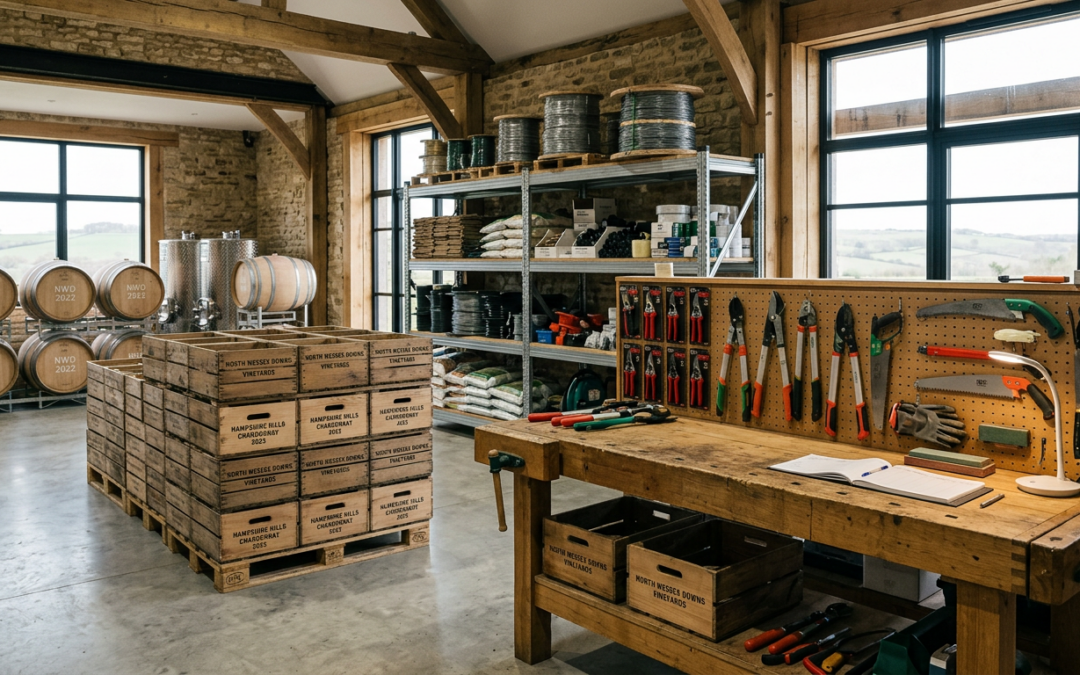
West Berkshire’s wine industry has transformed from a handful of experimental vineyards into a thriving sector producing award-winning English sparkling wines and still varieties. This growth brings new challenges for vineyard operators, particularly when it comes to storing the specialised equipment that keeps operations running smoothly throughout the year.
From frost protection fans and harvesting machinery to bottling equipment and oak barrels, vineyards accumulate substantial gear that is essential during peak seasons but takes up valuable space during quieter months. The right storage approach protects these investments whilst freeing up operational space for wine production and visitor experiences.
Why Vineyard Equipment Needs Proper Storage
Vineyard equipment represents significant capital investment. A single mechanical harvester can cost upwards of £200,000, whilst frost fans run between £8,000 and £15,000 each. Pruning equipment, sprayers, bottling lines, and temperature-controlled fermentation tanks add tens of thousands more to a vineyard’s asset register.
Leaving this equipment exposed to the elements accelerates wear and tear. Moisture causes rust on metal components, UV exposure degrades rubber seals and hoses, and temperature fluctuations damage electronic control systems. A harvester left outdoors year-round might lose 30% of its operational lifespan compared to one stored properly between seasons.
Think of it like owning a classic car collection. You would not leave a vintage Jaguar on the driveway under a tarpaulin and expect it to start perfectly after six months. You would keep it in a garage to preserve its mechanics and value. Vineyard machinery requires the same respect.
Beyond equipment preservation, space management becomes critical as vineyards expand. Production facilities need room for fermentation tanks during crush season, tasting rooms require space for events, and retail areas cannot double as storage yards. Many vineyard owners find themselves choosing between storing equipment or creating the customer experiences that drive direct sales.
Seasonal Equipment That Requires Off-Season Storage
Vineyards operate on distinct seasonal cycles, each requiring specific equipment that sits idle for months at a time. Understanding these patterns helps vineyard managers plan storage needs effectively.
Frost protection systems dominate spring storage needs. Wind machines and heaters protect tender shoots during late frosts but become redundant once the growing season establishes itself. These bulky items, including frost protection fans, occupy considerable ground space if left in situ.
Canopy management tools including hedge trimmers, leaf removers, and shoot positioning equipment see intensive use from May through August. Once the canopy is established, these machines can be stored until the following year. Spraying equipment for disease and pest management also falls into this category, with most applications concentrated in the growing season.
Mechanical harvesters represent the most valuable single pieces of equipment many vineyards own. These specialised machines work intensively for four to eight weeks during harvest, then sit unused for the remaining ten months. Their size, typically three to four metres wide and five metres tall, makes them challenging to accommodate in working production areas.
Climate Control Considerations for Wine Industry Equipment
Temperature and humidity stability matter enormously for vineyard equipment storage. Electronic components in modern harvesters and monitoring systems deteriorate rapidly in damp conditions. Circuit boards corrode, sensors drift out of calibration, and control systems fail when exposed to condensation cycles.
Hydraulic systems require particular attention. Moisture contamination in hydraulic fluid causes pump wear and cylinder damage. A harvester stored in a damp environment might need complete hydraulic system flushing before the next season; an expense of £2,000 to £3,000 that proper storage prevents.
Oak barrels demand the most stringent climate control. Empty barrels stored in fluctuating humidity conditions dry out and shrink, causing staves to separate and hoops to loosen. Repairing or replacing damaged barrels costs £600 to £900 each. Maintaining 60% to 70% relative humidity is essential for proper oak barrel ageing vessel maintenance, keeping the wood conditioned without encouraging mould growth.
Rubber components such as hoses, seals, and conveyor belts remain supple and functional when stored at stable temperatures between 10°C and 20°C. Extreme cold makes rubber brittle, whilst heat accelerates degradation. Equipment stored in unheated sheds might emerge in spring with perished hoses requiring replacement before use.
Security Requirements for High-Value Vineyard Assets
Vineyard equipment theft represents a growing problem across rural areas. Compact, high-value items like GPS guidance systems, weather monitoring stations, and portable pumps attract opportunistic thieves. A single GPS unit might be worth £3,000 to £5,000, whilst weather stations run £2,000 to £4,000.
Larger equipment faces different risks. Organised criminals target mechanical harvesters and tractors, often stealing to order for export or stripping for parts. The National Equipment Register reports that agricultural machinery theft costs UK farmers £10 million annually, with recovery rates below 20%.
Effective storage security combines physical barriers with monitoring systems. To secure commercial equipment, you need lockable facilities with robust construction to deter casual theft, whilst alarm systems and CCTV provide additional protection for high-value items. Some vineyard managers remove and separately store critical components, like harvester control modules or tractor keys, even when the main equipment is in secure storage.
Space Planning for Different Equipment Types
Calculating storage space requirements starts with equipment dimensions and access needs. A mechanical harvester needs not just its footprint, roughly 12 to 15 square metres, but clearance for manoeuvring, typically another 20% to 30% beyond its physical size.
Vertical space matters equally. Frost fans, spray rigs, and harvesters all exceed standard ceiling heights. A unit with 2.5-metre clearance will not accommodate equipment standing 3 to 4 metres tall. Measuring equipment at its tallest point, with spray booms raised or collection hoppers extended, prevents unpleasant surprises when moving items into storage.
Barrel storage requires different calculations. Stacked two or three high, 300 barrels occupy approximately 40 to 50 square metres. However, they need air circulation to prevent mould, meaning barrels cannot be packed tightly against walls or each other. Factor in 15% to 20% additional space for proper airflow.
At Newbury Self Store, we often advise vineyard managers to map out their ancillary items first. Hand tools, spare parts, chemicals, and supplies might seem negligible individually but collectively require substantial storage. A typical vineyard operation needs 10 to 15 square metres just for these ancillary items.
Accessibility and Seasonal Retrieval Planning
Equipment storage is not about putting things away and forgetting them; it is about strategic placement for efficient retrieval. Items needed first in spring should be most accessible, whilst equipment used only during harvest can sit further back.
Container storage offers particular advantages for vineyard operations. When you can access drive-up units, you can manoeuvre tractors and harvesters directly to storage without navigating tight corridors or lifts. Loading and unloading heavy equipment becomes straightforward rather than requiring elaborate planning.
Consider a typical vineyard’s annual cycle: frost protection equipment comes out in March or April, canopy management tools in May or June, and harvest machinery in September or October. Organising storage with this sequence in mind streamlines seasonal transitions.
Maintenance Access During Storage Periods
Equipment does not simply hibernate during storage; it requires regular maintenance to remain operational. Harvesters need greasing, hydraulic systems need checking, and batteries need charging. Storage arrangements must accommodate these maintenance tasks.
I recall a local vineyard manager who stored their harvester in a remote barn without electricity. Come spring, they discovered the battery completely dead and corrosion throughout the electrical system from months of dampness. The £4,500 repair bill taught an expensive lesson. Since moving to a professional facility, they perform regular mechanical harvester maintenance on-site, saving thousands in preventable repairs.
Maintenance access requirements vary by equipment type. Simple tools need occasional inspection, whilst complex machinery benefits from monthly checks. Storage facilities should allow you to work on equipment comfortably with adequate lighting and power for battery chargers.
Protecting Specialised Bottling and Processing Equipment
Bottling lines contain precision components that demand careful storage. Filling nozzles, cork insertion mechanisms, and labelling applicators all have tight tolerances that dirt and moisture compromise. Even small amounts of dust can cause jams and misalignment when equipment returns to service.
Bottling line machinery requires specific care. Many vineyard operators wrap bottling equipment in protective covers before storage, but this alone does not prevent humidity damage. Climate-controlled facilities maintain conditions that keep metal components rust-free and prevent condensation on cold surfaces when equipment warms up.
Processing equipment like crushers, de-stemmers, and presses must be thoroughly cleaned before storage. Residual grape material harbours bacteria and moulds that spread throughout equipment during storage months. Stainless steel components resist corrosion well, but only if properly cleaned and dried before being put away.
Chemical and Fertiliser Storage Regulations
Vineyard operations use various chemicals, from fungicides and pesticides to cleaning agents and fertilisers. Storing these materials requires compliance with COSHH (Control of Substances Hazardous to Health) regulations and environmental protection standards.
Chemicals cannot be stored alongside general equipment in most cases. Regulations require separate, ventilated areas with appropriate containment for spills. Many storage facilities prohibit chemical storage entirely, so vineyard managers must specifically confirm what is permitted before signing agreements.
Packaging materials such as bottles, corks, labels, and capsules also accumulate. These items need dry storage to prevent damage but do not require climate control. We recommend you purchase protective covers and sturdy boxes to organise these lower-value items efficiently.
Business Growth and Flexible Storage Solutions
West Berkshire vineyards are expanding. New plantings increase acreage, production volumes grow, and operations add visitor facilities and tasting rooms. This growth creates fluctuating storage needs that fixed facilities struggle to accommodate.
Business storage solutions offer the flexibility growing vineyards require. Need extra space during harvest season for additional processing equipment? Expand temporarily. Reducing production one year? Scale back storage accordingly. This adaptability prevents paying for unused space or scrambling to find additional capacity during peak periods.
Many vineyards also manage tasting rooms and event spaces. You can store seasonal items, such as outdoor furniture, marquees, or surplus glassware, in smaller units to keep your customer-facing areas clutter-free and welcoming.
Protecting Your Investment: Practical Storage Solutions
Vineyard equipment represents substantial investment in your operation’s future. A mechanical harvester should deliver 15 to 20 years of service with proper care, but only 8 to 10 years if stored poorly. Frost protection systems, sprayers, and processing equipment all follow similar patterns; their operational lifespan directly correlates with storage conditions.
Calculate the economics: a £150,000 harvester that lasts 20 years costs £7,500 annually. The same machine lasting only 10 years costs £15,000 per year. Spending £2,000 to £3,000 annually on proper storage suddenly looks like excellent value when it doubles equipment lifespan.
Beyond pure economics, proper storage reduces operational stress. Equipment that emerges from storage ready to work keeps your operation running smoothly during critical seasonal periods. There is no value calculation for the peace of mind that comes from knowing your harvester will start reliably when the grapes reach optimal ripeness.
Making Storage Work for Your Vineyard Operation
West Berkshire’s wine industry continues expanding, with new vineyards planting and existing operations scaling up production. This growth trajectory makes efficient equipment management increasingly important. Vineyards that develop systematic storage approaches gain competitive advantages through reduced equipment costs, improved operational efficiency, and better space utilisation.
The right storage solution depends on your specific operation. A small vineyard with minimal mechanisation might need 30 to 40 square metres for hand tools, small equipment, and supplies. A larger operation with mechanical harvesters, processing equipment, and substantial barrel inventory could require 150 to 200 square metres or more.
Location matters significantly. Storage facilities close to your vineyard reduce transport time and fuel costs when moving equipment seasonally. However, proximity must be balanced against facility quality; a nearby but inadequate facility costs more long-term than slightly distant but properly equipped storage.
West Berkshire vineyards are producing exceptional wines that compete internationally. Supporting this success requires professional approaches to every aspect of operations, including how you store and protect the equipment that makes quality wine production possible.
To discuss storage options for your vineyard equipment, call 01635 581 811 or contact our team to arrange a site visit.