
 01635 581 811
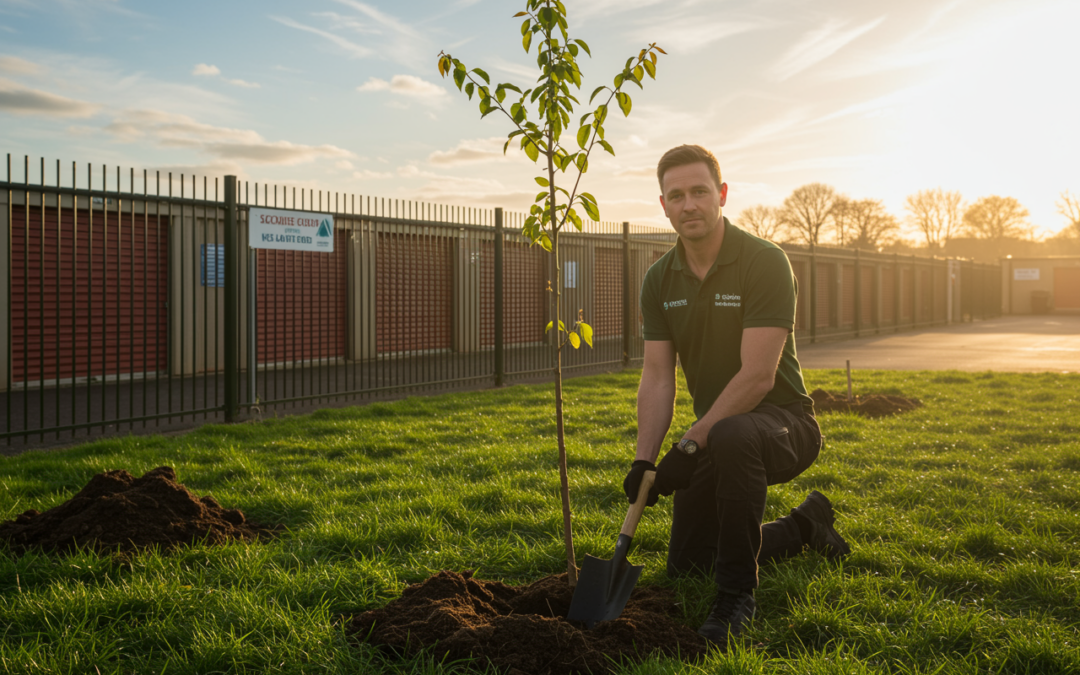
The self-storage industry is not typically associated with environmental activism, but that is changing. Across the UK, businesses are recognising their responsibility to offset operational emissions and contribute meaningfully to climate solutions. Moving beyond token gestures requires a systematic approach to balancing carbon footprints whilst supporting genuine reforestation efforts.
Storage facilities consume energy through lighting, security systems, climate control units, and vehicle movements. Even with LED upgrades and efficient building design, there is an environmental cost to providing secure, accessible storage space. Rather than simply acknowledge this impact, progressive facilities partner with verified tree planting organisations to create measurable environmental benefits that directly correspond to business operations.
Why Tree Planting Makes Environmental Sense for Storage Businesses
Trees represent one of nature’s most efficient carbon capture technologies. A single mature tree absorbs approximately 22 kilograms of CO2 annually, whilst also providing habitat for wildlife, preventing soil erosion, and improving air quality. For a storage business, supporting reforestation projects creates a tangible offset for the energy consumed keeping belongings safe and accessible.
The mathematics are straightforward. Facilities operate 24/7 security systems, maintain climate-controlled units for secure document archiving and sensitive items, and provide well-lit access areas for customer convenience. These essential services generate a calculable carbon footprint. By funding tree planting initiatives proportional to energy consumption, businesses are not claiming carbon neutrality; they are taking genuine responsibility for their environmental impact.
Think of it like this: if your car journey produces emissions, you cannot un-burn that fuel. However, you can support projects that actively remove CO2 from the atmosphere, creating a counterbalance. That is precisely what verified tree planting programmes accomplish.
How the Initiative Works in Practice
A robust tree planting commitment is not abstract. For every new customer who chooses to store personal belongings or business inventory, funds should be directed to planting trees through established reforestation partners. These organisations work in regions where deforestation has caused genuine environmental damage, not simply planting trees in areas that would naturally regenerate.
The process follows strict verification standards. Each tree planted receives GPS tagging and monitoring to ensure survival rates meet programme targets. Quarterly reports show exactly where trees have been planted, which species were selected for local ecosystem compatibility, and photographic evidence of project progress.
Here is what makes this approach credible:
- Trees are planted in areas requiring active reforestation, not natural woodland.
- Species selection matches local climate and soil conditions for maximum survival rates.
- Local communities benefit through employment in planting and maintenance programmes.
- Projects include long-term monitoring to verify trees reach maturity.
- Funding goes to certified organisations with transparent reporting structures.
We are not planting a token tree in a local park and calling it environmental action. We are supporting large-scale reforestation in regions where it creates genuine ecological restoration.
The Connection Between Storage and Sustainability
You might wonder what storing furniture or business stock has to do with environmental responsibility. The connection is more direct than it appears. When families use storage during home moves, they are often avoiding waste by keeping quality furniture instead of sending it to landfill and buying new. When small businesses use container storage for seasonal stock, they are reducing the need for larger permanent premises that consume more resources year-round.
Storage itself can be an environmentally sensible choice. Consider a family downsizing from a four-bedroom house to a smaller property. Rather than disposing of furniture that will not fit, they store items temporarily whilst deciding what they genuinely need. This prevents perfectly functional furniture from becoming waste whilst they adjust to their new space.
Similarly, e-commerce businesses using storage facilities reduce their commercial property footprint. Instead of leasing large warehouses with heating, cooling, and constant lighting, they rent exactly the space they need, accessing it only when necessary. This flexible approach to space usage inherently reduces resource consumption compared to traditional commercial property.
Selecting the Right Reforestation Partners
Not all tree planting programmes deliver equal environmental benefits. At Newbury Self Store, we have been selective about partnerships, prioritising organisations that meet rigorous standards. The key criteria include verified planting locations, transparent financial reporting, community involvement, and long-term monitoring commitments.
Some tree planting schemes operate more as marketing exercises than genuine reforestation. Trees planted without proper site preparation, species matching, or follow-up care often fail within the first year. That is why we work exclusively with partners who demonstrate survival rates above 80% and provide evidence of ongoing forest development.
Our partner organisations must demonstrate collaboration with local communities who benefit economically from projects, ensuring the initiative supports sustainable business operations globally. They must select native species appropriate for regional ecosystems and conduct proper land assessment to ensure planting locations require intervention. Multi-year monitoring with photographic documentation and transparent allocation of funds ensures our investment creates lasting environmental benefit rather than temporary PR value.
Measuring Real Impact Beyond Marketing Claims
Environmental initiatives can easily become greenwashing exercises, characterised by impressive-sounding commitments with little substance. We have structured our programme to deliver measurable outcomes that we report transparently. Each quarter, we publish data showing how many trees our customer base has funded, where they have been planted, and their verified survival rates.
The numbers matter. If we claim to offset a specific tonnage of carbon through tree planting, we need to show the calculations. A young tree absorbs relatively little CO2 in its first years, with absorption rates increasing as it matures. Our projections account for this growth curve, avoiding inflated claims based on theoretical maximum absorption rates.
We also acknowledge what tree planting cannot do. It does not make our operations carbon-neutral overnight. It does not eliminate our responsibility to reduce energy consumption through efficiency improvements. It is one component of a broader environmental strategy that includes LED lighting throughout our facility, motion-activated systems in less-used areas, and ongoing assessment of our operational practices.
The Broader Business Case for Environmental Responsibility
Beyond ethical considerations, there is a practical business case for environmental initiatives. Customers increasingly factor sustainability into purchasing decisions. When comparing storage providers, knowing that one actively offsets its environmental impact can influence choice.
This is not about exploiting environmental concern for marketing advantage. It is recognising that businesses operate within communities that care about climate action. When we invest in tree planting, we are responding to genuine customer values whilst taking responsibility for our operational footprint.
There is also the long-term perspective. Climate change will affect everyone, including businesses. Extreme weather events, regulatory changes, and shifting customer expectations are inevitable. Companies that proactively address their environmental impact position themselves better for these future challenges. For a storage business, this means considering how we will maintain operations as energy costs rise, how we will meet potential carbon reporting requirements, and how we will continue attracting customers who prioritise sustainability.
How Customers Contribute Without Additional Cost
Our tree planting programme does not require customers to pay environmental surcharges or opt into special schemes. It is built into our business model as standard practice. When you rent a unit to archive business records or store household items during a renovation, you are automatically contributing to reforestation efforts.
This approach reflects our belief that environmental responsibility should not be optional or cost extra. It is simply how we operate. The trees planted on behalf of our customers represent a collective impact that grows with our business; the more people who trust us with their storage needs, the greater our contribution to reforestation projects.
I recall explaining this to a long-term business customer recently. They were surprised to learn that simply by paying their standard invoice, they had effectively planted over 200 trees in the past year. They now use this data in their own sustainability reporting, demonstrating how supply chain choices amplify environmental impact.
Practical Steps Other Businesses Can Take
Our tree planting initiative is not unique to storage businesses. Any company with an operational carbon footprint can implement similar programmes. The key is moving beyond vague environmental statements to concrete, measurable actions.
For businesses considering tree planting initiatives, start by calculating your actual carbon footprint using recognised methodologies. Research reforestation partners thoroughly, verifying their credentials and track record. Commit to funding levels that meaningfully correspond to your environmental impact and report transparently on outcomes, including both successes and challenges.
The most credible environmental initiatives combine emission reduction with offset projects. We are constantly evaluating our facility operations for efficiency improvements whilst simultaneously funding tree planting. Neither approach alone is sufficient; both are necessary for true carbon neutral self storage aspirations.
The Long-Term Vision for Climate Action
Our tree planting programme represents current action on climate responsibility, but we are planning for expanded environmental initiatives. As the storage industry evolves, opportunities emerge for renewable energy integration, advanced building efficiency systems, and collaborative environmental projects with other local businesses.
We are exploring solar panel installation to generate a portion of our electricity needs directly. We are assessing rainwater collection systems for facility maintenance. We are investigating partnerships with local environmental organisations beyond tree planting. These initiatives take time to research, fund, and implement properly, but they are part of our long-term commitment to environmental responsibility.
The storage industry will not solve climate change alone. But every business that takes genuine responsibility for its environmental impact contributes to broader solutions. When customers choose providers based partly on environmental credentials, they are signalling market demand for sustainability. That demand drives more businesses to take action, creating a positive cycle of environmental improvement.
Making Storage Choices That Align With Your Values
When you need storage—whether for a house move, business expansion, or life transition—you are making practical decisions about space, security, and accessibility. But those decisions can also reflect your environmental values. Choosing a storage provider that actively offsets its carbon footprint means your practical needs and environmental concerns do not conflict.
We understand that environmental initiatives are not the primary reason people select storage facilities. You need secure units, convenient access, and reliable service. But when those practical requirements are met, knowing your storage choice supports reforestation efforts provides additional peace of mind.
If you are preparing items for storage, using recyclable packaging supplies ensures belongings remain protected, reducing waste from damaged items that need replacing. If you are a business using our facilities, flexible storage reduces your overall property footprint compared to leasing larger permanent premises. These practical benefits align naturally with environmental responsibility.
Conclusion
Tree planting initiatives work best when they are genuine commitments rather than marketing exercises. At Newbury Self Store, we have structured our programme to deliver measurable environmental benefits that directly correspond to our operational footprint. Every customer who stores with us contributes to reforestation efforts without additional cost or complexity.
The self-storage industry has environmental responsibilities like any other sector. We are addressing those responsibilities through verified tree planting partnerships, transparent reporting, and ongoing assessment of our operational practices. This is not about claiming perfection; it is about taking concrete action on climate responsibility whilst continuously improving our approach.
When you are comparing storage options, consider providers who demonstrate genuine environmental commitment through measurable initiatives. Whether you need space for household belongings, business stock, or anything in between, you can make choices that align with both your practical requirements and environmental values.
If you would like to discuss how your storage choice can support meaningful climate action, call 01635 581 811 or contact our team to find a solution that protects your belongings and the planet.