
 01635 581 811
Running a tour operation built around outdoor activities means you’re constantly juggling equipment that’s expensive, bulky, and essential to your business. When the season ends, whether it’s kayaks after summer or ski gear once the snow melts, you’re left with a serious storage challenge that can eat into your profits and operational space.
Most tour operators face the same dilemma: their premises aren’t designed to house dozens of kayaks, climbing harnesses, bikes, or camping equipment during the months they’re not generating revenue. The gear still needs protection from the elements, security from theft, and accessibility when you need to inspect or maintain it. That’s where strategic tour operator storage becomes less of a luxury and more of a business necessity.
Why off-season storage makes financial sense
The maths behind off-season storage is straightforward. If you’re paying year-round rent on a large premises to accommodate equipment you only use six months of the year, you’re essentially doubling your storage costs. A dedicated storage solution lets you downsize your operational space or repurpose it for income-generating activities.
Consider a kayaking tour operator in Berkshire. During summer, they run daily tours with 30 kayaks, paddles, life jackets, and safety equipment. Come October, those kayaks sit idle until April. That’s six months of valuable floor space occupied by equipment that’s not earning its keep.
By moving seasonal gear to business storage, you free up space for winter activities, equipment maintenance workshops, or even subletting to another operator. The storage cost is typically a fraction of what you’d pay for equivalent commercial premises, and you’re not locked into long-term leases that don’t match your seasonal business model.
What tour operators actually need to store
The variety of equipment tour operators manage is staggering, and each category has specific storage requirements. It’s not just about finding space, it’s about finding the right conditions.
Watercraft and water sports equipment includes kayaks, canoes, paddleboards, wetsuits, life jackets, paddles, and safety gear. These items need to be completely dry before storage to prevent mould, and they benefit from climate-controlled conditions to prevent material degradation.
Cycling and mountain biking gear encompasses bikes of various sizes, helmets, protective equipment, tools, spare parts, and sometimes bike racks or trailers. These need secure, dry conditions and ideally racking systems that prevent damage from stacking.
Climbing and adventure equipment covers ropes, harnesses, carabiners, helmets, climbing shoes, and safety gear. This equipment is particularly sensitive because any degradation can create safety issues. It requires dry storage and regular inspection.
Camping and hiking supplies include tents, sleeping bags, cooking equipment, backpacks, and portable shelters. These items are especially vulnerable to moisture and pests, making proper adventure gear storage conditions critical.
Winter sports equipment such as skis, snowboards, boots, poles, and winter clothing needs dry, temperature-stable conditions to prevent rust, warping, or material breakdown.
Preparing equipment for long-term storage
The difference between gear that emerges from storage ready to use and equipment that requires costly repairs comes down to preparation. Think of it like putting a car into long-term storage, you wouldn’t just park it and walk away.
Cleaning is non-negotiable. Every piece of equipment must be thoroughly cleaned before storage. Salt water, mud, sweat, and organic matter all accelerate deterioration. A kayak that goes into storage with dried salt residue will emerge with corroded fittings. Wetsuits stored damp will develop mould that’s nearly impossible to remove.
For watercraft, this means a complete fresh water rinse, checking all drainage points, and ensuring every surface is dry. One operator learned this the hard way when they stored 20 kayaks without proper drying, they returned to find water pooled inside several, leading to warped hulls and a £3,000 repair bill.
Inspection during preparation saves money. As you clean each item, check for damage, wear, or needed repairs. It’s far better to identify a fraying climbing rope now than to discover it when you’re preparing for your first spring tour. Create a maintenance log noting any issues, and schedule repairs during the off-season when you have time and repair shops aren’t backed up with rush orders.
Proper packaging protects your investment. Bikes need to be slightly deflated to prevent tyre damage. Climbing ropes should be loosely coiled, never tightly bound. Tents must be stored unfolded or loosely packed to prevent permanent creasing. Life jackets need to maintain their shape, so avoid crushing them under heavy items. Quality packaging materials are essential for protecting valuable equipment.
Here’s a practical approach: as you clean each item, photograph it and note its condition in a digital inventory. This creates a record for insurance purposes, helps you track equipment lifespan, and makes spring preparation far more efficient.
Choosing the right storage solution
Not all storage units suit tour operation equipment. A standard garage-sized unit might seem adequate until you try fitting 15 kayaks and realise you’ve created an inaccessible wall of fibreglass.
Size matters, but so does configuration. Container storage works brilliantly for tour operators because you can drive right up to load and unload. When you’re moving 30 kayaks or a dozen bikes, drive-up access isn’t a convenience, it’s essential. Trying to carry a 5-metre kayak through corridors and lifts is a recipe for damage and frustration.
Calculate your space needs based on your largest equipment pieces, then add 30% for access and organisation. If you pack a unit to 100% capacity, you’ll never be able to reach the items at the back without unpacking everything. That’s fine for long-term archive storage, but tour operators need periodic access for maintenance and early bookings.
Climate control isn’t always necessary, but it’s often worth it. Standard storage units in the UK experience temperature and humidity fluctuations that can damage sensitive equipment. Wetsuits become brittle, metal components rust, and electronic equipment fails. Climate-controlled units maintain stable conditions that extend equipment lifespan significantly.
One mountain biking operator calculated that climate control cost them an extra £40 per month, but they avoided replacing corroded brake cables, seized gears, and degraded tyres, repairs that would have cost £300+ across their fleet.
Security protects your business. Tour equipment is valuable and surprisingly easy to sell on secondary markets. Your storage facility should have comprehensive security: individual unit alarms, CCTV coverage, perimeter security, and controlled access. Check what insurance coverage the facility provides and whether you need additional business insurance for stored equipment.
Organising storage for easy access
A well-organised storage unit operates like a well-run warehouse, everything has a place, and you can locate any item in minutes. Poor organisation means wasted time, damaged equipment, and frustrated staff.
Create zones within your unit. Group similar items together: all watercraft in one area, cycling equipment in another, camping gear in a third. Within each zone, arrange items by size or frequency of use. Equipment you might need to access for winter maintenance or early bookings should be near the front.
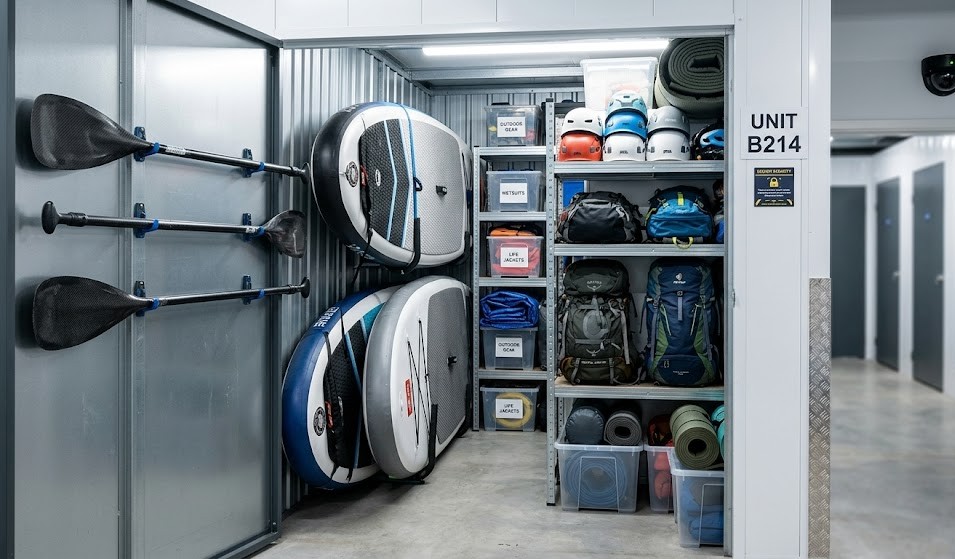
Vertical space is your friend. Kayaks can be stored on their sides on wall-mounted racks, bikes can hang from ceiling hooks, and camping equipment can go on shelving units. This approach can double or triple your effective storage capacity compared to simply stacking items on the floor. Smart adventure gear storage makes maximum use of every dimension.
Think of it like packing a suitcase, if you just throw everything in randomly, you’ll run out of space quickly. But if you roll clothes, use packing cubes, and organise strategically, you’ll fit twice as much in the same space. The same principle applies to storage units.
Label everything clearly. When you’re rushing to prepare for an unexpected early booking in March, you don’t want to spend an hour searching for specific equipment. Use large, clear labels on boxes and bins. Create a master inventory that maps where everything is located within the unit.
One rafting operator uses a simple grid system, they’ve divided their unit into quadrants (A, B, C, D) and created a spreadsheet listing what’s in each area. When they need specific equipment, they check the spreadsheet on their phone and go straight to the right location.
Maintain clear pathways. Always leave a walkway through your storage unit, even if it means renting slightly more space. Being able to walk through and inspect equipment without moving everything is invaluable. It also makes seasonal transitions far less chaotic when you’re not playing equipment Tetris every time you need something.
Maintenance during storage
Equipment doesn’t maintain itself just because it’s tucked away in storage. Regular checks during the off-season prevent small issues from becoming major problems.
Schedule quarterly inspections. Visit your storage unit every three months to check for moisture, pest activity, or unexpected damage. This is also when you should rotate equipment positions to prevent pressure damage and ensure even air circulation.
During these visits, check that nothing has shifted or fallen, inspect for any signs of moisture or condensation, and verify that all protective coverings are intact. It takes about an hour for a typical tour operator storage unit, and it’s time well spent.
Use the off-season for deep maintenance. This is when you should be servicing bikes, checking climbing equipment safety ratings, repairing small tears in tents, and replacing worn components. Many tour operators treat January and February as their maintenance season, systematically working through their inventory.
This approach means you’re not scrambling in March when bookings start arriving. Your equipment is tour-ready, safety-checked, and in peak condition. It’s the difference between a smooth season start and a chaotic one.
Insurance and documentation
Your tour equipment represents a significant investment, and proper documentation protects that investment. Before anything goes into storage, create a comprehensive inventory with photographs, serial numbers where applicable, and current replacement values.
This inventory serves multiple purposes: it’s essential for insurance claims, it helps you track equipment lifespan and replacement schedules, and it makes tax documentation straightforward. Store this inventory digitally in multiple locations, your computer, cloud storage, and possibly a physical copy at your business premises.
Check that your business insurance covers equipment in off-site storage. Some policies automatically include this, others require specific riders. Verify coverage limits and any requirements about storage facility security standards. Personal storage facilities may have their own insurance, but it’s typically limited and won’t cover the full replacement value of commercial tour equipment.
Seasonal transitions made efficient
The chaos of seasonal transitions, moving everything into storage in autumn and retrieving it in spring, can consume days of labour and create operational headaches. Smart operators treat these transitions as planned events with clear processes.
Create a transition checklist that covers every step: equipment cleaning, inspection, repairs needed, packing requirements, transport logistics, and storage organisation. This checklist ensures nothing is forgotten and helps you estimate the time and labour required.
Plan the spring retrieval strategically. Don’t wait until the week before your first tour to retrieve everything. Start bringing equipment out 4-6 weeks before the season begins. This gives you time to address any storage-related issues, complete final maintenance, and ensure everything is truly tour-ready.
One operator schedules their spring retrieval over three weekends in March, bringing out one category of equipment each weekend. This spreads the workload, prevents overwhelming their operational space, and allows time for thorough preparation.
The real cost-benefit analysis
When you factor in the true costs of keeping seasonal equipment on commercial premises year-round versus using dedicated adventure gear storage, the numbers are compelling. A tour operator paying £2,000 monthly for premises that are 40% occupied by off-season equipment is effectively spending £800 monthly on storage in one of the most expensive ways possible.
Compare that to a storage unit at £200-400 monthly that’s specifically designed for this purpose, with better security, climate control, and none of the overhead costs of commercial premises. The annual saving of £4,800-7,200 can fund new equipment, marketing, or simply improve your bottom line.
Beyond the direct financial calculation, there’s the operational benefit of having a dedicated, organised space for equipment. Your business premises remain functional and professional-looking year-round, you’re not constantly moving gear around to access other items, and your staff aren’t wasting time managing storage logistics.
Making storage work for your business
Effective tour operator storage isn’t about finding the cheapest space and cramming everything in. It’s about creating a system that protects your equipment, maintains accessibility, and supports your operational efficiency.
The tour operators who succeed with off-season storage treat it as a core business function, not an afterthought. They invest time in proper preparation, choose storage solutions that match their specific needs, maintain organised systems, and schedule regular maintenance. The result is equipment that lasts longer, seasonal transitions that run smoothly, and operational costs that make sense.
If you’re currently struggling with equipment storage, paying too much for space you don’t need year-round, or dealing with damaged gear that didn’t survive off-season storage, it’s worth reassessing your approach. The right adventure gear storage solution pays for itself quickly through reduced premises costs, extended equipment lifespan, and improved operational efficiency.
Contact us to discuss storage options that match your tour operation’s specific needs. Whether you’re managing kayaks, bikes, climbing gear, or a combination of outdoor equipment, finding the right tour operator storage solution can transform how you manage your off-season and set you up for successful, profitable seasons ahead.