
 01635 581 811
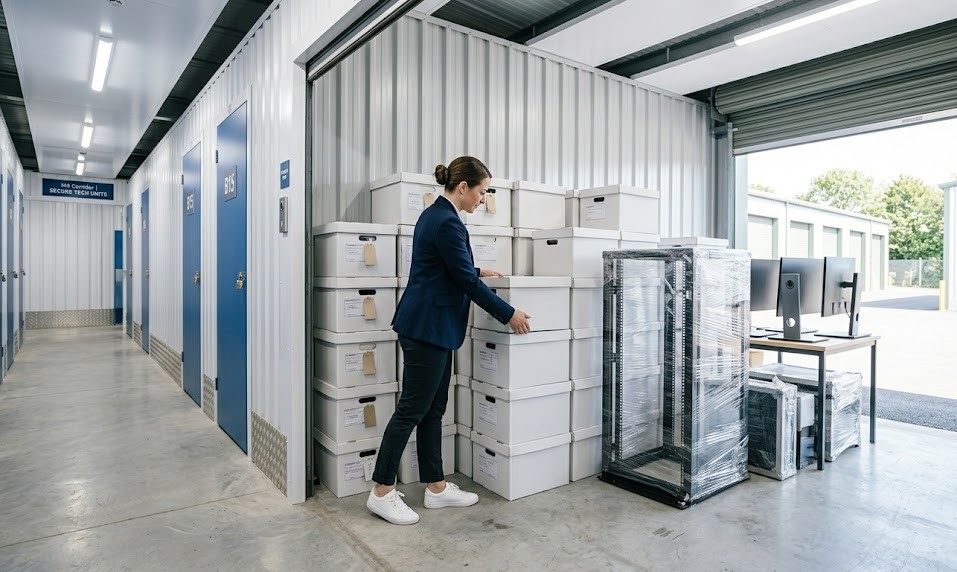
Growing a tech startup means juggling priorities that shift every quarter. One month you’re a team of three working from a co-working space. Six months later, you’ve got twelve people, boxes of promotional materials for three upcoming trade shows, and a server room that’s outgrown its corner of the office. The physical demands of scaling aren’t glamorous, but they’re real – and they can drain resources faster than you’d expect.
Tech startups in Newbury face a particular challenge. The town’s thriving business ecosystem and proximity to London make it an attractive base, but commercial property costs don’t always align with early-stage budgets. When you’re bootstrapping or managing investor capital carefully, committing to a larger office before you’re certain of headcount feels risky. That’s where flexible storage becomes a strategic tool rather than a stopgap measure for tech startup storage Newbury companies need.
Why Tech Companies Need More Than Office Space
Most tech startups don’t think about storage until they’re tripping over it. You’ve got the essentials: desks, laptops, perhaps some networking equipment. But growth introduces complications.
Marketing materials pile up after your first conference. You’ve ordered 500 branded t-shirts for a product launch, but you can’t justify office space that doubles as a stockroom. Hardware inventory becomes an issue if you’re developing IoT devices or managing a hardware-as-a-service model. Prototype iterations, returned units, and spare components need somewhere secure and accessible.
Then there’s the archive problem. Financial records, contracts, and compliance documentation accumulate quickly. Digital-first doesn’t mean paperless – auditors and legal teams still require physical records for certain documents. Storing these in expensive office space makes no financial sense.
Here’s a real scenario: A SaaS company in Newbury scaled from eight to twenty-five employees in eighteen months. They’d signed a two-year lease on office space sized for fifteen people. Rather than break the lease or cram desks into every corner, they moved archived files, marketing stock, and spare IT equipment into a business storage unit. The office stayed functional, and they avoided an expensive lease renegotiation until their renewal date. The monthly storage cost was roughly a tenth of what expanding their office would’ve cost.
What Flexible Storage Actually Means for Startups
Flexibility isn’t just a buzzword – it’s about adapting storage to match your business rhythm, not the other way round.
Short-term contracts matter when your six-month roadmap might pivot based on funding rounds or market feedback. Traditional commercial leases lock you into multi-year commitments with break clauses that penalise early exit. Self-storage agreements typically run month-to-month after an initial period, giving you the freedom to scale up or down without financial penalties.
Scalable space means you can start with a small unit and upgrade as needs change. A 50 sq ft unit might handle your first year’s archived paperwork and trade show materials. By year two, you might need 100 sq ft to accommodate additional inventory or equipment. The ability to resize without moving to an entirely new facility saves time and logistical headaches.
Access patterns vary by business model. If you’re storing archived documents you’ll reference quarterly, you don’t need daily access. But if you’re managing hardware inventory that ships to clients weekly, you need reliable, frequent access during business hours – or beyond. Drive-up access becomes essential if you’re loading equipment or bulk materials regularly.
Think of storage sizing like choosing server capacity. You wouldn’t provision infrastructure for peak load on day one, but you’d ensure you can scale quickly when traffic spikes. Storage works the same way – start with what you need now, with a clear path to expand.
The Hidden Costs of Inadequate Storage
Underestimating storage needs creates friction that slows everything down.
Productivity losses add up when team members waste time searching for misplaced equipment or documents. If your office doubles as a storage room, people spend minutes every day navigating boxes to reach printers, meeting rooms, or kitchen facilities. Those minutes compound across a team.
Opportunity costs emerge when you turn down projects because you lack space to store necessary materials. A hardware startup might decline a bulk order because they’ve nowhere to hold inventory before fulfilment. A marketing agency might limit event participation because they can’t store display materials between conferences.
Workplace morale suffers in cluttered environments. Tech startups thrive on energy and collaboration, but cramped conditions create stress. When your office feels like a storage unit, it’s harder to attract talent or impress visiting clients and investors.
One Newbury-based fintech startup stored old servers and networking equipment in their office corridor for three months whilst deciding whether to recycle or repurpose them. During a crucial investor visit, the first impression was a maze of cardboard boxes and cable tangles. They secured funding, but the CEO later admitted the clutter undermined their “cutting-edge” positioning. A secure storage unit would’ve cost less than the reputational risk they’d taken.
Choosing the Right Storage for Tech Equipment
Not all storage suits all business needs. Tech equipment demands specific considerations.
Security features should include individual unit alarms, CCTV coverage, and controlled site access. If you’re storing prototypes, development hardware, or client data on physical drives, you need more than a padlock. Look for facilities with 24/7 monitoring and restricted entry systems.
Climate control protects sensitive electronics from temperature fluctuations and humidity. Hard drives, circuit boards, and batteries degrade faster in uncontrolled environments. If you’re storing anything with a warranty or resale value, climate control isn’t optional – it’s insurance.
Insurance coverage should match the value of what you’re storing. Standard contents insurance often excludes business equipment or caps coverage at levels too low for tech inventory. Verify whether the storage facility offers business-grade insurance or integrates with your existing commercial policy.
Accessibility hours determine how quickly you can respond to urgent needs. If a client reports a hardware fault on Friday afternoon and you need to ship a replacement unit, you can’t wait until Monday. Facilities offering extended or 24-hour access provide operational flexibility that matches startup unpredictability.
Practical Storage Strategies for Different Startup Stages
Your storage needs evolve as your company matures. Here’s how to match strategy to stage.
Pre-seed and seed stage
At this startup stage, you’re lean by necessity. You might not have an office yet – just a co-working membership and a lot of ambition. Storage needs are minimal but specific.
What to store: Prototype materials, initial marketing collateral, founder documents (incorporation papers, early contracts), and perhaps some basic IT equipment you’re not using daily.
Unit size: A 25-50 sq ft unit typically suffices. That’s roughly the size of a garden shed – enough for a dozen archive boxes, some shelving, and a few pieces of equipment.
Access frequency: Low. You might visit monthly or quarterly. Prioritise cost over convenience at this stage.
Series A and growth stage
You’ve got traction, a growing team, and increasing operational complexity. Flexible storage becomes a strategic asset rather than an afterthought.
What to store: Expanded inventory (if you’re hardware-focused), archived financial records, marketing materials for multiple campaigns, spare office furniture, and IT equipment awaiting deployment or disposal.
Unit size: 75-150 sq ft gives you room to organise properly. Add shelving units to maximise vertical space and create clear zones for different categories.
Access frequency: Weekly or bi-weekly. You’re regularly retrieving items for campaigns, shipping inventory, or rotating archived materials. Container storage with drive-up access becomes valuable if you’re moving larger quantities.
Scale-up stage
You’re established, possibly profitable, and managing multiple product lines or service offerings. Storage needs become more sophisticated.
What to store: Significant inventory volumes, comprehensive archives (potentially years of financial and legal documents), event materials for regular conference participation, and legacy equipment that’s been depreciated but not yet disposed of.
Unit size: 150 sq ft or larger, potentially multiple units if you’re separating inventory from archives for security or access reasons.
Access frequency: Multiple times weekly. You might have a designated team member responsible for inventory management. Consider facilities close to your office or distribution routes to minimise travel time.
Organising Storage Space Like a Pro
How you organise storage determines whether it’s an asset or a liability. Poor organisation turns retrieval into an archaeological dig – like searching through years of Git commits without proper tags.
Shelving systems transform usable space. Stacking boxes on the floor wastes vertical space and makes bottom boxes inaccessible. Industrial shelving units (the kind you’d use in a garage) cost less than £100 and instantly double your effective capacity.
Labelling protocols should be detailed and consistent. “Marketing Materials” on a box tells you nothing useful. “Q3 2024 Conference Materials – TechExpo London – Banners & Brochures” tells you everything. Include dates on labels so you know when to review contents for disposal.
Inventory management becomes essential as volume grows. A simple spreadsheet tracking box numbers, contents, and locations prevents the “I know we have that somewhere” problem. Update it every time you add or remove items. Some startups use the same inventory management software they use for product stock to track storage contents.
Clear pathways matter more than you’d think. Leave a central aisle wide enough to walk through comfortably with a box. Don’t block the door with your least-accessed items – you’ll regret it when you need something from the back in a hurry.
Packing materials protect your investment. Don’t skimp on boxes, bubble wrap, and packing tape. Electronics should be packed in anti-static materials. Documents should go in waterproof containers or sealed plastic boxes. The packing materials you choose determine whether your stored items remain usable or become expensive rubbish.
The Financial Case for External Storage
Storage costs seem like an easy target when trimming budgets, but the maths often supports external storage over office space.
Office space in Newbury typically costs £20-35 per sq ft annually for commercial property. If you’re using 100 sq ft of office space for storage, that’s £2,000-3,500 per year – plus business rates, utilities, and service charges.
Self-storage costs for a 100 sq ft unit run approximately £150-250 per month (£1,800-3,000 annually), with no additional overheads. You’re saving money whilst freeing up office space for revenue-generating activities.
Productivity gains are harder to quantify but equally real. If moving storage off-site allows you to accommodate two more desks, you can hire sooner without relocating. If it reduces time spent searching for materials by even thirty minutes per week per person, that’s 26 hours annually per employee – time that could go towards product development or customer service.
Lease flexibility provides strategic value. When your office lease comes up for renewal, you have more negotiating power if you’re not desperate for additional space. You can evaluate options based on location and cost, not just square footage.
Security Considerations for Sensitive Materials
Tech startups often handle sensitive information – customer data, proprietary algorithms, unreleased product designs. Physical security matters as much as digital.
Access logs at quality storage facilities record who enters the site and when. This creates an audit trail if you ever need to verify when items were accessed or moved.
Individual unit alarms trigger if your specific unit’s opened outside your access times. This prevents unauthorised entry even if someone gains site access.
Insurance requirements should specify business use and cover the replacement value of stored items. Standard household contents insurance won’t cover business equipment or inventory. Verify coverage before storing anything valuable.
Data protection compliance applies to physical records as much as digital ones. If you’re storing documents containing customer information, you’re responsible for ensuring they’re secure. GDPR requirements don’t disappear because something’s in a storage unit rather than a filing cabinet.
When to Scale Up or Down
Knowing when to adjust storage’s as important as having it in the first place.
Scale up when you’re visiting weekly to retrieve items but consistently find you need to dig through boxes to find what you need. That’s a signal you’ve outgrown your space. Similarly, if you’re turning down opportunities because you lack storage capacity, you’re letting cost concerns limit revenue potential.
Scale down when you’ve digitised archives, disposed of obsolete equipment, or shifted to a business model that requires less physical inventory. Review storage contents quarterly. If you haven’t accessed something in twelve months, question whether you need to keep it.
Seasonal adjustments make sense for businesses with cyclical needs. If you attend three major conferences annually, you might need extra space for two months before each event to prepare materials, then scale back afterwards.
Making Storage Part of Your Growth Strategy
The most successful tech startups treat storage as infrastructure, not an afterthought. When you’re planning your next funding round or expansion phase, factor storage into your operational model.
Budget for it in financial projections. Include storage costs in your burn rate calculations so you’re not caught off-guard when you need additional space.
Location matters for efficiency. Storage fifteen minutes from your office integrates into workflows more easily than storage thirty minutes away. The time saved over a year justifies slightly higher monthly costs.
Review regularly with the same discipline you apply to software subscriptions or supplier contracts. Storage needs change, and what made sense six months ago might not fit your current situation.
Putting Flexible Storage to Work
Growing a tech startup demands focus on what drives value – product development, customer acquisition, and team building. Physical space management shouldn’t drain resources or attention from those priorities.
Flexible storage gives growing companies room to expand without overcommitting to fixed costs. It keeps your office functional and professional whilst providing secure space for everything else. Most importantly, it adapts as your needs change, which is exactly what early-stage tech companies require.
If you’re running a tech startup in Newbury and finding that physical space’s becoming a constraint rather than an enabler, it’s worth evaluating whether external storage solutions make strategic sense. The cost comparison often surprises founders who assume office space is the only option.
Newbury Self Store understands that tech startups need flexibility as much as they need security. You need storage that scales with your funding rounds, adapts to your changing inventory needs, and doesn’t lock you into commitments your runway can’t support. We know that your equipment, archives, and materials aren’t just stuff – they’re the physical foundation of your growing business.
Need to discuss specific storage requirements for your business? Contact us to explore unit sizes, access options, and how flexible storage can support your growth plans without locking you into long-term commitments you’re not ready for. Your focus should be on scaling your product, not managing warehouse logistics.