
 01635 581 811
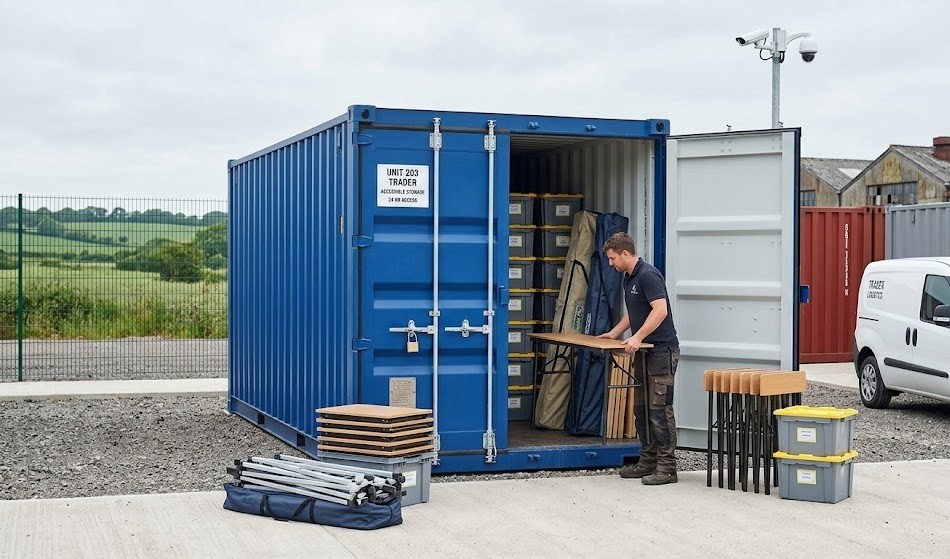
Running a market stall brings genuine freedom – you’re your own boss, you set your own hours, and you build direct relationships with customers who return week after week. But there’s a practical challenge that every weekend trader knows too well: where do you store everything from Sunday evening until Friday morning? Your stock, your display equipment, your gazebo, your tables – it all needs to go somewhere safe, and your spare bedroom or garage can only accommodate so much before your home starts resembling a warehouse.
Market trader storage has become essential for anyone serious about building a sustainable stall business. Whether you’re selling vintage clothing at farmers’ markets, handmade crafts at artisan fairs, or fresh produce at weekend food markets, you need accessible, secure space that doesn’t cost the earth. The right weekly trading storage solution transforms how you operate, turning chaotic Sunday night pack-downs into smooth, efficient routines that protect your investment and your sanity.
Why weekend traders need dedicated storage space
Think about what happens when you don’t have proper storage. You’re cramming boxes into hallways, stacking crates in your living room, and explaining to family members why they can’t park in the garage anymore. One trader we worked with was storing vintage furniture in her daughter’s bedroom – every Thursday night became a furniture-moving marathon before market day.
The problem compounds when your business grows. Success means more stock, better display equipment, and additional supplies. What started as three boxes of handmade jewellery becomes a full inventory system with seasonal stock, backup supplies, and professional display units that cost hundreds of pounds.
Home storage creates three major headaches:
- Your living space shrinks as your business expands, creating tension with family members who want their home back
- Stock gets damaged from constant moving, poor conditions, or simply being in the way during daily life
- You can’t scale up because there’s physically nowhere to put additional inventory
Personal storage solves this by creating clear boundaries between your business operations and your home life. Your products stay protected in proper conditions, your family reclaims their space, and you gain room to grow your operation.
The true cost of inadequate storage
Here’s what inadequate storage actually costs you, beyond the obvious frustration. A craft trader once told me she’d lost £400 worth of handmade candles when her garage flooded during winter. She’d been storing them on the floor because she’d run out of shelf space. The insurance didn’t cover it because it was classified as business stock in a domestic property.
Damage and loss add up quickly:
- Temperature fluctuations ruin products that need stable conditions
- Damp environments destroy fabric, paper, and wooden items
- Poor organisation means you can’t find what you need when restocking between markets
- Lack of security puts your entire inventory at risk
Then there’s the time cost. Every hour you spend moving stock around your house, searching for specific items, or reorganising because something doesn’t fit is an hour you’re not making products, marketing your stall, or actually selling. One food trader calculated he was spending six hours per week just managing storage logistics at home – that’s over 300 hours per year of unpaid labour that could be spent growing the business.
Understanding your storage requirements
Before you choose a storage solution, you need to understand exactly what you’re storing and how you’ll access it. This isn’t complicated, but it requires honest assessment rather than guesswork.
Start by categorising your inventory:
- Current stock: Items ready to sell this weekend
- Backup stock: Products you’ll need in the next month
- Seasonal items: Goods that sell at specific times of year
- Display equipment: Gazebos, tables, shelving, signage
- Packaging and supplies: Boxes, bags, wrapping materials, receipt books
A vintage clothing trader might need hanging space for garments, flat storage for folded items, and separate areas for different seasons. A plant seller needs ventilated space and easy vehicle access for loading heavy pots. A jewellery maker requires secure, climate-controlled conditions for delicate pieces.
Think about your access pattern too. Do you pack everything Thursday evening and load it all Friday morning? Or do you make multiple trips throughout the week to restock and prepare? The answer determines whether you need drive-up access or whether a standard unit works perfectly well.
Choosing the right unit size
Here’s a simple analogy: choosing a storage unit is like picking the right van for your business. Too small and you’re making multiple trips or leaving stock behind. Too large and you’re paying for empty space you’ll never use. You want something that fits your current needs with just enough room to grow.
Most weekend traders find these size ranges work well:
- 25-50 sq ft: Solo traders with compact stock (jewellery, small crafts, minimal display equipment)
- 50-75 sq ft: Medium operations with multiple product lines and standard market equipment
- 75-100 sq ft: Larger stalls with extensive inventory, multiple display systems, or bulky items like furniture
One food market trader started with a 50 sq ft unit for her artisan bread business. She stored baking equipment, packaging supplies, and her market gazebo comfortably with room to spare. As she expanded into pastries and added a second market day, she upgraded to 75 sq ft – enough space to organise everything properly and accommodate seasonal stock increases during Christmas markets.
Don’t forget vertical space. Proper shelving transforms a storage unit, effectively doubling your capacity by using height efficiently. Stack boxes of backup stock high, keep current inventory at eye level, and store equipment you use every week at ground level for easy access.
Midweek access and flexibility
Weekend trading creates a specific access pattern that standard business storage doesn’t always accommodate. You need to get in Thursday or Friday to pack your van, and you need to return Sunday evening or Monday morning to unload. Some traders also visit midweek to restock, reorganise, or prepare for special events.
Flexible access matters for several practical reasons:
- Market schedules change – you might add a midweek evening market or a special weekend event
- Restocking doesn’t always happen on a fixed schedule, especially for makers who produce items in batches
- Weather cancellations mean you need to unload quickly when a market gets called off
- Emergency access lets you retrieve specific items when a customer makes a special request
Business storage facilities that understand trader schedules typically offer extended access hours or 24/7 availability. This flexibility transforms your operations because you’re not constrained by 9-5 office hours that don’t match your working pattern.
One plant trader we worked with operates on a Thursday-to-Monday cycle. She collects fresh stock from suppliers Thursday morning, preps everything Thursday afternoon, loads her van Friday evening, trades Saturday and Sunday, then returns everything Monday morning. She needs access outside standard business hours, and a rigid facility would make her entire business model unworkable.
Security considerations for market stock
Your market stock represents genuine investment – the products you’ve bought or made, the equipment you’ve purchased, and the supplies you need to operate. Losing it to theft or damage doesn’t just cost money; it can shut down your trading completely until you rebuild your inventory.
Proper security means multiple layers of protection:
- Individual unit locks that only you control
- Perimeter security with fencing and gated access
- CCTV coverage of access points and corridors
- Well-lit facilities that deter opportunistic theft
- On-site management or security presence
Think about insurance too. Most home insurance policies explicitly exclude business stock or limit coverage to a few hundred pounds. When you’re storing thousands of pounds worth of inventory, that’s inadequate. Dedicated weekly trading storage facilities typically carry insurance that covers stored goods, and their security measures often qualify you for better rates on your business insurance.
A craft trader storing handmade furniture learned this lesson expensively. She’d been using a cheap, unsecured lockup where someone broke in and stole £3,000 worth of finished pieces before a major Christmas fair. Her home insurance didn’t cover it because it was business stock. She moved to proper secure storage immediately afterwards, accepting that the monthly cost was insignificant compared to the risk of losing everything again.
Climate control: when you need it and when you don’t
Climate control sounds like a premium feature you might not need, but for many traders it’s essential protection for their inventory. The question isn’t whether climate control is nice to have – it’s whether your stock will survive without it.
These products genuinely need climate-controlled conditions:
- Fabric and textiles that develop mould in damp conditions
- Wooden items that warp or crack with temperature changes
- Paper goods, books, and prints that deteriorate in humidity
- Cosmetics and certain food products requiring stable temperatures
- Electronics and battery-powered equipment sensitive to moisture
Standard storage units experience the same temperature and humidity fluctuations as an unheated garage. That’s perfectly fine for metal equipment, plastic containers, or robust display materials. But if you’re storing vintage clothing, handmade paper goods, or wooden crafts, you’ll find your stock damaged within a few months.
One vintage clothing trader initially chose a standard unit to save money. After one winter, she discovered mildew on several garments and that distinctive musty smell that’s almost impossible to remove from fabric. She switched to climate-controlled storage and hasn’t had a single issue since. The extra £20 per month is trivial compared to losing valuable vintage pieces.
Organising your unit for efficient loading
Here’s where many traders waste time: they treat their storage unit like a dumping ground, shoving everything in Sunday night and hoping they can find it all Friday morning. That approach creates stress, wastes time, and means you’re constantly moving things around just to access what you need.
Organise your unit like a well-run shop stockroom instead:
- Create a loading zone near the door for items you use every market
- Group products by category so you know exactly where everything lives
- Label boxes clearly with contents and dates
- Keep an inventory list attached to the inside of your unit door
- Store seasonal stock at the back, current stock at the front
Think about your loading sequence too. The last things you load into your van should be at the front of your unit – your gazebo, your tables, your display equipment. Products go in next, organised by how you’ll arrange your stall. This means you’re not unpacking half your van to find the table legs you stored at the back.
A food trader who sells preserves and chutneys uses a simple but effective system. She has three sections: current stock ready to sell, backup stock organised by product type, and a packing station where she has all her bags, labels, and receipt books. Friday evening loading takes 20 minutes because everything has its place and she’s not searching for anything.
Cost management for market traders
Storage costs money, but so does running out of space, damaging stock, or losing inventory to poor conditions. The question isn’t whether you can afford storage – it’s whether you can afford not to have it.
Calculate the real cost by considering what you’re currently spending:
- Wasted stock from damage or poor storage conditions
- Time spent managing storage at home (value your hours properly)
- Opportunity cost of not being able to expand your inventory
- Relationship stress from business taking over your home
- Potential insurance gaps on business stock stored domestically
For most weekend traders, a 50 sq ft unit costs roughly what you’d make from one decent market day per month. That’s the price of protecting everything you’ve invested in your business and giving yourself room to grow.
Container storage offers another option for traders with larger operations or those sharing space with other market sellers. Some traders team up to split a container, reducing individual costs while still gaining secure, accessible storage.
Packing and protection best practices
How you pack and protect your stock matters as much as where you store it. Even the best market trader storage facility won’t prevent damage if you’re throwing things into boxes without proper protection.
Follow these practical packing principles:
- Use sturdy boxes that won’t collapse when stacked
- Wrap fragile items individually in bubble wrap or packing paper
- Fill empty space in boxes to prevent items shifting
- Stack heavier boxes at the bottom, lighter ones on top
- Keep frequently accessed items in easy-reach locations
Invest in proper packaging supplies rather than using whatever random boxes you’ve collected. Quality materials protect your investment and make packing and unpacking faster because everything fits together properly.
One ceramics trader learned this after a box of mugs collapsed because she’d used old, weakened cardboard boxes. She lost 30 pieces worth £15 each – £450 of damage that proper boxes costing £20 would have prevented. She now uses double-walled boxes specifically designed for fragile items, and hasn’t had a single breakage in storage since.
Scaling your storage as your business grows
Your storage needs change as your market business develops. What works when you’re testing products at local markets becomes inadequate when you’re trading multiple days per week or preparing for the busy Christmas season.
Plan for growth by building flexibility into your storage approach:
- Choose facilities that allow easy upgrades to larger units
- Organise your current space efficiently so you know when you’re genuinely running out of room
- Track seasonal patterns to understand when you need extra capacity
- Consider short-term additional space during peak trading periods
One trader started with a 35 sq ft unit for her handmade soap business. Within a year, she’d expanded to 75 sq ft to accommodate increased stock and better display equipment. Two years later, she’s now using 100 sq ft and employing part-time help. Her storage facility made each upgrade simple because she didn’t need to move to a different location or sign complicated new contracts.
Seasonal traders face different challenges. A Christmas decoration specialist needs minimal space from January to August, but requires triple the capacity from September to December. Flexible weekly trading storage arrangements that allow temporary expansion make this business model viable without paying for empty space most of the year.
Making storage work for your trading schedule
The best storage solution integrates seamlessly with your existing routine rather than forcing you to adapt to inconvenient constraints. Your storage facility should make market trading easier, not add another layer of complexity to your week.
Consider how storage fits your specific pattern:
- Location relative to your home and your regular markets
- Access hours that match when you actually need to load and unload
- Drive-up access if you’re loading heavy or bulky items
- On-site facilities like trolleys or loading bays that speed up the process
A trader who works full-time Monday to Friday and trades markets on weekends needs different access than someone who makes products all week and trades one Sunday per month. There’s no universal solution – you need storage that matches your reality.
Think about the total time equation too. A facility that’s 15 minutes further away but offers drive-up access might actually save time compared to a closer location where you’re carrying boxes down corridors and up lifts. One furniture trader switched to a slightly more distant facility specifically because he could back his van right up to his unit door, cutting his loading time from 90 minutes to 30 minutes.
Building a sustainable market trading business
Proper storage isn’t just about convenience – it’s about building a business that’s genuinely sustainable long-term. When your operations are chaotic, your home is cluttered, and you’re constantly worried about damaged stock, you’re not building something that can grow and thrive.
Professional market trader storage creates clear boundaries between your business and your personal life. Your home becomes your home again. Your stock is protected. You have room to expand when opportunities arise. You’re not making decisions based on storage constraints but on what’s actually best for your business.
The most successful market traders treat weekly trading storage as essential infrastructure, not an optional extra. They understand that protecting their inventory, creating efficient systems, and having room to grow isn’t a luxury – it’s the foundation that makes everything else possible.
Whether you’re just starting out with a few boxes of handmade goods or you’re running a substantial weekend trading operation, the right storage solution transforms how you work. It removes stress, protects your investment, and creates the space you need to focus on what actually matters: creating great products, building customer relationships, and growing a business you’re proud of.
If you’re ready to reclaim your home and give your market business the professional foundation it deserves, contact us to discuss which storage solution fits your trading pattern and inventory needs. Your stock deserves better than that overcrowded spare room.