
 01635 581 811
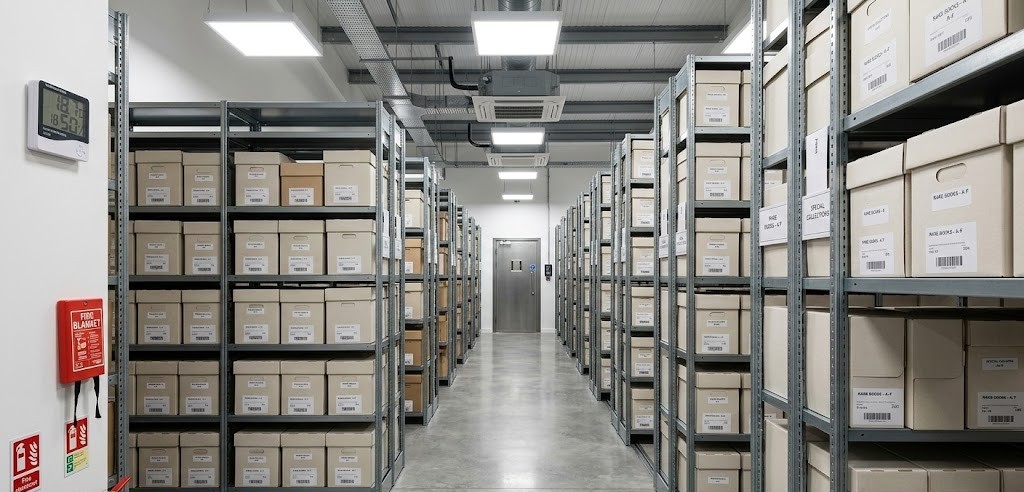
Independent bookshops face a unique challenge that most retailers never encounter: their most valuable stock often isn’t the newest release on the front table, but the decades-old first edition tucked away in the back room. Rare and out-of-print books represent significant financial investment and cultural heritage, yet they’re notoriously difficult to store properly. One damp corner, one pest problem, or one overstuffed stockroom can destroy inventory worth thousands of pounds.
Rare book storage demands more than simply finding shelf space. These volumes need controlled environments, proper handling protocols, and security measures that protect both their monetary value and historical significance. For independent booksellers operating from premises with limited square footage, the question isn’t whether to use external storage, but how to do it properly.
Why rare books can’t just sit anywhere
Rare and out-of-print books deteriorate rapidly when stored incorrectly. Paper yellows and becomes brittle in fluctuating temperatures. Leather bindings crack in dry conditions and develop mould in damp ones. Dust jackets fade under fluorescent lighting. A first edition that might fetch £500 in pristine condition becomes worthless when its spine splits or foxing spreads across the pages.
Think of rare books like vintage wine. You wouldn’t store a £200 bottle in your garden shed, and the same principle applies here. These items need consistent conditions, not the temperature swings of a typical stockroom that’s freezing in winter and sweltering in summer.
The financial implications are stark. A bookseller we worked with recently discovered that improper storage had damaged roughly 30% of their antiquarian stock over three years. That’s not just lost inventory – it’s lost reputation. Collectors talk, and word spreads quickly when a dealer sells books with hidden condition issues.
The hidden costs of on-premises storage
Most independent bookshops operate from charming but compact premises. Every square metre devoted to archive storage is space that can’t generate revenue through customer browsing or events. The maths becomes uncomfortable quickly: if your shop floor generates £300 per square metre annually in sales, but you’re using ten square metres to store slow-moving rare stock, you’re sacrificing £3,000 in potential revenue.
Beyond the opportunity cost, on-site storage creates practical headaches. Rare books need to be organised meticulously – you can’t have a customer waiting twenty minutes whilst you search through stacks for that specific 1960s poetry collection they’ve requested. Yet creating that level of organisation in a cramped back room, often shared with new stock, packaging materials, and staff facilities, becomes nearly impossible.
Insurance presents another complication. Insurers charge significantly higher premiums when valuable rare books are stored in mixed-use premises, particularly older buildings with outdated security systems. The difference can amount to hundreds of pounds annually.
What proper archive storage actually protects
When we talk about rare book storage, we’re addressing several distinct threats simultaneously. Temperature fluctuations cause the most insidious damage because they happen gradually. Paper expands and contracts with temperature changes, weakening the binding over time. A book that survives a hundred years in stable conditions can fall apart in five years of poor storage.
Humidity matters even more than temperature. The ideal relative humidity for rare books sits between 35-50%. Drop below 30% and leather bindings dry out and crack. Rise above 60% and you’re creating perfect conditions for mould growth. Once mould establishes itself in a collection, it spreads from book to book, and remediation costs quickly exceed the value of many volumes.
Light damage is cumulative and irreversible. UV radiation breaks down the chemical bonds in paper and ink, causing fading and brittleness. Even indirect daylight causes harm over time, which is why serious collectors and institutions store valuable books in darkness except when actually handling them.
Pests represent the nightmare scenario. Silverfish, booklice, and carpet beetles all feed on paper, glue, and cloth bindings. A single infestation can devastate a collection before you even notice the problem. Professional storage facilities maintain pest control protocols that individual bookshops simply can’t match.
Organising your archive collection for external storage
The transition to external storage forces beneficial discipline. You can’t simply move boxes of books and hope for the best – you need a system that lets you locate specific titles quickly and track what you actually own.
Start by categorising your rare stock into clear groups:
High-value items (anything worth over £200): These need individual documentation with photographs, condition notes, and provenance details. Store them in acid-free boxes or archival sleeves, and maintain a digital inventory with precise location information.
Medium-value collectables (£50-200): Group these by subject or author in clearly labelled boxes. Each box should have a detailed contents list attached to both the physical container and your digital records. Proper collectible book storage for this category prevents damage whilst maintaining accessibility.
Interesting but lower-value out-of-print stock (under £50): These can be organised more broadly by genre or period, but still require systematic labelling so you can find them when needed.
Create a master spreadsheet that records every book’s location down to the specific box number. When a customer enquires about a title, you need to know within seconds whether you have it and where it’s stored. This level of organisation feels tedious initially, but it transforms your rare stock from a liability into a properly managed asset.
Consider implementing a rotation system. Not every rare book needs permanent archive storage. Items that generate regular interest or have recently increased in value might warrant temporary return to your shop floor, whilst slower sellers move into storage. Review your inventory quarterly to optimise what’s accessible versus what’s archived.
Choosing storage that actually protects books
Not all storage units suit rare books. The cheapest option often proves the most expensive when you factor in potential damage. When evaluating facilities, focus on these specific factors:
Climate considerations: Standard storage units without climate control experience the same temperature swings as a garden shed. You need a facility that maintains consistent temperature year-round. Whilst full climate control might seem excessive for moderately valuable stock, remember that prevention costs far less than restoration or replacement. Proper collectible book storage requires these controlled conditions.
Security features: Rare books are high-value, easily portable, and difficult to trace once stolen. Look for facilities with 24/7 CCTV, individual unit alarms, and controlled access systems that log every entry. Your insurance provider will likely require these features for adequate coverage anyway.
Accessibility: How quickly can you retrieve a specific book when a customer requests it? If your storage facility has limited access hours or sits an hour’s drive away, you’ll lose sales. Ideally, you want somewhere you can reach within 30 minutes during business hours. Business storage solutions designed for commercial use typically offer more flexible access than residential storage options.
Unit size and layout: Rare books don’t need enormous space, but they do need organised space. A smaller unit with good shelving beats a larger unit where everything sits in stacked boxes. Calculate your requirements based on linear shelf metres rather than floor space – most rare books store spine-out on standard depth shelving.
Packing rare books for storage
Proper packing prevents more damage than any other single factor. Even perfect storage conditions can’t protect books that were packed carelessly.
Never pack books flat in tall stacks. The weight crushes spines and warps covers. Always store books upright, as they’d sit on a bookshelf, with adequate support so they don’t lean or slump. Books of similar size should be grouped together – don’t mix a tall folio with pocket-sized volumes in the same box.
Use acid-free boxes and packing materials exclusively. Standard cardboard boxes contain lignin and acids that off-gas over time, causing yellowing and deterioration. The cost difference between regular and archival boxes is minimal compared to the value you’re protecting.
Wrap valuable individual volumes in acid-free tissue paper or glassine before boxing. This provides an additional barrier against dust and creates a buffer between books. Never use newspaper, bubble wrap, or standard tissue paper – all contain chemicals that can transfer to book surfaces.
Fill empty spaces in boxes with crumpled acid-free paper to prevent books shifting during transport or whilst in storage. Movement causes abrasion damage to covers and spines. Each box should be snug but not compressed – you shouldn’t need force to close the lid.
Label everything clearly on multiple sides of each box. Include general contents on the outside, but keep detailed inventories separate. You don’t want to advertise “First Editions £200+” to anyone who might see your storage unit.
Insurance and documentation
Your standard shop insurance probably doesn’t adequately cover rare books in external storage. Review your policy carefully and speak to your insurer about specific coverage for archived stock. You’ll likely need to provide detailed inventories and proof of value for high-end items.
Photograph every significant book before storage. Capture the cover, spine, title page, and any distinguishing features or condition issues. These photographs serve multiple purposes: they document condition for insurance claims, provide visual references for online sales, and help with identification if theft occurs.
Maintain two separate inventory systems – one digital and one physical. Cloud-based inventory management protects against data loss, but a printed backup stored separately from your stock ensures you’re never completely dependent on technology. Update both systems whenever books move in or out of storage.
Consider creating a simple check-in/check-out log. When you retrieve books from storage, note the date, which titles you removed, and when you return them. This creates an audit trail and helps you understand which parts of your archive collection actually generate sales versus which items are truly dormant.
Making archive storage work financially
External storage costs money, but so does tying up valuable shop space with slow-moving stock. The calculation depends on your specific circumstances, but the break-even point often arrives sooner than booksellers expect.
Calculate your shop’s revenue per square metre by dividing annual turnover by your retail floor space. If archive storage currently occupies space that could accommodate browsing customers or host events, multiply that square metreage by your revenue density. That’s your opportunity cost.
Compare this figure to the annual cost of appropriate external storage. For many independent bookshops, a small climate-controlled unit costs £1,200-1,800 annually. If freeing up that space generates even £2,000 in additional revenue, you’re ahead financially whilst also protecting your stock more effectively.
Factor in the improved sales potential of properly archived rare books. When your collection is organised and accessible rather than jumbled in a back room, you can actually sell it. Many booksellers find that moving to systematic rare book storage increases rare book sales by 20-30% simply because they can locate and retrieve items efficiently.
The inventory discipline required for external storage also reveals which rare books actually deserve space in your collection. You might discover that 40% of your archive stock hasn’t generated a single enquiry in three years. That’s capital tied up unproductively – stock that might be better sold at modest prices to free up funds for more saleable acquisitions.
Creating a retrieval system that works
The best storage solution becomes useless if you can’t efficiently retrieve books when customers want them. Develop a retrieval protocol before you move anything into storage.
Assign each storage box a unique identifier – many booksellers use a simple numbering system (Box 001, Box 002, etc.) combined with a location code if using multiple units. Record these identifiers in your inventory system alongside detailed contents lists.
Maintain a “frequently requested” category in your database. If certain authors or subjects generate regular enquiries, those books might warrant keeping on-premises even if they’re technically archive stock. Review this category monthly – demand patterns change.
Consider batching retrieval trips. Rather than driving to storage every time someone requests a rare book, implement a system where customers understand there’s a 24-48 hour lead time for archived stock. Batch your trips to collect multiple books at once, improving efficiency. Most serious collectors accept this delay – they’re accustomed to waiting for rare books.
Create a “returns box” at your shop for books that have been retrieved but didn’t sell. When this box fills up, make a single trip to return everything to storage rather than multiple small trips. This reduces both time investment and the risk of books being damaged during frequent transport.
When to expand or consolidate storage
Your archive storage needs will change as your business evolves. Review your requirements annually to ensure you’re not paying for more space than necessary or cramming too much into too little space.
Signs you need more collectible book storage include difficulty locating specific books, boxes stacked unsafely high, or books stored in less-than-ideal positions because proper shelf space has run out. Don’t wait until you’re damaging stock through poor organisation.
Conversely, if you’re paying for a unit that’s half empty, consider downsizing. The money saved could fund better packaging materials or improve your shop’s climate control. Empty space in a storage unit generates no value – it’s just wasted money.
Some booksellers find that their archive needs fluctuate seasonally. If you acquire heavily at certain times of year (perhaps buying entire collections from house clearances in spring and summer), consider whether flexible storage arrangements might work better than a fixed annual contract. Many facilities offer shorter-term options for businesses with variable requirements.
Building storage costs into your pricing
Rare book pricing should reflect storage costs just as it reflects acquisition costs and your expertise. If you’re paying £150 monthly for proper archive storage, that’s £1,800 annually that needs to be recovered through sales.
Calculate your storage cost per book by dividing annual storage expenses by the number of books in archive storage. If you’re storing 1,000 books at £1,800 annually, that’s £1.80 per book per year. A book that sits in storage for three years before selling has accumulated £5.40 in storage costs that should be reflected in your pricing.
This doesn’t mean adding £5.40 to every book’s price tag. Fast-moving rare stock effectively subsidises slower items. But understanding these costs helps you make informed decisions about which books deserve space in your collection and which should be sold at modest prices to free up capital.
Be ruthless about books that will never generate enough value to justify their storage costs. That £15 out-of-print novel that’s been in storage for five years has cost you £9 in storage fees alone. Better to sell it at £10 and use that space for something more valuable.
Making storage work for your business
Proper archive storage transforms rare and out-of-print stock from a management headache into a genuine business asset. The initial effort of organising, documenting, and moving books feels substantial, but the long-term benefits – protected inventory, freed-up shop space, improved organisation, and increased sales – justify the investment.
The key lies in treating collectible book storage as a business system, not just rented space. Create protocols for what goes into storage, how it’s organised, when it’s retrieved, and how costs are tracked. Review and refine these systems regularly based on actual experience.
Independent booksellers who implement proper rare book storage consistently report similar outcomes: reduced stress about valuable stock, more efficient use of shop space, better inventory control, and improved customer service when locating specific titles. The books themselves benefit most of all – preserved properly, they’ll remain saleable for decades rather than deteriorating into worthlessness.
If your rare and out-of-print stock currently occupies valuable shop space or sits in conditions that threaten its preservation, it’s worth exploring dedicated storage solutions. The investment protects both your inventory’s financial value and the cultural heritage these books represent. Contact us to discuss storage options that suit the specific needs of rare book collections, with the climate control and security that valuable stock demands.