
 01635 581 811
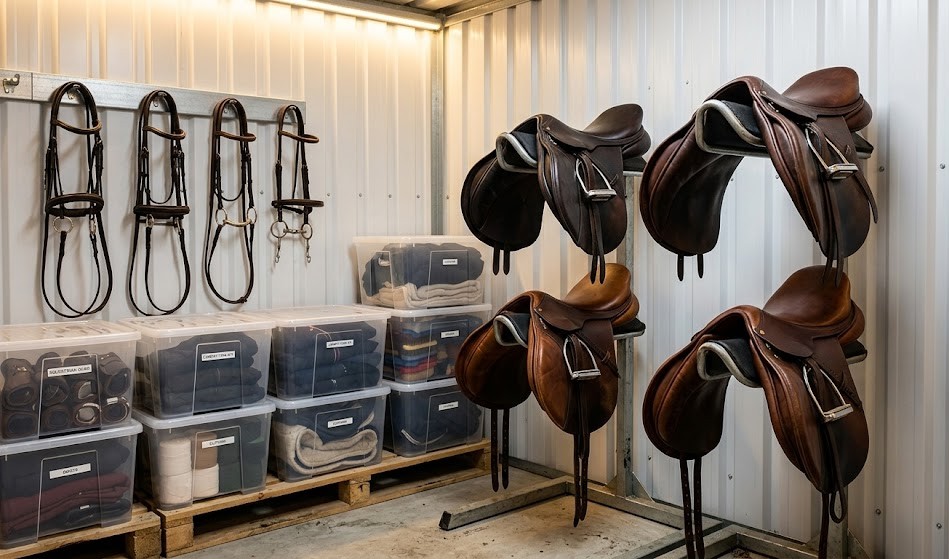
Running an equestrian business means juggling saddles, bridles, competition gear, spare equipment, and seasonal items that quickly overwhelm even the most organised tack room. When your working space is crammed with spare saddles, winter rugs in summer, and competition equipment you only use a few times a year, you’re not just losing space – you’re losing efficiency and potentially damaging valuable kit.
Proper equestrian tack storage isn’t just about tidiness. It’s about protecting leather goods from mildew, keeping metal fittings rust-free, and ensuring you can actually find that specific bit when a client needs it. Many equestrian professionals find themselves storing thousands of pounds worth of equipment in damp tack rooms, garden sheds, or even car boots – none of which offer the conditions these items need to stay in good condition.
Why Equestrian Businesses Need Dedicated Storage Space
The reality of running riding schools, competition yards, or equestrian retail businesses is that you accumulate equipment faster than you can use it. You’ve got spare saddles for different disciplines, bridles for various horse sizes, competition gear that only comes out for shows, and seasonal items like summer sheets and winter turnout rugs that sit unused for half the year.
Your working tack room needs to hold daily-use items. Everything else becomes clutter that makes it harder to find what you need quickly. When you’re preparing multiple horses for lessons or competitions, every minute spent searching for the right numnah or spare girth costs you time and money.
The financial investment in tack and equipment’s substantial. A quality dressage saddle can cost £2,000 or more, competition bridles run into hundreds of pounds, and even everyday items like numnahs, boots, and bandages add up quickly. Storing these items in unsuitable conditions – damp sheds, unheated containers, or overcrowded tack rooms – risks leather cracking, metal rusting, and fabric developing mildew. That’s money literally deteriorating in storage.
What Equestrian Equipment Benefits Most from Self-Storage
Not everything needs to live in your daily-access tack room. Identifying what to store elsewhere frees up working space and protects items you don’t use regularly.
Spare and backup saddles are prime candidates for off-site storage. If you keep extra saddles for different riders, guest horses, or as backups when your regular saddles are being reflocked, you don’t need them taking up tack room space. The same applies to saddles you’re holding between selling horses or waiting to sell on.
Competition equipment used only during show season makes sense to store separately. Show bridles with fancy browbands, white numnahs and bandages, tail bags, plaiting kits, and those pristine boots you only use for dressage tests don’t need to gather dust in your working space for ten months of the year. Store them properly between seasons and they’ll stay in better condition than sitting in a busy tack room where they get knocked about.
Seasonal items create the most obvious storage need – like swapping out your entire wardrobe between summer and winter because you don’t have room for both simultaneously. Winter turnout rugs, heavyweight stable rugs, and fleece coolers sit unused all summer. Conversely, lightweight summer sheets, fly masks, and cooling rugs just take up space during winter months. Rotating these items in and out of storage as seasons change keeps your working area manageable.
Retail stock for equestrian businesses selling tack and equipment needs proper storage. You can’t display everything, and keeping excess stock in suitable conditions protects your investment until items sell. This applies particularly to leather goods, which need stable humidity levels to prevent drying out or developing mildew.
Historical or sentimental equipment that you’re not ready to sell but don’t actively use deserves proper storage. That saddle from your competition days, your first horse’s bridle, or equipment passed down through your family shouldn’t deteriorate in a damp shed just because you’ve no room elsewhere.
Creating the Right Environment for Tack Storage
Leather and fabric don’t tolerate extremes. Too much moisture causes mildew and rust; too little causes leather to dry out and crack. Metal fittings corrode in damp conditions. Fabric items can develop musty odours or even rot if stored incorrectly.
Think of leather tack like a good pair of boots. You wouldn’t leave them in a damp shed or a sweltering attic. Leather needs relatively stable conditions – not necessarily warm, but dry and without wild temperature swings. The same principle applies to saddles, bridles, and leather boots.
Climate-controlled storage units maintain consistent temperature and humidity levels year-round. This matters particularly for valuable saddles and bridles. You’re not paying for luxury; you’re paying to prevent your £2,000 saddle from developing mildew or the leather drying out and cracking. For businesses storing significant amounts of tack and equipment, this protection quickly pays for itself.
Standard storage units work for many items, particularly if you’re storing things like horse rugs, bandages, and boots that aren’t as sensitive to temperature fluctuations. However, you’ll still want a clean, dry environment that doesn’t get damp. Rugs stored in damp conditions develop that unmistakable musty smell that’s almost impossible to remove.
Preparing Tack and Equipment for Storage
Proper preparation prevents you from pulling out mildewed saddles or rusted bits six months later. It’s not complicated, but it does require doing things properly rather than just throwing items in boxes.
Clean everything thoroughly before storage. Leather tack needs cleaning with saddle soap to remove dirt, sweat, and grime. Once clean, condition the leather properly. Don’t over-oil it – a light coating of quality leather conditioner’s better than drowning items in oil, which can actually cause problems over time. Pay particular attention to areas that flex, like girth straps and stirrup leathers, as these are most prone to cracking.
Metal bits, stirrups, and buckles need cleaning and drying completely. Any moisture left on metal will cause rust in storage. A light coating of oil on bits prevents corrosion, but make sure you’ll clean them again before use.
Horse rugs require washing and complete drying before storage. Even if a rug looks clean, body oils, sweat, and dirt will attract insects and can cause fabric deterioration over time. Make sure rugs are bone dry – any dampness will cause mildew in storage. Hang them to air for at least 24 hours after washing, even if they feel dry.
Pack items appropriately for protection. Saddles should never be stored flat on the pommel or cantle as this can distort the tree. Use a saddle rack or stand, or if you must stack saddles, place them on their sides with protective padding between them. Cover saddles with breathable cotton covers, not plastic, which traps moisture.
Bridles can hang on proper bridle racks or hooks, but make sure they’re not squashed or bent unnaturally. Leather boots should be stuffed with paper to maintain their shape. Fabric items like numnahs, bandages, and boots can go in breathable storage bags or boxes – again, avoid plastic bags that trap moisture.
Create an inventory as you pack. This sounds tedious until you need to find a specific item six months later. A simple list noting what’s in each box or which saddles are stored where saves hours of searching. Take photos of valuable items before storage for insurance purposes.
Organising Storage Space for Easy Access
A storage unit that’s just a jumble of boxes and saddles becomes useless quickly. You need to find things without unpacking everything, which means organising logically from the start.
Group items by type and usage frequency. Competition equipment you’ll need next season goes in one area, spare everyday items in another, and seasonal items you won’t need for months at the back. This way, when show season starts, you can access everything you need without moving storage boxes full of winter rugs.
Use shelving units to maximise vertical space. Saddle racks can stack vertically on shelving, boxes of smaller items sit on shelves rather than piling on the floor, and you can actually see what you’ve got. Industrial shelving units are relatively inexpensive and transform how much you can fit in a space.
Label everything clearly. “Winter rugs – 6’3″” is more helpful than “rugs” when you’re trying to find specific items. Use waterproof labels or permanent markers on boxes. For valuable items or things you access regularly, consider a more detailed labelling system that notes contents without opening boxes.
Keep a master list at the front of your unit showing what’s stored where. A simple clipboard with your inventory means you can check what you have without searching through boxes. Update it when you add or remove items.
Here’s a real-world example: a riding school manager in Reading stores all spare school saddles on racks along one wall, organised by size. Competition equipment sits in clear plastic boxes (with lids off to prevent moisture buildup) on shelves, labelled by discipline. Winter rugs live in large bags at the back during summer, clearly marked by size. When a school saddle needs replacing, she knows exactly where the spares are. When competition season starts, she pulls out the relevant boxes without disturbing anything else. Her system meant she could find and load equipment for three riders competing at a local show in under 20 minutes, versus the hour-plus she’d previously spent hunting through a disorganised shed whilst horses waited ready-tacked.
Making Storage Work for Your Business Operations
Storage shouldn’t be somewhere you dump things and forget about them. It should function as an extension of your working space that makes your business more efficient.
Plan regular access times rather than treating storage as a place you visit once a year. If you’re rotating seasonal items, schedule time to swap summer and winter equipment. If you’re storing competition gear, plan to collect items a week before shows rather than in a last-minute panic.
Consider a larger unit than you think you need. It’s like choosing a storage box – if you fill it completely, you can’t add anything else and you can’t access items easily. A unit with some spare space allows you to move things around, add items as your business grows, and actually walk in to find what you need. The small additional cost’s worth the flexibility.
Use storage as part of your business planning. When you buy new equipment, you can keep the old items as spares rather than selling them immediately. When you’re between horses or clients, you’ve got space for their equipment without cluttering your working tack room. When you find a great deal on retail stock, you can buy in bulk and store excess properly.
Think about access requirements. If you need to collect items frequently, choose a facility with extended access hours. If you’re moving large items like saddle racks or multiple rugs, drive-up access makes loading and unloading significantly easier than carrying items through corridors.
The packaging you use matters too. Invest in proper storage boxes, breathable garment bags, and saddle covers rather than using whatever’s lying around. Good packaging protects your investment and makes organisation easier.
Insurance and Security Considerations
Tack theft’s a genuine concern in the equestrian world. Saddles are valuable, portable, and relatively easy to sell on. When you’re storing thousands of pounds worth of equipment, security matters.
Check what insurance coverage you need. Your business insurance might cover items in storage, or you might need additional coverage. Either way, make sure you know what’s covered and what documentation you need. That inventory list and photos of valuable items become essential if you ever need to make a claim.
Choose a facility with proper security measures. Individual unit alarms, CCTV coverage, secure perimeter fencing, and controlled access aren’t luxuries – they’re essential when you’re storing valuable equipment. Ask about security features before committing to a facility.
Consider how you transport items to and from storage. Don’t leave saddles visible in your car when you’re moving items. Make multiple trips if necessary rather than advertising what you’re carrying.
When to Reassess Your Storage Needs
Your storage requirements change as your business evolves. A unit that worked perfectly when you started might be too small now, or perhaps you’re paying for space you no longer need.
Review what you’re storing every six months. Are you keeping items you’ll never use again? Could you sell equipment that’s just taking up space? Are there items you need to access more frequently than you expected? Regular reviews prevent you from paying to store things you don’t actually need.
Consider whether items still need storage. Equipment you thought you’d use again might be better sold. Conversely, if your business has grown, you might need more storage space rather than cramming everything into a unit that’s now too small.
For many equestrian businesses, business storage becomes as essential as the tack room itself. It’s not about having more stuff – it’s about having the right things in the right places, protected properly, and accessible when needed.
Making Storage Part of Your Business Efficiency
The most successful equestrian businesses treat storage as a tool, not just a place to dump excess equipment. When your working tack room contains only what you need daily, you work faster and more efficiently. When your spare and seasonal equipment’s stored properly, it stays in good condition and lasts longer. When you can find what you need quickly, you save time and frustration.
Think of storage as similar to having a proper filing system. You could keep every document you’ve ever created piled on your desk, but that makes finding anything impossible. Or you could file things logically, keep current items accessible, and archive older material properly. Storage works the same way – it’s about organisation and efficiency, not just space.
The investment in proper storage pays for itself through equipment that lasts longer, a working space that functions better, and the ability to find what you need when you need it. For equestrian businesses where time’s money and equipment represents significant investment, that’s not an expense – it’s smart business practice.
Newbury Self Store understands that equestrian businesses need storage supporting efficient operations, not generic warehouse space. You need facilities where equestrian tack storage protects valuable saddles and bridles, where competition equipment stays organized between shows, and where seasonal items rotate efficiently. We know that your tack isn’t just equipment – it’s the foundation of professional services that clients and horses depend on.
Whether you’re running a competition yard, a riding school, or an equestrian retail business, the right approach to tack and equipment storage makes your operation run more smoothly. Your working space stays organised, your valuable equipment stays protected, and you’ve got room to grow without drowning in clutter. That’s not just good storage – it’s good business.
If you’re ready to explore proper storage or need advice on the right unit size for your equestrian operation, contact us to discuss your specific requirements. Personal storage solutions designed for valuable items offer the security and conditions that tack demands.