
 01635 581 811
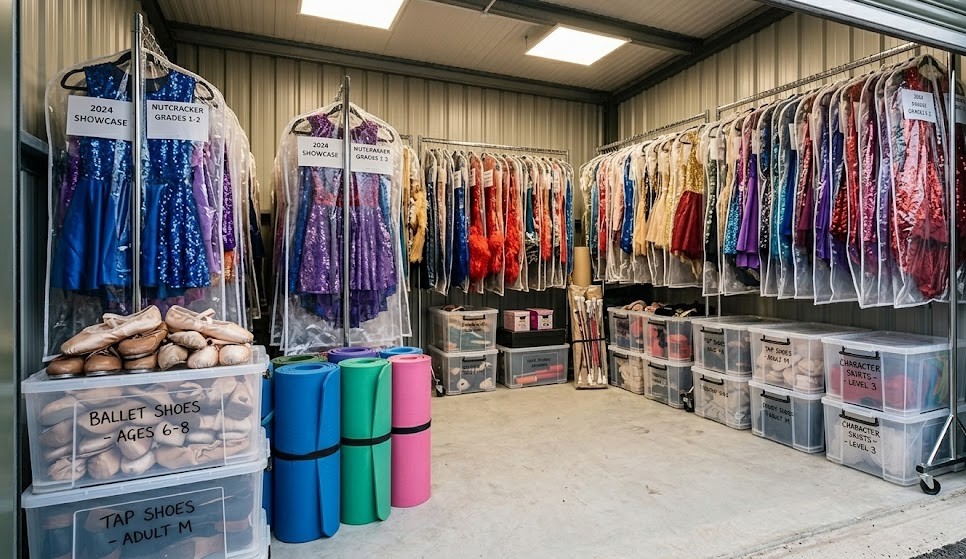
Dance schools accumulate an extraordinary amount of kit. Tutus from last year’s recital, mirrors waiting to be rehung, sound systems that’re only used for performances, and boxes of tap shoes in every conceivable size. These items aren’t just clutter – they represent significant investment and hold genuine sentimental value for students and teachers alike.
The challenge isn’t simply finding space. It’s about protecting delicate fabrics from moths and damp, keeping expensive audio equipment safe from temperature fluctuations, and maintaining an organised system so you can actually find that sequined headpiece when dress rehearsal rolls around. Many dance school owners resort to cramped cupboards, garage storage, or even taking items home, creating a logistical nightmare that compounds every term.
Self-storage offers dance schools a practical solution that goes beyond mere square footage. It provides dedicated space where performance costumes can be properly stored, equipment remains accessible yet secure, and seasonal items can be rotated without disrupting your teaching space. Let’s examine how to make dance school costume storage work efficiently for your specific needs.
Why Dance Schools Need Dedicated Storage Space
Most dance studios operate from commercial premises where every square metre costs money. Using valuable studio floor space to stack costume boxes or store bulky props means less room for actual dancing – the activity that generates your income.
Consider the typical inventory of a modest dance school: perhaps 200 performance costumes spanning multiple productions, sound systems worth several thousand pounds, portable barres, floor sections for competitions, promotional banners, and administrative records. That’s before accounting for props like the oversized mushrooms from last year’s Alice in Wonderland performance or the wooden soldiers from The Nutcracker.
The financial equation becomes clear quickly. Renting studio space typically costs considerably more per square metre than business storage, yet schools often dedicate premium teaching space to storage simply because they haven’t explored alternatives. This represents a hidden cost that compounds annually.
There’s also the question of presentation. Parents assessing your school for their children notice everything. A cluttered studio crammed with boxes doesn’t convey professionalism, regardless of your teaching quality.
Costume Storage: Protecting Your Investment
Dance costumes represent substantial financial outlay. A single professional-quality tutu can cost £150-300, whilst full production costumes for a show with 40 performers might total £5,000-8,000. These aren’t disposable items – with proper care, costumes can serve multiple productions over several years.
The enemies of stored costumes are predictable: moths, moisture, crushing, and disorganisation. Each requires specific countermeasures.
Moths destroy natural fibres with alarming efficiency. A single breeding cycle can devastate an entire costume collection. Prevention requires more than just mothballs (which many dancers find irritating anyway). Costumes must be thoroughly cleaned before storage – moths are attracted to body oils, perspiration, and food residue. Even costumes that appear clean harbour enough organic matter to attract pests.
Proper costume storage follows a systematic approach:
- Clean every garment professionally or according to care labels before storage
- Use breathable garment bags rather than plastic, which traps moisture
- Store costumes hanging when possible to prevent crushing and creasing
- Group by production or costume type for easy retrieval
- Include cedar blocks or lavender sachets as natural moth deterrents
- Maintain an inventory list with photos for quick identification
Sequins, beads, and delicate embellishments require particular attention. These elements can snag, detach, or tarnish when costumes are stacked carelessly. Hanging storage prevents most damage, but if you must stack, place acid-free tissue paper between layers and avoid excessive weight on lower boxes.
One dance school owner discovered this lesson the hard way. She’d stored all her recital costumes in cardboard boxes in a garage, thinking she’d saved money. When she opened them three months later for the next show, moths had eaten through twelve tulle skirts and the damp had mildewed the bodices. The £2,000 replacement cost far exceeded what proper storage would’ve cost for an entire year.
Here’s a scenario many dance school owners recognise: Three weeks before your annual show, you need the fairy costumes from two years ago. Without a proper system, this means excavating multiple boxes, creating chaos, and potentially discovering that moths have rendered several costumes unwearable. With organised storage and proper inventory management, you locate the exact box in minutes, knowing the costumes inside are pristine.
Equipment Storage: Sound Systems, Mirrors, and Portable Floors
Dance schools invest heavily in studio equipment that isn’t used daily but remains essential for performances and competitions. Sound systems, portable mirrors, sprung floor sections, and lighting equipment all require careful storage between uses.
Electronics and temperature fluctuations present specific challenges. Temperature swings and humidity damage sensitive components. Storing a £2,000 sound system in a damp garage risks corrosion, whilst extreme heat can degrade capacitors and other electronic elements. Climate-controlled storage isn’t excessive for valuable equipment – it’s insurance against costly replacement.
Mirrors deserve particular mention. Full-length studio mirrors are expensive, fragile, and awkward to store. If you’re refurbishing your studio or temporarily relocating, mirrors need protection from impact and temperature stress. Proper storage means standing them vertically (never laying flat, which stresses the glass), padding corners and edges, and ensuring they’re secured against tipping.
Portable dance floors represent another significant investment. Competition-grade floors can cost thousands of pounds and require protection from moisture, which causes warping, and from crushing weight. These should be stored flat in their original cases or wrapped in protective covering, never leaned against walls where they might bow.
Creating an equipment storage system:
- Photograph each item and its condition before storage
- Use original packaging when available, especially for electronics
- Label all cables and components clearly
- Store items off the floor using pallets or shelving
- Keep instruction manuals and warranty information with equipment
- Schedule annual checks to ensure everything remains functional
The analogy here resembles a theatre’s costume and prop department. Professional theatres don’t store valuable items haphazardly because they understand these assets must perform reliably for years. Dance schools deserve the same systematic approach.
Seasonal Rotation: Managing Multiple Productions
Dance schools typically operate on an academic calendar with distinct seasons: autumn term focusing on technique, Christmas performances, spring competitions, and summer recitals. Each season brings different storage requirements.
The seasonal rotation challenge intensifies for schools running multiple programmes. Your ballet students need Nutcracker costumes in December, contemporary dancers require specific props in March, and tap students need different equipment for their June showcase. Meanwhile, last year’s materials must remain accessible because you’ll likely reuse elements.
Effective seasonal rotation requires thinking like a logistics manager. Items currently in use stay in your studio, next season’s materials remain easily accessible in storage, and previous years’ items occupy deeper storage until needed for reference or reuse.
Consider implementing a colour-coded system. Blue labels for Christmas productions, green for spring shows, yellow for summer recitals. This visual system allows anyone on your team to locate specific items quickly, which proves invaluable when you’re managing the chaos of production week.
A practical rotation schedule might look like this:
- August: Retrieve all autumn term teaching materials, store summer performance items
- November: Access Christmas production costumes and props, archive autumn materials
- February: Bring out competition equipment, store Christmas items
- May: Prepare summer recital materials, archive spring competition gear
This systematic approach prevents the common scenario where everything accumulates in your studio simultaneously, creating dangerous clutter and wasting time searching for specific items.
Organisation Systems That Actually Work
The difference between storage that helps and storage that simply relocates chaos comes down to organisation. A unit crammed with unlabelled boxes creates more problems than it solves.
Start with comprehensive inventory management. Every box should list its contents externally, and you should maintain a master spreadsheet or database showing what’s stored and where. Include photographs – visual references prove invaluable when you’re trying to remember whether the blue costumes are royal blue or navy.
Shelving units maximise vertical space and prevent the common problem of needing something from a box at the bottom of a stack. Heavy-duty shelving costs perhaps £100-200 but transforms storage efficiency. Items remain visible and accessible without requiring excavation.
Clear plastic boxes cost more than cardboard but offer significant advantages for costume storage. You can see contents without opening boxes, they protect against moisture better than cardboard, and they stack more reliably. For items you access frequently, this investment pays for itself in saved time.
Create zones within your storage unit:
- Current season zone: Items needed regularly, positioned near the entrance
- Next season zone: Upcoming materials, easily accessible but not blocking current items
- Archive zone: Previous years’ materials, deeper in the unit but still organised
- Equipment zone: Valuable electronics and technical equipment, protected and inventoried
Think of your storage unit like a well-organised library. Everything has a specific location, items are catalogued systematically, and retrieval follows logical processes. This might seem excessive until you’re managing your third production of the year whilst teaching full-time.
Protecting Valuable and Sentimental Items
Some items in your collection transcend practical value. Perhaps you have costumes from your school’s founding performance, or a set of pointe shoes signed by a professional dancer who visited your studio. These items deserve particular protection.
Archival storage for special items requires specific materials. Acid-free tissue paper prevents fabric degradation, whilst archival boxes protect against environmental damage. These supplies cost more than standard materials but provide genuine long-term protection for irreplaceable items.
Document these special pieces thoroughly. Photograph them from multiple angles, record their history and significance, and store this information both digitally and physically with the items. If something happened to your storage, this documentation becomes invaluable for insurance claims and preserving institutional memory.
Security matters significantly for valuable equipment. When selecting storage, prioritise facilities offering proper security measures: individual unit alarms, CCTV coverage, secure perimeter fencing, and controlled access. Your sound systems and lighting equipment represent thousands of pounds – they warrant protection beyond a basic padlock.
The packing materials you use for delicate items make a genuine difference. Bubble wrap, acid-free tissue, and proper boxes aren’t luxuries – they’re essential tools for protecting your investment. Cutting corners here often means replacing items that could’ve lasted years longer with proper care.
Practical Considerations: Access, Insurance, and Costs
Access frequency should guide your storage choices. If you need items weekly, drive-up access becomes essential rather than convenient. Loading costumes and equipment through multiple corridors and lifts transforms a quick errand into an ordeal.
Insurance deserves careful attention. Your dance school’s standard policy may not adequately cover items in storage, particularly high-value equipment. Speak with your insurance provider specifically about stored items, providing accurate valuations for costumes, sound systems, and other equipment. This conversation might reveal coverage gaps that could prove costly if something goes wrong.
The cost equation for dance school storage should factor in several elements beyond the monthly rental fee. Calculate the value of studio space you’ll reclaim, the time saved through better organisation, the extended lifespan of properly stored items, and the reduced risk of damage or loss. For most schools, these factors make storage considerably more economical than it initially appears.
Questions to ask when selecting storage:
- Can you access your unit outside standard business hours for late-night load-ins?
- Does the facility offer climate control to protect sensitive items?
- Is there adequate lighting for finding specific items quickly?
- Can you drive directly to your unit for loading heavy equipment?
- What security measures protect your valuable items?
Making Storage Work for Your Dance School
Implementing a storage solution requires initial effort but delivers ongoing benefits. Start by auditing everything your school owns – costumes, equipment, props, administrative records, and teaching materials. This inventory reveals exactly what you’re managing and helps determine the storage space you actually need.
Personal storage facilities designed for household items often work well for smaller dance schools, whilst larger schools benefit from commercial storage options. Dance schools typically need units ranging from 50 to 150 square feet, depending on the number of students and productions you manage annually.
The transition to organised storage follows a logical sequence:
- Complete your inventory, photographing and cataloguing items
- Clean all costumes and equipment before storage
- Acquire proper storage materials: boxes, garment bags, shelving, labels
- Set up your storage unit with zones and shelving systems
- Move items systematically, updating your inventory as you go
- Create a retrieval system that your entire team can follow
Many dance schools discover that proper storage transforms their entire operation. Teaching space becomes genuinely dedicated to teaching, valuable items receive protection they deserve, and the stress of managing multiple productions simultaneously decreases significantly.
Creating Your Storage Strategy
Dance schools face unique storage challenges that generic solutions don’t adequately address. Costumes require specific care to prevent moth damage and fabric degradation. Equipment needs protection from temperature extremes and humidity. Seasonal rotation demands systematic organisation. These aren’t problems that resolve themselves by simply renting space and filling it with boxes.
The investment in proper storage pays dividends beyond immediate convenience. Costumes last longer, reducing replacement costs. Equipment remains functional and reliable. Your studio presents professionally because it’s no longer doubling as a warehouse. Staff spend less time searching for items and more time teaching. These benefits compound year after year.
Think of storage as infrastructure for your dance school, comparable to sprung floors or quality mirrors. You wouldn’t compromise on teaching equipment that directly affects your students’ experience and safety. Storage deserves similar consideration because it protects the assets that make your productions possible and preserves the memories you create with your students.
Whether you’re running a small studio with 30 students or a larger school managing multiple locations and hundreds of performers, storage solutions can adapt to your specific needs. The key lies in approaching storage systematically rather than treating it as an afterthought.
Your costumes represent more than fabric and sequins. They’re the visual embodiment of countless hours of practice, the excitement of performance night, and memories your students will carry for decades. They deserve protection, organisation, and care that matches their significance to your school’s story.
Newbury Self Store understands that dance schools need more than just empty space. You need facilities where delicate costumes stay protected, expensive equipment remains secure, and your entire team can access what they need without chaos. We know that your costumes and equipment aren’t just business assets – they’re part of every performance, every recital, every moment your students shine on stage.
Contact us to discuss how proper storage can support your dance school’s needs. Let’s create a solution that protects your investment whilst giving you back the teaching space you need.