
 01635 581 811
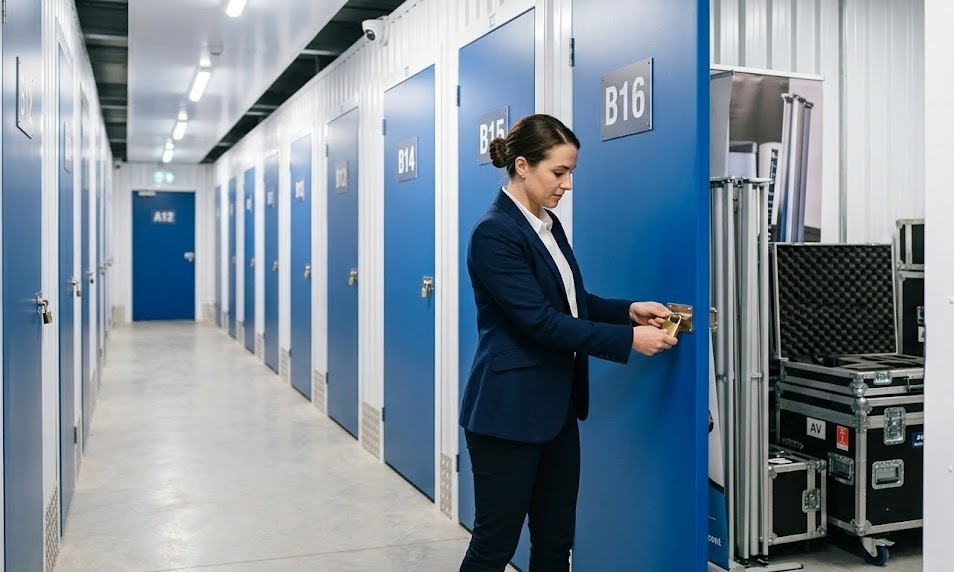
Corporate events demand precision. A single missing cable or damaged banner can derail months of planning, yet most event planners still wrestle with cluttered offices, damaged equipment, and last-minute scrambles to locate essential items. The solution isn’t buying more storage containers or renting bigger offices – it’s implementing a strategic approach to managing your AV equipment and display materials between events.
Professional event planners handle thousands of pounds worth of projectors, sound systems, lighting rigs, and branded displays. These assets represent significant investment, but they’re only valuable when they’re accessible, undamaged, and ready to deploy. Poor storage practices cost the events industry millions annually through equipment replacement, emergency rentals, and missed opportunities. Effective event AV storage has become essential for maintaining profitability and delivering consistent results.
Why event AV storage requires specialised attention
AV equipment isn’t like storing office furniture. Projectors contain sensitive optical components that degrade in humid conditions. Sound systems have delicate connections that corrode when exposed to temperature fluctuations. Display materials fade under direct light, and roller banners warp in damp environments.
We’ve seen event companies lose entire inventories because they treated technical equipment like ordinary office supplies. A £3,000 projector stored in a garden shed for six months? The lens developed fungal growth. A set of custom exhibition stands left in a garage over winter? Moisture damage made the graphics peel away from the frames.
The financial impact extends beyond replacement costs. When equipment fails during setup, you’re hiring emergency replacements at premium rates, often paying three times the normal rental fee. Your team spends billable hours troubleshooting problems that proper storage would have prevented entirely.
Categorising your event equipment for effective storage
Before you can store equipment properly, you need to understand what you’re actually storing. Most event planners accumulate gear across multiple categories, each requiring different handling.
Audio-visual equipment includes projectors, screens, microphones, speakers, mixing desks, and cables. These items demand climate-controlled environments and careful packaging to prevent internal damage. A single drop can misalign a projector’s optical system, whilst cables stored in tangles develop internal breaks that cause intermittent failures.
Display materials encompass roller banners, pop-up stands, branded backdrops, and signage. These suffer primarily from physical damage – creasing, tearing, and fading. They’re bulky but relatively lightweight, making them ideal candidates for vertical storage solutions that maximise floor space.
Lighting equipment ranges from basic uplighters to sophisticated intelligent fixtures. Heat-sensitive components need protection from temperature extremes, whilst the fixtures themselves are surprisingly fragile despite their industrial appearance.
Furniture and staging includes chairs, tables, podiums, and modular stage sections. These items consume significant space but tolerate standard storage conditions. The challenge here is accessibility – you need frequent access to mix-and-match pieces for different event configurations.
Think of your storage system like a professional kitchen. Chefs don’t throw all their tools in one drawer. Knives go in the knife block, pots hang overhead, and spices sit in labelled racks. Your event equipment deserves the same logical organisation.
Climate control: non-negotiable for technical equipment
Here’s what happens to a £2,000 projector stored in a cold, damp garage for three months: condensation forms on internal components, circuit boards develop corrosion, and lens coatings degrade. By the time you power it up for your next event, you’re facing a repair bill that exceeds the cost of proper storage.
Electronic equipment operates within specific environmental parameters. Most manufacturers recommend storage temperatures between 10-25°C with relative humidity below 60%. Exceed these limits, and you’re accelerating component degradation with every passing week.
Sound systems are particularly vulnerable. Amplifiers contain capacitors that dry out in excessive heat. Speaker cones can separate from their surrounds in humidity. Microphones develop internal corrosion that creates crackling and dropouts. These aren’t theoretical risks – they’re the predictable outcomes of inadequate presentation equipment storage.
But what about the cost? Climate-controlled storage costs more than a basic unit, but consider the alternative. Replace one damaged projector annually, and you’ve spent more than five years of proper storage would have cost. Add the emergency rental fees, staff time sourcing replacements, and reputation damage from technical failures, and the economics become overwhelming.
Packaging techniques that actually protect equipment
Original packaging exists for a reason. Manufacturers design those foam inserts and cardboard boxes to protect equipment during shipping – the same protection your gear needs in storage. Yet most event planners discard original packaging within weeks of purchase, then wonder why equipment arrives at venues with scratched casings and loose components.
When original packaging isn’t available, you need proper alternatives. For projectors and technical equipment, use rigid plastic cases with custom foam cutouts. The foam prevents movement during transport and storage, eliminating the micro-impacts that damage delicate components over time.
Cables deserve special attention. A tangled mess of XLR cables, HDMI leads, and power cords isn’t just unprofessional – it’s destructive. Internal cable damage from tight bends and knots causes intermittent failures that are notoriously difficult to diagnose. Wind each cable using the over-under technique, secure with velcro straps (never zip ties that create pressure points), and store in clearly labelled bags.
Display materials need protection from creasing and moisture. Roll banners should remain in their protective cases – never store them without cases, as the graphics will develop permanent creases. Pop-up frames need padding between sections to prevent scratching. Fabric graphics benefit from acid-free tissue paper that prevents colour transfer and moisture damage.
Consider investing in quality packaging materials specifically designed for equipment storage. Bubble wrap, furniture covers, and proper boxes aren’t expenses – they’re insurance policies against equipment damage.
Creating an inventory system that saves time and money
Here’s a scenario every event planner recognises: You’re three days from a major corporate event, and you can’t locate the wireless presentation remote. You know you own one. You’ve used it dozens of times. But right now, it could be in any of fifteen equipment boxes spread across your storage unit.
An effective inventory system eliminates these scenarios entirely. Start with a master spreadsheet listing every significant item: equipment type, model number, serial number, purchase date, and current condition. Add a location code that corresponds to specific boxes or shelf positions in your storage space.
Barcode systems take this further. Assign each equipment case a unique barcode, then scan items in and out as you pack for events. This creates an automatic audit trail showing exactly what’s deployed, what’s in storage, and what might be missing. Several free smartphone apps provide basic barcode functionality without requiring expensive dedicated scanners.
Photograph everything. When you’re quoting for an event and a client asks whether you have a specific type of backdrop, you can show them actual images of your inventory rather than relying on memory. These photos also document equipment condition, providing evidence for insurance claims if items are damaged or stolen.
Schedule quarterly inventory audits. Set aside a morning to physically verify that your spreadsheet matches reality. Test technical equipment to confirm it’s operational. Inspect display materials for damage. This proactive approach identifies problems when you have time to address them, not three hours before an event begins.
Maximising space in your storage unit
Event equipment is deceptively space-hungry. A modest inventory of AV gear and displays can easily fill a small storage unit if you’re simply stacking boxes. Strategic space utilisation can often reduce your storage footprint by 30-40%, directly cutting your monthly costs.
Vertical storage is your most powerful tool. Industrial shelving units transform floor space into three-dimensional storage, allowing you to stack equipment safely whilst maintaining accessibility. Heavy items like speakers and lighting fixtures go on lower shelves, whilst lighter display materials occupy upper levels.
Standardise your packaging where possible. When equipment cases are uniform sizes, they stack efficiently without wasted space. Custom foam inserts allow you to store multiple items in single cases – for example, a projector, its remote, and essential cables all in one protective container.
Create clear pathways through your storage space. That narrow gap between equipment stacks might save a few square feet, but it costs you twenty minutes of shifting boxes every time you need something. Design your layout so you can access 80% of your inventory without moving other items.
Label everything from multiple angles. When boxes are stacked three high, you need labels visible from the aisle, not just on top surfaces. Use large, clear text and consider colour-coding by equipment category – red labels for audio, blue for lighting, green for displays.
For event planners managing larger inventories, business storage solutions provide the space and accessibility needed for frequent equipment rotation. You’re not just storing items – you’re operating a functional equipment depot that supports your business operations.
Security considerations for valuable event equipment
Event AV equipment is attractive to thieves. Projectors, sound systems, and lighting fixtures are compact, valuable, and easily resold. A single burglary can eliminate tens of thousands of pounds in equipment, potentially destroying a small event business overnight.
Security starts with choosing the right storage facility. Look for locations with 24-hour CCTV coverage, individual unit alarms, and controlled access systems that log every entry. Perimeter fencing and adequate lighting deter opportunistic theft, whilst on-site management provides rapid response to security alerts.
Within your unit, avoid advertising your contents. Boxes labelled “Projector – £3,000” are invitations to thieves. Use coded systems that only you understand – “AV-P-001” reveals nothing to casual observers but tells you exactly what’s inside.
Consider additional insurance specifically for stored equipment. Your standard business policy may not provide adequate coverage for items in storage, particularly if they’re stored off your business premises. Specialist event equipment insurance addresses this gap, though premiums decrease significantly when you demonstrate proper presentation equipment storage practices.
Document your inventory thoroughly with photographs, serial numbers, and purchase receipts. If theft does occur, this documentation accelerates insurance claims and helps police recover stolen property. Engrave or mark equipment with your company details using UV pens – permanent enough to identify recovered items but subtle enough not to affect resale value when you upgrade.
Maintenance schedules for stored equipment
Equipment doesn’t maintain itself during storage. Batteries leak, seals dry out, and firmware becomes outdated. A maintenance schedule transforms storage from passive warehousing into active asset management.
Battery-powered equipment requires particular attention. Remove batteries from wireless microphones, presentation remotes, and portable speakers before storage. Alkaline batteries can leak within months, causing corrosion that destroys circuit boards. Even rechargeable batteries benefit from removal, as they self-discharge over time and can develop capacity issues if stored fully depleted.
Schedule quarterly testing sessions for technical equipment. Power up projectors, run sound through speakers, and cycle through lighting fixtures. This accomplishes two goals: it identifies problems whilst you have time to arrange repairs, and it prevents internal components from seizing due to extended inactivity.
Lubricate moving parts on display equipment. Roller banner mechanisms need occasional lubrication to prevent jamming. Pop-up frame joints benefit from silicone spray that keeps them operating smoothly. These simple maintenance tasks extend equipment life by years.
Update firmware on smart equipment during these sessions. Projectors, mixing desks, and intelligent lighting fixtures receive firmware updates that improve performance and fix bugs. Maintaining current firmware prevents compatibility issues when you’re integrating equipment at event venues.
Transportation planning: from storage to venue
The journey from storage to venue is where most equipment damage occurs. A carefully stored projector can suffer catastrophic damage during a poorly planned van journey. Transportation planning is as crucial as storage itself.
Invest in proper transport cases with wheels and handles. Carrying heavy equipment across car parks causes dropped items and back injuries. Purpose-built cases distribute weight properly and protect contents during movement. They’re more expensive than cardboard boxes, but they pay for themselves by preventing damage and reducing physical strain on your team.
Create event-specific packing lists that detail exactly what’s needed for each setup. This prevents the wasteful practice of transporting your entire inventory to every event “just in case”. Smaller loads mean fewer vehicle trips, reduced fuel costs, and faster setup times.
Load vehicles strategically. Heavy items like speakers and stage sections go in first, creating a stable base. Fragile equipment travels secured in the middle of the load, protected from impacts. Display materials go in last, allowing quick unloading for immediate setup.
Consider the environmental transition from storage to venue. Equipment stored in climate-controlled conditions and immediately deployed in a cold venue can develop condensation on internal components. Allow technical equipment to acclimatise for 30 minutes before powering up, preventing moisture-related damage.
When your office can’t handle the volume
Many event planners start storing equipment in office corners, spare rooms, or even their homes. This works initially, but most businesses hit a tipping point where informal storage becomes actively counterproductive.
You’ve reached that point when equipment blocks access to other items, when you’re spending more than an hour locating gear for each event, or when you’re turning down work because you literally have nowhere to store additional equipment. These are symptoms of a business outgrowing its storage infrastructure.
Professional storage solutions provide the space and conditions your equipment needs without the commitment of leasing commercial premises. Proper event AV storage facilities offer climate control, security, and accessibility – you’re paying for storage space, not the additional overheads of business rates, utilities, and maintenance that come with commercial property.
Accessibility matters significantly. Choose storage facilities that offer extended access hours or even 24-hour availability. Event work doesn’t follow office hours – you need equipment access at 6 AM on Sunday just as readily as 2 PM on Tuesday. Drive-up access eliminates the hassle of navigating lifts and corridors with heavy equipment cases.
Location impacts your operational efficiency. Storage facilities twenty miles from your office might offer lower rates, but consider the time cost of each retrieval trip. A closer facility with slightly higher rates often proves more economical when you factor in fuel, vehicle wear, and staff time.
For event planners needing reliable presentation equipment storage, container storage offers drive-up access that’s particularly valuable when loading heavy AV cases and bulky display materials.
Building a sustainable equipment management system
The difference between successful event businesses and struggling ones often comes down to systems. Talented planners with poor equipment management lose money on every event through inefficiency and equipment damage. Adequate planners with excellent systems consistently deliver profitable events.
Start by documenting your current processes. How do you currently decide what equipment to store where? How do you track what’s deployed versus what’s available? How do you maintain equipment between events? Writing down your existing approach reveals inefficiencies and gaps.
Implement changes incrementally. Overhauling your entire storage system in one weekend creates chaos. Instead, focus on one improvement each month: install shelving, create an inventory spreadsheet, photograph all equipment, implement a labelling system. These incremental improvements compound into transformative change.
Train your team on storage protocols. The best system fails if staff don’t follow it consistently. Create simple checklists for packing equipment after events, conducting inventory checks, and reporting damage. Make compliance easy by providing proper materials and clear instructions.
Review and refine quarterly. Your equipment inventory changes, your business grows, and your storage needs evolve. Schedule regular reviews of your storage system, asking what’s working, what’s frustrating, and what could improve. The best systems adapt continuously rather than remaining static.
Conclusion
Managing AV equipment and display materials effectively separates professional event planners from amateurs. The investment in proper event AV storage – whether that’s climate-controlled space, quality packaging, or robust inventory systems – pays for itself many times over through extended equipment life, reduced emergency costs, and operational efficiency.
Your equipment represents significant capital investment and the foundation of your service delivery. Treating it as a strategic asset rather than a necessary inconvenience transforms your business operations. Clients notice when your gear arrives in perfect condition, when setup proceeds smoothly because everything’s where it should be, and when technical elements perform flawlessly throughout their events.
The path forward is clear: audit your current storage situation, identify the gaps between your current approach and best practices, and implement improvements systematically. Whether you’re storing a modest collection of projectors and banners or managing a comprehensive inventory of event equipment, the principles remain consistent – protect your investment, maintain accessibility, and create systems that scale with your business growth.
If you need guidance on implementing better presentation equipment storage solutions, contact us to discuss options tailored to your specific equipment needs and business patterns.