
 01635 581 811
Running a care home means balancing compassionate resident care with practical facility management. One challenge that often catches operators off guard is resident property storage – managing the sheer volume of belongings residents bring, seasonal equipment overflow, and the constant need to maintain a clutter-free, safe environment for vulnerable adults.
When a new resident moves in, they’re not just bringing essentials. They’re bringing a lifetime of possessions – furniture that holds memories, photo albums, seasonal clothing, mobility aids they might need later, and items their families can’t bear to part with yet. Add to that the facility’s own storage needs – spare wheelchairs, festival decorations, archived records, winter bedding, and maintenance equipment – and suddenly, your designated storage areas are bursting at the seams.
The result? Corridors become cluttered, fire safety compliance becomes a worry, and staff spend valuable time searching for items instead of caring for residents. That’s where strategic care home storage makes a tangible difference to facility operations and resident wellbeing.
Why care homes run out of space
Most care facilities were designed with a specific capacity in mind, but storage requirements rarely stay static. Here’s what typically happens:
Resident belongings accumulate over time. A resident arrives with a reasonable amount of furniture and personal items. Six months later, their family has brought additional clothing, a second armchair, boxes of books, and seasonal decorations. Multiply this by 30 or 40 residents, and effective care home storage becomes essential rather than optional.
Seasonal equipment takes up permanent space. Garden furniture for summer, heaters for winter, Christmas decorations, and summer activity supplies all need somewhere to live for months at a time. Storing these items on-site means dedicating valuable square footage to things you’ll only use occasionally.
Regulatory requirements demand documentation storage. Care Quality Commission (CQC) regulations require you to maintain detailed records for several years. Even with digital systems, many homes still need physical storage for archived paperwork, medication records, and historical documentation.
Mobility equipment needs vary constantly. You might have three spare wheelchairs, two walking frames, a bath lift that’s being repaired, and a hoist that’s no longer needed but hasn’t been disposed of yet. These bulky items can’t just be shoved in a cupboard.
Think of your care home’s storage like a wardrobe that’s meant for one person’s clothes but somehow needs to accommodate an entire family’s belongings, plus sports equipment, plus everything for every season. Something’s got to give.
The hidden costs of poor storage management
When storage becomes chaotic, the problems extend far beyond just looking untidy. Here’s what we’ve seen happen:
Fire safety compliance issues. Blocked corridors, overstuffed storage cupboards, and items stacked against walls can all flag during inspections. One care home manager told us how they nearly failed an inspection because seasonal decorations were blocking a fire exit – they simply had nowhere else to put them.
Staff time wasted searching for items. When there’s no proper system for storing equipment, staff spend 10 minutes here, 15 minutes there, hunting for spare bedding or a particular resident’s winter coat. Those minutes add up to hours every week that could be spent on direct care.
Resident dignity compromised. When personal belongings get damaged because they’re crammed into inadequate spaces, or when families visit and see their loved one’s possessions treated without care, it affects the home’s reputation and the emotional wellbeing of everyone involved.
Increased risk of trips and falls. Clutter in communal areas or storage rooms creates hazards for residents, staff, and visitors. Given that falls are the leading cause of injury in care settings, this isn’t a minor concern.
What actually needs storing: a realistic assessment
Before you can develop effective care home storage solutions, you need to understand exactly what you’re dealing with. Let’s break it down:
Resident property storage challenges begin with personal belongings that exceed room capacity. Most care home rooms are compact – typically 12-15 square metres. Residents often bring furniture, clothing, and personal items suited to a much larger space. Families struggle to let go of meaningful possessions, even when there’s clearly no room.
Seasonal clothing and bedding. Heavy winter coats, summer dresses, extra duvets, and blankets all need rotation throughout the year. Storing these items in residents’ rooms creates clutter and can be overwhelming for those with dementia.
Archived records and documentation. CQC requires care homes to retain records for specific periods. Even with digital systems, many facilities maintain physical backups. These boxes accumulate quickly and can’t just be thrown away.
Medical and mobility equipment. Spare wheelchairs, zimmer frames, commodes, pressure relief cushions, and other equipment that’s either waiting to be assigned or kept as backups for emergencies.
Facility supplies and seasonal items. From Christmas decorations to summer garden furniture, from bulk supplies of continence products to spare mattresses, these items are essential but only occasionally needed.
Items awaiting family collection. When residents pass away or move to different care settings, their belongings often remain on-site for weeks or months whilst families arrange collection. This creates temporary but significant storage pressure.
Creating a practical storage strategy
The solution isn’t about finding more cupboards – it’s about creating a systematic approach that separates what needs to be on-site from what can be stored securely elsewhere.
Categorise everything by access frequency. Items needed daily stay in the facility. Things needed monthly or seasonally can move off-site. One residential home we work with keeps current season clothing and frequently used equipment on-site, whilst winter coats in July and Christmas decorations in March live in external storage.
Implement a rotation system. Rather than trying to accommodate everything simultaneously, create a schedule for swapping seasonal items. This works particularly well for clothing – swap out residents’ wardrobes twice a year, keeping the facility uncluttered whilst ensuring everyone has appropriate clothing available.
Establish clear resident property storage protocols for family belongings. Set expectations from day one about how much personal property can be accommodated. Offer secure personal storage as an option for families who want their loved one’s possessions nearby but not necessarily in their room.
Audit equipment regularly. Every quarter, review what mobility equipment and medical supplies you’re actually using versus what’s just taking up space. Donate, dispose of, or store items that haven’t been touched in three months.
Off-site storage: when it makes sense
Professional care home storage isn’t about getting rid of things – it’s about creating breathing room in your facility whilst keeping items accessible when needed.
For archived records and documentation. Once paperwork moves beyond the active consultation period, it can live securely off-site. You’ll still have it for audits or queries, but it won’t be consuming valuable office space.
For seasonal equipment and decorations. Garden furniture doesn’t need to occupy your maintenance room from October through March. Christmas decorations don’t need to live in your activities cupboard year-round. Rotate these items as needed, keeping your facility storage focused on current requirements.
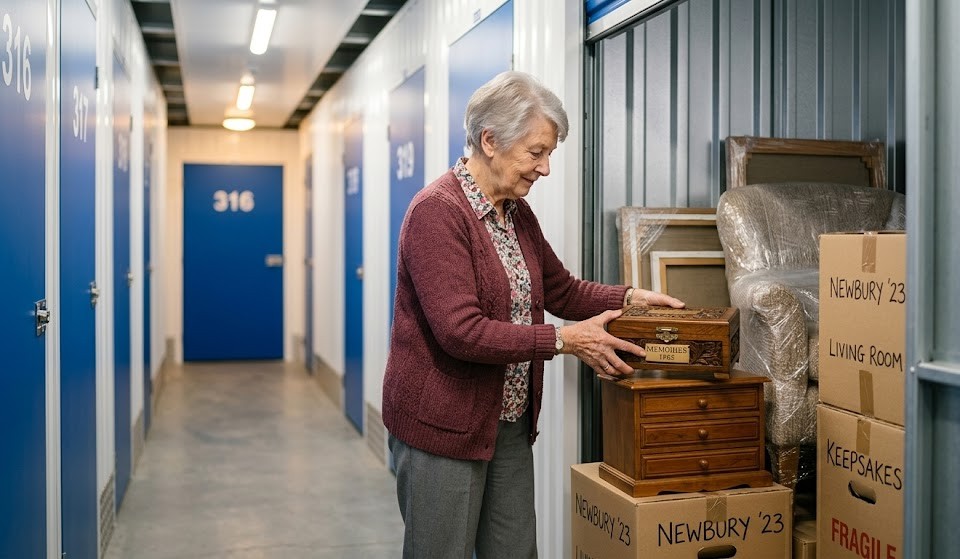
For residents’ excess belongings. Some families find comfort in knowing their loved one’s possessions are safe and accessible, even if they can’t all fit in the care home room. Offering or recommending secure storage nearby can ease the emotional difficulty of downsizing whilst maintaining dignity.
For equipment between uses. Specialist items like patient hoists or adapted bathing equipment that’s awaiting repair, or backup wheelchairs that are rarely needed, can live off-site until required.
Here’s a real-world example: A 40-bed nursing home in Berkshire was struggling with storage across their facility. They moved archived records (seven years’ worth), seasonal decorations, and backup equipment to a nearby storage unit. The result? They reclaimed an entire office that became a quiet room for families, and their maintenance team could actually find tools when needed. The monthly storage cost was less than the value of the staff time they’d been wasting searching for items.
Practical considerations for care home storage
When you’re managing storage for a care facility, certain factors become non-negotiable:
Accessibility matters enormously. You can’t have a situation where you need a spare wheelchair urgently and it’s an hour’s drive away. Look for storage that’s genuinely local – within 10-15 minutes of your facility. Drive-up access makes loading and unloading significantly easier, especially when you’re moving bulky equipment.
Security must meet your standards. Proper resident property storage means taking responsibility for residents’ belongings and sensitive documentation. Any storage solution needs robust security – 24-hour CCTV, individual unit alarms, and controlled access as a minimum.
Climate control protects valuable items. Photographs, documents, fabric items, and wooden furniture all deteriorate in damp or fluctuating temperatures. For anything with sentimental or monetary value, climate-controlled storage isn’t a luxury – it’s essential.
Flexibility accommodates changing needs. Your storage requirements will fluctuate. Perhaps you’re taking on new residents, perhaps you’re undergoing refurbishment, perhaps you need temporary space during a CQC inspection preparation. Month-to-month arrangements give you the flexibility to scale up or down without being locked into long contracts.
Organisation systems prevent chaos. It’s not enough to just move items off-site – you need a clear system for labelling, inventorying, and tracking what’s where. Use clear labelling on boxes, maintain a digital inventory, and assign responsibility for managing the storage space to specific team members.
Making the transition: a step-by-step approach
If you’re ready to address your facility’s storage challenges, here’s how to approach it methodically:
Start with a comprehensive audit. Walk through every storage area in your facility and document what’s actually there. You’ll likely discover items you’d forgotten about, duplicates you don’t need, and things that should have been disposed of months ago.
Categorise by necessity and frequency. Create three categories: must be on-site daily, needed occasionally (monthly/seasonally), and rarely accessed but must be retained (archives, backup equipment). Only the first category needs to occupy your facility’s storage.
Involve your team in the decision-making. Your activities coordinator knows which seasonal decorations actually get used. Your maintenance staff know which equipment is essential versus “just in case.” Your care team understand which residents’ belongings could be rotated seasonally. Get their input.
Communicate clearly with families. If you’re implementing new policies about personal belongings or offering storage solutions for excess items, explain the reasoning. Most families will appreciate that you’re trying to maintain a safe, dignified environment.
Establish clear processes moving forward. Once you’ve sorted your current storage situation, create protocols to prevent it becoming chaotic again. This might include quarterly audits, clear limits on personal belongings, and scheduled seasonal rotations.
The packaging and protection element
When you’re moving items between your facility and storage, proper protection becomes critical. Residents’ belongings aren’t just objects – they’re memory triggers, comfort items, and connections to identity. Damage isn’t acceptable.
Invest in proper packing materials. Boxes, bubble wrap, furniture covers, and wardrobe boxes aren’t expensive, but they make an enormous difference in protecting items during transport and storage. The packaging supplies you need for care home storage are the same ones that protect household moves – sturdy boxes in various sizes, protective wrap for furniture, and clear labelling materials.
Protect documents appropriately. Archived records need to be boxed properly, labelled clearly with date ranges, and stored in a way that prevents moisture damage. Use archive boxes specifically designed for document storage – they’re sturdier and protect better than standard cardboard boxes.
Wrap furniture carefully. Residents’ furniture often has sentimental value that far exceeds its monetary worth. Wrap wooden pieces in furniture blankets, protect upholstery with covers, and ensure items won’t rub against each other during transport or storage.
Label everything comprehensively. When you need to retrieve something six months from now, you’ll thank yourself for clear labelling. Include the resident’s name (if applicable), contents description, and date stored on every box and item.
When temporary becomes essential: refurbishment and expansion
Sometimes storage needs spike temporarily but significantly. If you’re refurbishing rooms, upgrading facilities, or expanding your care home, you’ll need somewhere to put everything whilst work happens.
Container storage can be particularly useful during major projects. You can load an entire room’s contents into a secure container, know exactly where everything is, and access it easily when the refurbishment completes. It’s like having a portable extension of your facility that appears exactly when you need it.
One care home manager described it as similar to having a spare room that only exists when you need it – you’re not paying for empty space year-round, but when you’re upgrading 10 bedrooms simultaneously, having somewhere to put 10 rooms’ worth of furniture and belongings becomes absolutely essential.
The business case: cost versus value
Let’s address the practical question: is external storage worth the cost? Here’s how to think about it:
Calculate the value of reclaimed space. If you can convert a cluttered storage room into a usable family room, quiet space, or additional office, what’s that worth to your facility? If you can clear corridors and improve safety compliance, what’s that worth in reduced risk?
Consider staff efficiency. If your team spends even 30 minutes per day collectively searching for items, that’s 2.5 hours per week, roughly 10 hours per month. At an average care home staff wage, that’s a significant cost in wasted time.
Factor in compliance and reputation. A failed CQC inspection due to storage-related safety issues can have serious consequences. Maintaining compliance isn’t just about avoiding penalties – it’s about protecting your reputation and your residents.
Account for resident wellbeing. Clutter affects people with dementia particularly severely. Creating calm, organised spaces directly improves quality of life. That’s not easily quantified, but it’s arguably the most important consideration.
For most care homes, the monthly cost of appropriate storage is comparable to a few hours of agency nursing cover. When you consider what you gain – safety, efficiency, compliance, and dignity – it’s not really an expense. It’s an investment in running your facility properly.
Building long-term storage solutions
The goal isn’t just to solve today’s storage crisis – it’s to create sustainable systems that prevent future problems. This means thinking strategically about resident property storage and how your facility manages belongings and equipment over time.
Develop clear admission protocols. When new residents arrive, have honest conversations with families about space limitations. Provide guidance on what can reasonably fit in a care home room, and offer solutions for excess belongings from day one.
Create seasonal rotation schedules. Don’t wait until storage becomes chaotic. Build regular rotation into your annual calendar – swap winter and summer clothing in April and October, rotate decorations seasonally, and review archived materials quarterly.
Assign storage management responsibility. Someone on your team needs ownership of the storage system. This doesn’t need to be a full-time role, but it does need clear accountability. Without this, systems gradually break down.
Review and adapt regularly. What works for a 30-bed facility might not work when you expand to 45 beds. What works in your first year might need adjustment by year three. Schedule annual reviews of your storage strategy and adjust as needed.
Moving forward with confidence
Managing storage in a care home doesn’t need to be a constant source of stress and compliance worry. With a clear strategy, appropriate external storage for items that don’t need to be on-site daily, and proper systems for tracking and rotating belongings, you can create a facility that’s organised, safe, and focused on what matters most – resident care.
The difference between a cluttered, chaotic facility and an organised, calm one often comes down to recognising that not everything needs to be on-site all the time. By thoughtfully separating daily-use items from occasional-use items, and by creating proper systems for managing both, you protect resident dignity, improve staff efficiency, maintain compliance, and create the kind of environment where people actually want to live and work.
If your care home is struggling with storage, don’t wait until it becomes a crisis. Start with an honest audit of what you’re storing and why, involve your team in finding solutions, and consider how strategic use of secure, accessible external storage could transform your facility’s operations. The residents, families, and staff who depend on your care home deserve an environment that’s organised, safe, and focused on wellbeing rather than wrestling with clutter.
For care homes in and around Newbury looking for practical storage solutions, get in touch to discuss how flexible storage arrangements can support your facility’s specific needs, whether that’s managing resident belongings, storing seasonal equipment, or creating space during refurbishment projects.