
 01635 581 811
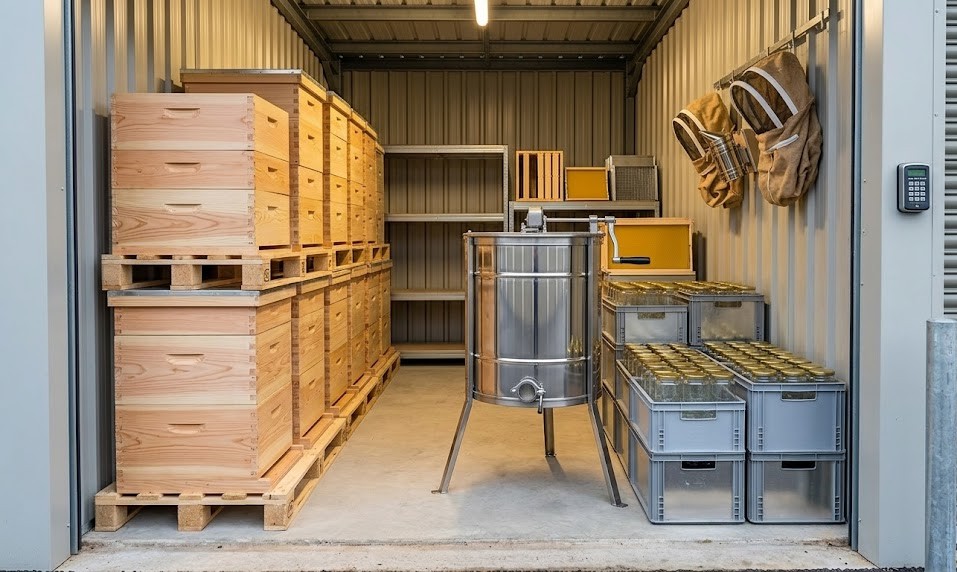
Beekeeping equipment takes up serious space, and most of it sits idle for months at a time. Between active hive components, extraction gear, bottling equipment, and protective clothing, a hobbyist with just ten hives can easily fill a garage. Scale that up to 50 or 100 hives, and you’re looking at a storage challenge that affects your home, your workflow, and your ability to maintain valuable equipment properly.
The seasonal nature of beekeeping creates a particular problem. You need instant access to supers and frames during the spring nectar flow, but those same boxes become dead weight by October. Your honey extractor earns its keep for six intense weeks, then demands floor space for the remaining 46. This rhythm of intense activity followed by long dormancy makes beekeeper equipment storage a practical necessity rather than a luxury.
Why Beekeepers Need Dedicated Storage Space
Most beekeepers start small, convinced they’ll manage with a garden shed or spare room. Then the operation grows. You add more hives. You invest in a proper extractor. You stock up on frames during a supplier sale. Before long, your partner’s patience wears thin as bee boxes colonise the hallway and spare bedroom – like trying to fit an entire library into a single bookshelf when you really need proper shelving throughout the house.
The equipment itself demands respect. Wooden hive components warp when stored in damp conditions, and wax moth larvae will devastate unprotected comb if given the chance. Your extractor’s stainless steel drum needs dry conditions to prevent corrosion. Protective suits and veils require proper hanging space to maintain their integrity. Stack everything in a damp garage corner, and you’ll replace more equipment than necessary.
Commercial operations face additional pressures. A beekeeper managing 200+ hives needs staging areas for equipment rotation, space for bulk honey processing gear, and secure storage for valuable extractors and bottling lines worth thousands of pounds. Operating from home becomes impractical when you’re moving pallets of supers and running commercial-grade equipment.
What Equipment Actually Needs Storing
The volume surprises most people. A single National hive in full production uses a brood box, two or three supers, a crown board, and a roof. That’s roughly 1.2 cubic metres per hive when stacked. Ten hives require 12 cubic metres just for the active components, before you factor in spare equipment, extraction gear, and processing tools.
Spare brood boxes and supers (most beekeepers maintain 50-100% spare capacity), frames with drawn comb requiring wax moth protection, queen excluders, crown boards, and roofs, entrance blocks and mouseguards for winter preparation, and nucleus boxes and swarm collection equipment all demand space.
Honey extraction and processing equipment includes extractors (tangential or radial models ranging from 3-frame hobbyist units to 20-frame commercial extractors), uncapping trays and heated knives, settling tanks and honey buckets, bottling equipment including heated tanks and filling nozzles, and filtering systems and straining equipment.
Protective gear and tools encompass bee suits, veils, and gloves requiring ventilation to prevent mould, smokers and hive tools, feeders (contact, rapid, and frame feeders), treatment application equipment, and scales for monitoring hive weight.
A beekeeper running 20 hives typically needs 15-20 square metres of storage space to house everything properly. That’s equivalent to a small bedroom, and it assumes efficient stacking and organisation.
Seasonal Storage Patterns Throughout the Year
Beekeeping follows a predictable annual rhythm, and your storage needs shift accordingly. Understanding these patterns helps you plan space requirements and access frequency.
Spring preparation (February-April) sees maximum equipment movement. You’re pulling supers from storage, assembling frames, and preparing hive components for the nectar flow. Everything needs to be accessible because you’re making multiple trips as colonies expand rapidly. This is when inadequate storage creates genuine problems – you can’t afford to spend hours hunting for equipment when bees are drawing comb.
Summer production (May-August) requires frequent access to extraction equipment. You’re rotating supers on and off hives, extracting honey every few weeks during peak flow, and managing the constant cycle of empty and full boxes. Your extractor moves from storage to workspace and back repeatedly. Processing equipment needs to be genuinely accessible, not buried behind winter gear.
Autumn preparation (September-October) involves putting equipment away. Supers come off hives permanently, get cleaned, and enter storage until next spring. This is your window to assess damage, identify repairs, and organise everything properly. Rush this process, and you’ll regret it when spring arrives.
Winter dormancy (November-January) represents your lowest access period. Equipment sits untouched for months. This is when climate-controlled storage proves its worth – wax moth larvae remain dormant in cool conditions, and wooden components maintain stable moisture content.
Protecting Equipment from Pests and Damage
Wax moth larvae will destroy stored comb faster than most beekeepers expect. A super of beautiful drawn comb, left unprotected in warm conditions, can become a webbed mess of tunnels and frass within six weeks. The greater wax moth (Galleria mellonella) targets stored equipment specifically, and female moths can detect beeswax from considerable distances.
Store comb in cool conditions below 10°C where larvae development slows dramatically. Stack supers with adequate airflow between boxes. Use paradichlorobenzene (PDB) crystals or acetic acid fumigation for valuable drawn comb. Inspect stored equipment monthly during warmer months. Freeze frames for 48 hours before storage to kill any existing eggs.
Mice cause different damage but equal frustration. A mouse nest built inside stored supers ruins wooden components and contaminates frames with urine and droppings. They chew through comb, destroy foundation, and leave behind mess that requires complete frame replacement. Secure storage with proper pest exclusion prevents these losses entirely.
Wooden hive components need stable humidity. Store them in damp conditions, and you’ll deal with mould growth, warping, and accelerated decay. The wood absorbs moisture, swells, and loses dimensional accuracy. Joints separate. Paint flakes. Store them too dry, and wood shrinks, creating gaps and poor fits. Aim for 40-60% relative humidity – the same range that preserves furniture and prevents warping.
Organising Equipment for Efficient Access
Random storage creates chaos when you need specific items quickly. A beekeeper searching through stacked boxes for queen excluders during a swarm emergency wastes time and loses swarms. Proper organisation means labelling everything, grouping similar items, and maintaining clear access paths to frequently used equipment.
Vertical stacking works well for hive components. Stack supers in columns of 6-8 boxes maximum, with similar sizes grouped together. Place a label on each stack indicating contents and condition. Keep your best equipment – boxes with perfect joints and undamaged frames – in the most accessible positions. Damaged or questionable equipment goes at the back for repair assessment during quiet periods.
Extraction equipment deserves dedicated space. Your extractor needs room around it for maintenance access. Store it clean and dry, with the drum interior wiped down and the tap mechanism lubricated. Keep related items together – uncapping knives with the uncapping tray, settling tanks near the extractor, bottling equipment in its own section.
Think about a small e-commerce business managing its first major stock delivery. You wouldn’t pile everything randomly in a corner. You’d create zones: incoming stock here, packed orders there, supplies in this section. Apply the same logic to beekeeping equipment. Create functional zones that match your workflow.
Seasonal rotation systems prevent the common mistake of burying summer equipment behind winter gear. Position items you’ll need first at the front of your storage space. In February, that means supers and frames. By September, it means processing equipment. Reorganise twice yearly to match the seasonal cycle.
Climate Control Considerations
Temperature stability matters more than most beekeepers realise. Wax comb stored in fluctuating temperatures develops condensation, encouraging mould growth. Wooden components expand and contract with temperature swings, accelerating wear at joints and painted surfaces. Your extractor’s bearings and seals benefit from consistent conditions that prevent moisture accumulation.
Personal storage maintains steadier conditions than most domestic garages or sheds. Garages experience wild temperature swings – below freezing on winter nights, above 30°C on summer afternoons. These extremes stress equipment unnecessarily. A proper storage facility moderates these fluctuations, even without active climate control.
Ventilation prevents the musty odours and mould growth that plague poorly stored beekeeping equipment. Stagnant air allows moisture to accumulate, particularly around stacked wooden boxes. Adequate airflow keeps everything fresh and prevents the damp smell that indicates deteriorating conditions.
Some equipment genuinely requires climate control. If you’re storing valuable drawn comb, expensive extraction equipment, or large quantities of wooden components, the investment in temperature-controlled space pays for itself through reduced replacement costs. A £2,000 extractor deserves better than a leaking shed.
Security for Valuable Processing Equipment
Beekeeping equipment holds significant value, and theft’s a genuine concern. A commercial-grade extractor costs £1,500-3,000. A complete bottling line with heated tanks and filling equipment represents £2,000-5,000 in investment. Stainless steel settling tanks, uncapping equipment, and quality protective gear add up quickly.
Garden sheds and garages offer minimal security. A determined thief with a crowbar can access most domestic storage in under two minutes. Insurance companies know this, which is why premiums increase when you’re storing valuable equipment in unsecured locations.
Professional storage facilities provide multiple security layers. Perimeter fencing, CCTV coverage, individual unit alarms, and controlled access systems create genuine deterrence. Your equipment sits behind several barriers, each requiring time and effort to breach. Most thieves target easier opportunities.
Documentation supports insurance claims if theft occurs. Photograph your equipment, record serial numbers from extractors and electrical items, and maintain an inventory with approximate values. Store this documentation separately from the equipment itself. Update it annually as you add new items or retire old ones.
Space Requirements by Operation Size
A hobbyist with 5-10 hives needs roughly 10-15 square metres of storage space. That accommodates active hive components, spare equipment, basic extraction gear, and protective clothing with room for organisation and access paths.
Mid-scale beekeepers (20-50 hives) require 20-30 square metres. You’re managing more spare equipment, larger extraction gear, possibly bulk honey processing equipment, and the accumulated tools and supplies that grow with experience. This is the point where home storage becomes genuinely impractical.
Commercial operations (100+ hives) need 40-60 square metres minimum, often more. You’re storing equipment by the pallet, managing multiple extractors, running commercial bottling operations, and maintaining substantial spare capacity for expansion and equipment rotation. At this scale, business storage becomes essential infrastructure rather than optional convenience.
Calculate your needs honestly. Measure your current equipment, add 30% for growth and spare capacity, then add another 20% for access paths and working space. Most beekeepers underestimate requirements and end up in cramped conditions that waste time and damage equipment.
Preparing Equipment for Storage
Clean everything thoroughly before storage. Propolis and beeswax residue attract pests and create sticky messes that worsen over time. Scrape hive boxes clean, removing all propolis from joints and surfaces. Wash extraction equipment with hot water, ensuring no honey residue remains in corners or crevices.
Wooden components benefit from inspection and minor repairs during the storage preparation process. Check for rot, particularly at joints and bottom edges where water accumulates. Identify loose joints requiring glue. Note any boxes needing paint refresh before next season. Address these issues now, not in March when you’re desperate to add supers.
Frames with drawn comb require special attention. Inspect each frame for wax moth damage, removing and freezing any showing signs of infestation. Stack frames in supers with adequate spacing for airflow. If using chemical protection, apply PDB crystals according to manufacturer directions, sealing boxes to contain fumigant vapour.
Your extractor needs draining completely, with all honey residue removed from the drum, tap mechanism, and cage components. Lubricate moving parts, check the cage for damage, and ensure the tap seals properly. Cover the drum opening to prevent pest entry. Store it where you won’t need to move it repeatedly – extractors are heavy and awkward.
Accessing Storage During the Active Season
Frequency matters when choosing storage location. If you’re extracting honey every two weeks during summer, you need convenient access to processing equipment. A storage unit 30 minutes away becomes frustrating when you’re making multiple trips weekly. Consider proximity alongside cost when evaluating options.
Loading access affects efficiency significantly. Container storage with drive-up access lets you load supers directly from your vehicle, saving the awkward carrying involved with indoor units. When you’re moving 20-30 supers at a time, this convenience prevents backache and speeds up the process.
Plan your visits to minimise trips. When collecting extraction equipment, grab everything you’ll need for the next month – spare buckets, filters, bottling supplies. When returning equipment, take the opportunity to collect items for upcoming tasks. Consolidating trips saves time and fuel.
Some beekeepers maintain a split storage system – frequently used items at home, seasonal equipment in storage. This works if you have adequate home space for active equipment. Keep your current supers, regular tools, and protective gear accessible. Store the bulk of spare equipment, off-season items, and processing gear you use periodically.
Cost-Benefit Analysis of Professional Storage
Calculate the true cost of home storage. If beekeeping equipment occupies a garage that could house a vehicle, you’re paying for street parking or risking weather damage to your car. If it fills a spare room, you’re sacrificing rental income or guest accommodation. These opportunity costs add up quickly.
Equipment replacement costs matter too. Wooden hive components stored in damp conditions last 5-7 years instead of 15-20. Wax moth damage destroys drawn comb worth £3-5 per frame. An extractor rusting in a leaking shed needs replacement years early. Proper storage extends equipment life significantly.
Professional storage typically costs £60-120 monthly for a 15-20 square metre unit, depending on location and features. That’s £720-1,440 annually. Compare this against replacing damaged equipment, opportunity costs of occupied home space, and the value of convenient access during busy periods.
Many beekeepers find storage costs tax-deductible as a business expense, particularly if selling honey commercially. Consult an accountant about your specific situation, but legitimate business storage often qualifies as an allowable expense against honey sales income.
Combining Storage with Workshop Space
Some beekeepers use storage units as seasonal workshops, assembling frames, repairing equipment, and preparing hives away from home. This works particularly well if you lack adequate workspace at home or if your family prefers not to share living space with sticky honey processing.
A storage unit with power access lets you run heated uncapping knives, warming cabinets, and electric extractors on-site. You can process honey entirely within the storage space, bottling and labelling without taking over the kitchen. This separation keeps home life distinct from beekeeping operations.
Workshop organisation requires planning. You need adequate lighting, a sturdy work surface, and proper tool storage. Consider whether you need water access for cleaning equipment. Some facilities offer units with sinks, which dramatically simplifies honey processing and equipment maintenance.
The packaging supplies you need for proper equipment storage – sturdy boxes for small items, bubble wrap for delicate tools, labels for organisation – are readily available. Invest in proper storage materials rather than making do with random containers. The organisation pays dividends when you’re searching for specific items during busy periods.
Making the Storage Decision
Start by auditing your current situation honestly. Measure everything you’re storing. Calculate the space it actually requires when properly organised. Assess whether your current storage conditions are genuinely adequate or simply convenient.
Consider your beekeeping trajectory. Are you maintaining current hive numbers, or planning expansion? Will you invest in better extraction equipment next year? Are you moving toward commercial production? Your storage needs will grow with your operation, so plan with some headroom.
Visit potential storage facilities before committing. Check access hours, security measures, and actual unit sizes. Ask about pest control procedures and building maintenance. Speak with other users about their experiences. A cheap unit with poor security or pest problems costs more in the long run.
Think about the relief of reclaiming your garage or spare room. Picture opening your storage unit to find everything organised, labelled, and exactly where you left it. Imagine preparing for spring without the frustration of hunting through piles of randomly stacked equipment. Professional storage isn’t an expense – it’s infrastructure that makes beekeeping more enjoyable and efficient.
Newbury Self Store understands that beekeepers need storage supporting seasonal operations, not generic warehouse space. You need facilities where hive equipment stays protected from pests, where honey extraction equipment remains accessible during active months, and where beekeeper equipment storage protects your investments year-round. We know that your beekeeping equipment isn’t just tools – it’s the foundation of producing honey and supporting vital pollinator populations.
If you’re ready to explore proper equipment storage or need advice on the right unit size for your beekeeping operation, contact us to discuss your specific requirements. We’ve helped numerous beekeepers solve their seasonal storage challenges, and we understand the unique demands of protecting valuable hive components and processing equipment.