
 01635 581 811
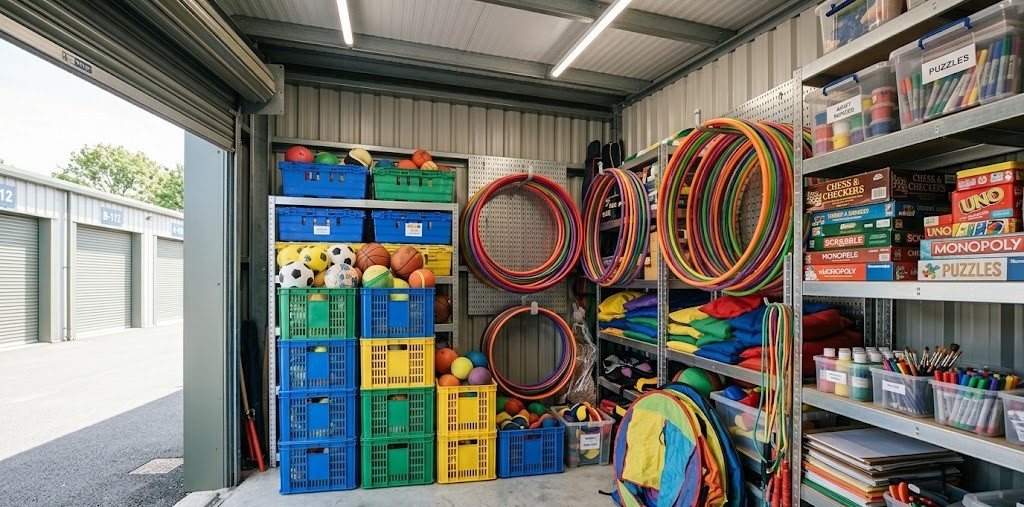
Running an after-school club means juggling dozens of responsibilities at once. You’re managing registrations, coordinating staff, planning activities, and ensuring every child stays safe and engaged. Then the school holidays arrive, and suddenly you’re faced with another challenge: what to do with all that equipment.
Sports gear, art supplies, musical instruments, board games, outdoor play equipment – it all needs to go somewhere for six weeks. Leaving it in school halls or community centres often isn’t an option, especially when those spaces are being used for holiday clubs, maintenance work, or summer lettings. Storing everything at home sounds simple until you realise you’re trying to fit £3,000 worth of club equipment into your spare bedroom.
After-school club equipment storage becomes essential during school holidays, protecting your investment whilst keeping everything organised and ready for the new term. The right storage solution means you’re not scrambling to find missing items or replacing damaged gear when September arrives.
Why After-School Clubs Need Dedicated Storage Space
Most after-school clubs operate on tight budgets. Every piece of equipment represents careful planning and fundraising efforts. A set of tennis rackets costs £200. Art supplies for a term run to £150. That parachute the kids love? Another £80.
Losing or damaging items during the holiday period directly impacts what you can offer when term restarts. If your football goals get rusty from being left outside, or your craft materials get water-damaged in a damp garage, you’re either running activities with substandard equipment or dipping into next term’s budget for replacements.
Beyond protecting your investment, proper storage solves practical problems. School premises often need complete clearance during school holidays for deep cleaning, building work, or alternative bookings. Community centres might host different groups throughout the summer. You can’t simply leave your equipment stacked in a corner and hope it’ll be there in September.
Security matters too. Equipment left in accessible areas becomes vulnerable to theft or misuse. A storage solution with proper security measures – CCTV, individual unit locks, controlled access – means you’re not worrying about your equipment throughout the entire break.
What Equipment Actually Needs Storing
Think about everything you use across a typical week of after-school sessions. The list adds up quickly.
Sports equipment takes up significant space: footballs, basketballs, netballs, tennis rackets, cricket sets, badminton nets, hockey sticks, sports cones, bibs, and goal posts. Many after-school clubs run multiple sports activities, meaning you’re storing equipment for several different games.
Arts and crafts supplies include paints, brushes, paper, card, glue, scissors, fabric, beads, clay, and all the half-finished projects children want to complete next term. These art supplies are often sensitive to temperature and humidity – cheap paint that freezes becomes unusable, and damp conditions ruin paper stocks.
Games and indoor activities cover board games, puzzles, books, LEGO sets, construction toys, and educational resources. These items might seem robust, but dampness causes board game boxes to deteriorate, and pieces get lost when everything’s packed carelessly.
Outdoor play equipment presents the biggest storage challenge. Climbing frames (if portable), balance beams, tunnels, play parachutes, skipping ropes, hula hoops, and playground toys are bulky and awkward to transport.
Administrative items also need consideration: registers, first aid kits, emergency contact details, risk assessments, and any IT equipment like tablets or laptops used for activities or admin.
One club manager ran a popular craft club with 40 kids enrolled across three weekly sessions. Every holiday, she’d load her car with boxes of supplies and store them in her dining room – her family couldn’t use the table for six weeks. She was running the club solo whilst working full-time, so the chaos multiplied. When September arrived, she’d discover paint tubes had dried out because they weren’t stored upright, paper had got damp from being stacked near an exterior wall, and she could never find the specific googly eyes or pipe cleaners she needed. She’d waste the first week of term replacing supplies and reorganising, which delayed getting activities running properly. After switching to proper storage with shelving and climate control, her setup time dropped from a week to a single afternoon.
Choosing the Right Storage Unit Size
Getting the size right matters. Too small and you’re playing Tetris with expensive equipment, risking damage. Too large and you’re paying for empty space that could’ve gone towards new resources – like renting a three-bedroom house when you only need one bedroom, wasting money on unused rooms.
As a rough guide, most after-school clubs running 2-3 sessions per week need between 35-50 square feet of storage space. That’s roughly equivalent to a small bedroom or large walk-in wardrobe.
If you run daily sessions with varied activities – sports, arts, drama, music – you’ll likely need 50-75 square feet. This accommodates the greater variety of equipment plus seasonal items like outdoor games for summer term and indoor crafts for winter.
Here’s a practical way to estimate: gather everything you’d need to store and measure the floor space it currently occupies. Then add 30% for proper organisation and access. You don’t want to stack everything floor-to-ceiling with no way to reach items at the back.
Consider future growth too. If you’re planning to expand your club or add new activities, factor that into your decision. Moving to a larger unit mid-year creates unnecessary hassle and expense.
Business storage solutions work perfectly for after-school clubs, offering the flexibility to scale up or down as your needs change throughout the year.
Packing and Organising Equipment for Storage
How you pack determines what condition your equipment will be in when term starts. Throwing everything into boxes might seem efficient in July, but it creates problems in September.
Start with a complete inventory. List every item going into storage, noting its condition. Take photos of expensive equipment. This record proves invaluable if you need to make an insurance claim, and it helps you identify what’s missing when you unpack.
Group items by activity type. All football equipment in one clearly labelled box. All art supplies together. All board games in another container. This system means you can quickly locate specific items when planning your first week back.
Use sturdy, stackable plastic boxes rather than cardboard. Cardboard deteriorates if there’s any moisture, and it provides no protection against knocks. Clear plastic boxes let you see contents without opening everything, and they stack securely.
Protect delicate items properly. Wrap anything breakable in bubble wrap. Store paints and glues upright to prevent leaking. Keep electrical items like speakers or tablets in their original packaging if possible, or wrap them carefully with plenty of padding.
Label everything clearly on multiple sides. When boxes are stacked, you need to identify contents from any angle. Include both the activity type and key items: “Art Supplies – Paints, Brushes, Paper” tells you more than just “Art Box 1”.
Create an access plan. Items you might need during the holidays should be near the front. Emergency contact details, insurance documents, and any equipment for holiday clubs you’re running separately should be easily accessible. Seasonal items for September can go towards the back.
Think of it like packing for a long trip. You wouldn’t bury your passport at the bottom of your suitcase under clothes you won’t need for days. Apply the same logic to your storage unit.
Protecting Different Types of Equipment
Different materials need different care during storage. Getting this wrong means replacing items unnecessarily.
Sports equipment generally tolerates storage well, but deflate balls slightly to prevent pressure damage. Wipe down any equipment that’s been used outdoors to remove dirt and moisture. Metal items like goal posts should be dry before storage to prevent rust.
Art supplies are temperature-sensitive. Water-based paints can freeze and separate. Glue can dry out or become unusable in extreme heat. If possible, choose a climate-controlled storage option, or at least ensure supplies are well-insulated and stored in sealed containers.
Fabric items like sports bibs, costumes, or soft play equipment should be clean and completely dry before storage. Damp fabric develops mould and mildew, creating unpleasant odours and potential health hazards. Consider vacuum storage bags for bulky fabric items – they save space and protect against moisture.
Electronic equipment needs protection from temperature extremes and humidity. Remove batteries from items like remote controls or handheld games – batteries can leak and cause corrosion. Wrap devices in bubble wrap and store them in sealed plastic boxes.
Paper-based resources like books, worksheets, or craft paper deteriorate quickly in damp conditions. Store them off the floor, ideally on shelving, and ensure they’re in sealed containers. Silica gel packets inside boxes absorb excess moisture.
Musical instruments require particular care. Guitars and violins need stable humidity levels. Recorders and percussion instruments should be clean and dry. If you store valuable instruments, climate control becomes essential.
Proper packaging materials make a significant difference. Investing in quality boxes, bubble wrap, and protective covers now prevents costly replacements later.
Security Considerations for Club Equipment
Your equipment represents significant investment, often funded through parent contributions, fundraising events, or tight local authority budgets. Protecting it isn’t just about avoiding financial loss – it’s about maintaining trust with parents and ensuring activities continue smoothly.
Choose a storage facility with robust security measures. Look for CCTV coverage, individual unit alarms, secure perimeter fencing, and controlled access systems. Each unit should have its own lock, with you controlling who has keys or access codes.
Limit access to essential people only. Decide who genuinely needs to access the storage unit during holidays. Typically, this might be the club manager and one deputy. More people with access means more potential for security issues.
Keep an updated inventory that includes serial numbers for valuable items like tablets, cameras, or musical instruments. If theft does occur, detailed records help with insurance claims and police reports.
Review your insurance coverage. Check whether your existing policy covers equipment stored off-site. Some policies have specific requirements about storage security standards. If your current cover doesn’t extend to storage, arrange additional protection.
Consider what you’re storing together. High-value items like IT equipment or musical instruments might warrant extra precautions. Some clubs choose to store particularly valuable items separately or take them home rather than leaving them in storage.
Security isn’t about being paranoid – it’s about being sensible. You wouldn’t leave £3,000 worth of equipment in an unlocked shed. Apply the same thinking to your storage choices.
Cost Management and Budgeting
Storage costs money, but losing or replacing equipment costs more. The key’s finding the right balance for your budget.
Calculate your current equipment value. Add up what it would cost to replace everything you own. Most established after-school clubs have £2,000-£5,000 worth of equipment. That figure helps justify storage costs when presenting budgets to committees or funders.
Compare storage options realistically. The cheapest option isn’t always the best value. A facility 20 miles away might have lower monthly fees, but factor in fuel costs and time for multiple trips. A slightly more expensive facility closer to your school or home might actually cost less overall.
Consider shared storage with other clubs. If you know another after-school club or community group facing the same challenge, sharing a larger unit can reduce costs for everyone. This works best when you establish clear agreements about space allocation and access.
Look at term-time versus holiday-only storage. Some clubs need year-round storage because they lack on-site space. Others only need storage during school holidays. Storage options often offer flexible terms that accommodate seasonal needs.
Factor storage into your annual budget from the start. Storage shouldn’t be a surprise expense each July. Build it into your planning alongside insurance, equipment replacement, and venue hire. This approach makes costs manageable and ensures you’re not scrambling for funds at the last minute.
Explore funding options. Some local authorities provide grants for after-school provision that covers operational costs including storage. Parent-teacher associations might contribute. Local businesses sometimes sponsor community groups. Don’t assume you have to absorb all costs yourself.
One club coordinator ran sessions for 35 children weekly with a mixed programme of sports, arts, and drama. She calculated that proper storage cost £45 per month during the six-week summer holiday – that’s £270 total. The previous year, before they used storage, they’d lost or had to replace about £400 worth of damaged equipment: two footballs that went flat and couldn’t be found for repair, paint that froze and separated in someone’s garden shed, and a set of board games that got water damage. The storage not only paid for itself but gave her peace of mind, and she wasn’t imposing on her family’s living space anymore.
Making Collection and Delivery Easier
The logistics of moving equipment to and from storage can feel overwhelming, especially if you’re doing it alone. Planning ahead makes the process manageable.
Choose a storage facility with good vehicle access. Drive-up units or ground-floor facilities with trolley access save enormous effort. Carrying boxes up stairs or across car parks adds unnecessary difficulty.
Schedule collection strategically. Don’t try to move everything on the last day of term when you’re already exhausted. If possible, start moving non-essential items a week or two before term ends. This spreads the workload and reduces stress.
Recruit help for the heavy lifting. Other staff members, parent volunteers, or older students on community service hours can assist. Make it a team effort rather than a solo mission. Provide clear instructions about what goes where.
Use proper equipment for transport. Trolleys, sack barrows, or folding wagons make moving multiple boxes easier. Many storage facilities provide trolleys for customer use. If you’re making multiple trips, invest in or borrow equipment that protects your back.
Plan your unit layout before you start loading. Know where different categories of equipment will go. Create pathways so you can access items without unpacking everything. Place frequently needed items near the front.
Document what you store. Take photos of your organised unit. This visual record helps when you’re trying to remember what’s where, and it’s useful for insurance purposes.
Schedule retrieval with enough time before term starts. Don’t plan to collect everything the day before your first session. Give yourself at least a week to retrieve items, check their condition, and identify anything that needs replacing or repairing.
Container storage offers particularly convenient access for clubs with large amounts of equipment, providing drive-up access that makes loading and unloading straightforward.
Alternative Storage Solutions and Why They Often Fall Short
Before committing to proper storage, many after-school clubs try alternative solutions. Understanding why these often don’t work helps justify the investment in professional storage.
Storing equipment at home seems free and convenient until you’re living around boxes for six weeks. Your family loses living space. Items get mixed up with household belongings. If something happens – a leak, a break-in – your home insurance might not cover business equipment.
Leaving equipment at school works only if the school explicitly agrees and provides secure space. Many schools need complete clearance for cleaning, maintenance, or holiday lettings. Equipment left without permission might be moved, damaged, or disposed of.
Using a committee member’s garage or shed creates similar problems to home storage, plus additional complications if that person moves, leaves the committee, or has a falling out with the group. Domestic outbuildings often lack security and climate control.
Piling everything into cars is impractical for more than minimal equipment. It ties up vehicles, risks damage, and creates security concerns if cars are parked on streets or in unsecured areas.
Renting the cheapest available space without checking security, access, or conditions can cost more in the long run. Equipment damaged by damp or stolen from an insecure facility needs replacing.
Professional storage exists because these alternatives have limitations. When you’re responsible for other people’s money and children’s activities, proper solutions matter.
Preparing for the New Term
The real test of good storage comes when you retrieve everything for the new term. Proper preparation means you’re ready to start strong rather than scrambling to replace missing items.
Schedule retrieval with plenty of time. Collect equipment at least a week before your first session. This buffer allows you to identify problems, order replacements, and organise everything properly.
Check inventory against your original list. Confirm everything’s accounted for and in good condition. Note anything damaged or missing immediately.
Clean and prepare equipment before first use. Even items stored carefully might need a quick wipe-down. Check sports equipment for wear, test electronic items, and ensure art supplies are still usable.
Restock consumables. Storage is a good time to assess what you’ve used up and what needs replacing. Order new supplies before term starts rather than running out during your second week.
Review what worked and what didn’t. Did your packing system make retrieval easy? Was the unit size right? Did everything stay in good condition? Use these insights to improve your process for next time.
Update your inventory system. Note any items retired or replaced. This ongoing record keeps your equipment list accurate and helps with budgeting and insurance.
The goal isn’t just storing equipment – it’s ensuring your after-school club can restart smoothly, offering the same quality activities children and parents expect.
Making Storage Work Long-Term
Once you’ve established a good storage system, maintaining it becomes straightforward. Consistency matters more than perfection.
Keep your packing system. Use the same boxes, labels, and organisation method each time. This consistency means anyone on your team can pack or retrieve items without confusion.
Review your storage needs annually. As your club grows or activities change, your storage requirements might shift. Don’t stay in an unsuitable unit because it’s what you’ve always used.
Maintain relationships with your storage provider. Good communication helps if you need to adjust your unit size, extend your rental period, or access your unit outside normal hours.
Budget for storage as an operational cost. Treating it as essential infrastructure rather than an optional extra ensures it’s always available when needed.
Share your system with your team. Document your approach so other committee members or staff can manage storage if you’re unavailable. This knowledge-sharing prevents your club from depending on one person’s memory.
After-school clubs provide invaluable support for working families and enriching experiences for children. Protecting the equipment that makes these activities possible isn’t an administrative detail – it’s fundamental to your club’s success. Proper storage during school holidays ensures every new term starts with everything you need, in good condition, ready to create more positive experiences for the children you serve.
Newbury Self Store understands that after-school clubs operate on tight budgets and need storage solutions that protect equipment investments without breaking the bank. You need facilities where sports equipment stays rust-free, where art supplies remain usable, and where everything’s organized for quick September retrieval. We know that your equipment isn’t just gear – it’s the foundation of activities that working families depend on and children look forward to.
If you’re planning ahead for the next school holiday period, contact us to discuss storage options that work for your after-school club’s specific needs and budget. Proper storage protects your investment and ensures children never miss out on activities because equipment was lost or damaged during the holidays.