
 01635 581 811
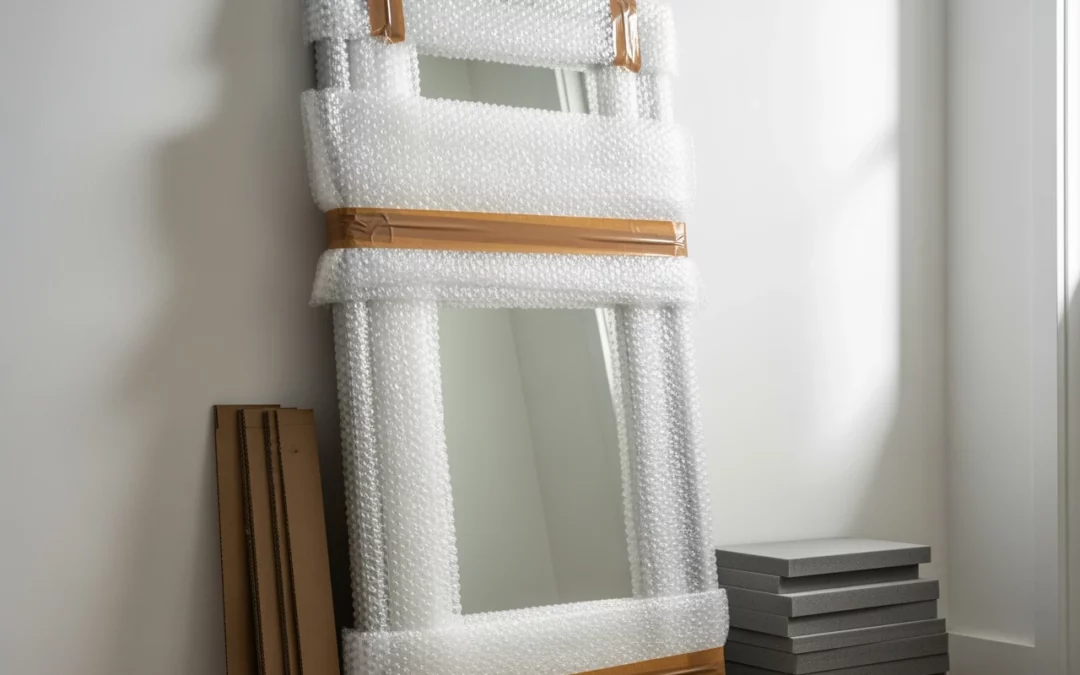
Mirrors represent more than decorative items or functional necessities. They are often expensive investments, family heirlooms, or architectural features that define a room’s character. Yet despite their value, they are among the most vulnerable items during moves and storage. A single crack transforms a pristine mirror into a safety hazard and a financial loss.
The risk is not just about dropping a mirror during transport. Most damage occurs during storage itself, when pressure builds over weeks or months, when temperature swings stress the glass, or when inadequate protection allows surfaces to scratch against packing materials. Knowing how to store mirrors safely requires understanding both the immediate threats and the gradual forces that compromise glass integrity over time.
Why Mirrors Break in Storage
Glass appears solid, but it contains internal stresses that concentrate at weak points when support is inadequate. The edges and corners are particularly vulnerable because they lack the structural support found in the mirror’s centre. Stack boxes on top of a mirror, lean items against it, or store it flat with uneven weight distribution, and you have created stress points that will eventually result in fractures.
Temperature fluctuations present another serious threat. Glass expands and contracts with temperature changes, and the backing material (whether wood, plastic, or metal) expands at a different rate. This differential movement creates internal stress that accumulates over weeks and months. I have seen mirrors that survived professional house moves crack weeks later in storage because someone placed a heavy box against one corner.
Vibration damage develops gradually and is often completely invisible until a fracture becomes visible. If your storage unit sits near a busy road, loading dock, or area with frequent foot traffic, the cumulative effect of small vibrations can weaken the glass structure over time. The mirror does not crack from a single vibration, but from thousands of tiny movements that propagate microfractures through the glass.
Essential Materials for Mirror Protection
Proper mirror storage begins with quality materials. Start with clean packing paper or newsprint for the initial layer. This creates a buffer between the glass and any harder protective materials. Avoid using newspaper directly on the glass, as ink can transfer and become difficult to remove, particularly during long-term storage.
Corner protectors are non-negotiable for storing mirrors safely. These foam or cardboard guards distribute pressure away from the most vulnerable points. You can purchase purpose-built mirror corner protectors, or create effective versions from cardboard sheets folded into triangular profiles. Each corner needs individual protection, not just tape wrapped around the edges.
Bubble wrap provides the cushioning layer, and size matters. Large bubble wrap with bubbles approximately 25mm in diameter works better than small bubble wrap for mirrors. The larger air pockets create better shock absorption and distribute pressure more evenly. For the final rigid outer layer, cardboard sheets or purpose-made mirror boxes provide a solid barrier against impacts and prevent flexing during storage. All these storage-ready packaging materials are available in one place, saving preparation time.
Step-by-Step Mirror Wrapping Technique
Surface preparation determines how well your wrapping performs. Clean the mirror thoroughly with glass cleaner, removing dust, fingerprints, and any residue. Particles trapped between the glass and wrapping materials can scratch the surface during movement or when pressure compresses the protective layers. Let the mirror dry completely before wrapping.
Apply the first layer of packing paper directly to the glass surface. Lay the mirror face-up on a clean, soft surface, then drape packing paper across the entire face. Secure it with painter’s tape along the edges, never applying tape directly to the mirror’s reflective surface. Install corner protectors before adding bubble wrap, sliding them over each corner and securing them to the mirror’s backing only.
Wrap bubble wrap around the entire mirror with the bubbles facing toward the glass for the first layer, then add a second layer with bubbles facing outward. This dual-layer approach provides both cushioning and puncture resistance. Secure the bubble wrap with packing tape wrapping around the entire perimeter, then create the cardboard shell by cutting sheets slightly larger than the mirror dimensions and taping one to each face. Seal all edges completely to prevent flexing.
Choosing the Right Storage Position
The fundamental rule for wrapping mirrors for storage is this: store mirrors vertically, never flat. Vertical storage distributes weight along the mirror’s strongest axis rather than concentrating pressure on the glass surface. Think of it like storing plates: you stand them on edge in a dish rack, not stack them flat where weight accumulates.
When storing mirrors vertically, ensure they lean slightly backward at about 5 to 10 degrees from vertical against a solid wall. This angle prevents the mirror from tipping forward whilst the wall provides stable support. Create separation between the mirror and the wall using foam strips or cardboard spacers. This gap allows air circulation and prevents the mirror from resting directly against potentially rough wall surfaces.
For multiple mirrors, store them side by side rather than stacked. Insert cardboard sheets between each mirror to prevent glass-to-glass contact. Support the bottom edge with foam padding, folded blankets, or purpose-built mirror stands running the entire width of the mirror, not just at the corners. Even with protective wrapping, direct contact between mirrors can cause scratches if they shift during storage.
Newbury Self Store: Consistent Conditions for Mirror Preservation
Newbury Self Store provides facilities that maintain stable conditions, protecting vulnerable items from garage or attic storage. This consistency prevents the thermal stress that causes mirrors to crack weeks or months into storage, even when they appeared perfectly wrapped and positioned at the time of placement.
I once helped a client who stored an antique cheval mirror in her garage for six months. The mirror had survived two house moves without damage, but garage storage in summer heat caused the wooden backing to warp. The warping created uneven pressure that cracked the glass in three places. The same mirror would have remained pristine in climate-controlled storage, where temperature stability prevented the wood movement that caused the damage.
This real-world outcome illustrates precisely why home storage spaces rarely meet the requirements for wrapping mirrors for storage to be a complete long-term solution. Professional facilities eliminate the variables that cause delayed damage long after the initial packing has been done correctly.
Common Mistakes That Cause Mirror Damage
Insufficient corner protection ranks as the most frequent error when people attempt to store mirrors safely. People wrap mirrors thoroughly in bubble wrap but neglect the corners, where the majority of storage damage occurs. A mirror can survive pressure on its face but will crack immediately if a corner receives a sharp impact. Always reinforce corners with dedicated protectors, not just extra layers of bubble wrap.
Storing mirrors flat is another surprisingly common mistake. Flat storage concentrates the mirror’s entire weight on its central glass surface, the area least able to handle sustained pressure. Add a few boxes on top, and you have created ideal conditions for stress fractures to develop over weeks.
Using plastic wrap directly on glass creates problems during temperature changes. Plastic wrap can trap moisture against the mirror surface, and temperature fluctuations cause this moisture to condense. The result is water spots, backing damage, or in extreme cases, delamination of the reflective coating. Always use packing paper as the first layer.
Professional Storage Solutions
Self-storage facilities offer significant advantages for valuable mirrors that home storage cannot match. Climate-controlled units maintain the temperature and humidity stability that prevents thermal stress and backing damage. Secure personal storage with 24-hour surveillance and individual unit access controls provides protection that home garages or attics cannot offer for antique or designer pieces.
Expand storage capacity with dedicated business units for interior designers, property developers, or staging companies managing multiple mirrors across different projects. Having a secure, organised space for inventory prevents the handling damage that occurs when pieces are moved in and out of unsuitable temporary locations repeatedly.
Ground-floor spacious drive-up units simplify mirror transport significantly. You can reverse your vehicle directly to the unit door, minimising the distance you carry the mirror and reducing the handling risks that cause the majority of accidental damage. This accessibility proves invaluable when storing large architectural mirrors or multiple pieces at once.
Protecting Your Investment
Mirrors combine beauty, function, and often significant monetary or sentimental value. Proper storage techniques protect these investments from the multiple threats that compromise glass integrity. The process requires quality materials, careful wrapping, correct positioning, and stable environmental conditions working together.
The difference between a mirror that emerges from storage in pristine condition and one that is cracked or scratched often comes down to details: corner protection, vertical storage, climate control, and proper wrapping. Skip any of these elements, and you have created a vulnerability that time and storage conditions will exploit.
Whether you are storing mirrors during a house move, renovations, or long-term downsizing, knowing how to store mirrors safely using the techniques outlined here will preserve their condition. Invest the time in proper preparation, choose appropriate storage conditions, and your mirrors will emerge from storage exactly as you left them.
Call 01635 581 811 or contact us to discuss climate-controlled storage options that keep your mirrors safe and undamaged.