
 01635 581 811
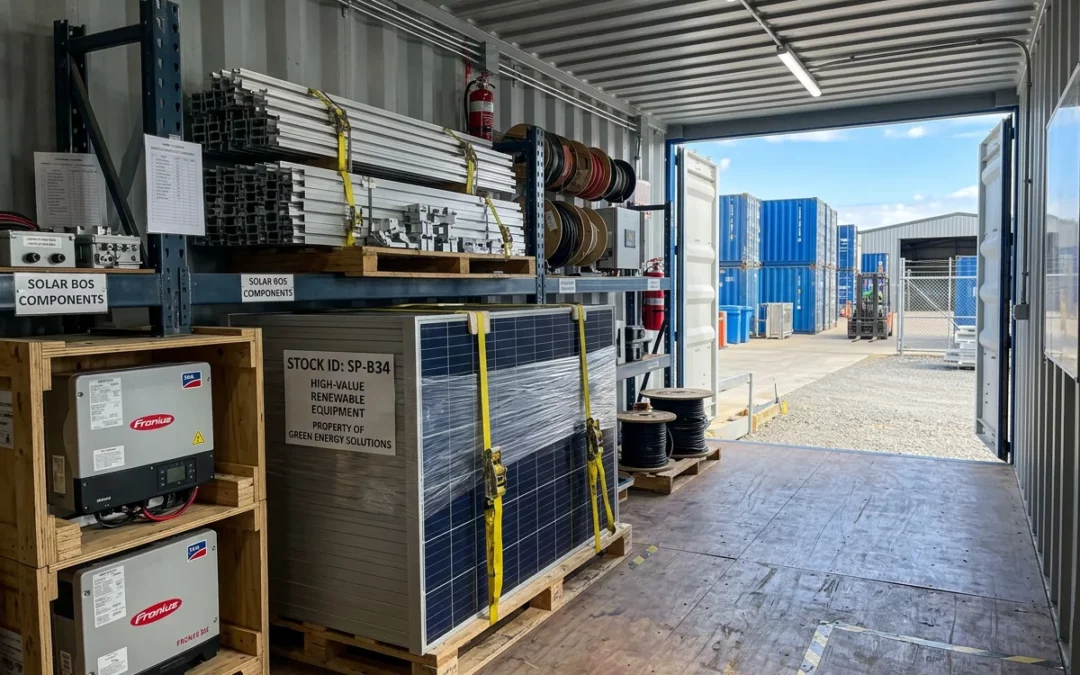
You’ve won the contract, your crew is ready, and then you spend the first hour of the morning hunting for mounting brackets buried somewhere in a disorganised garage. That’s not a skills problem. That’s a storage problem, and it’s costing you more than you realise.
Many solar installation businesses in Newbury carry tens of thousands of pounds worth of stock with no proper home for it. Finding reliable, secure space for solar panel storage, along with inverters and specialist installation equipment, is one of the most overlooked challenges in the trade. Most installers only fix it after something goes wrong.
A single pallet of premium solar panels can be worth £3,000 to £5,000. Add inverters at £1,200 each, mounting systems, and the rest of your kit, and you’re holding stock worth more than most work vehicles. Keeping it in a garage or leaving it exposed in a yard isn’t just inconvenient; it’s a direct threat to your insurance cover, your warranties, and your ability to respond to new work quickly.
The installers who pull ahead in this market understand something their competitors don’t: professional renewable energy installer storage isn’t an overhead to be minimised. It’s the infrastructure that keeps your business moving. When your equipment is secure, organised, and ready to deploy at short notice, you can say yes to contracts that less-prepared competitors have to turn down.
The True Cost of Inadequate Equipment Storage
Weather damage is the most common, and most preventable, loss for renewable energy installers. Solar panels are built to survive decades outdoors once installed, but solar panel storage has very different requirements. Panels left outside face moisture at junction boxes, frame corrosion from ground contact, and micro-cracking from temperature changes. These faults often stay hidden until installation, when testing reveals reduced output or complete failure.
I worked with one Newbury installer who lost £8,000 worth of panels to moisture damage after a particularly wet autumn. The panels had been stored in a “waterproof” shipping container that developed condensation from temperature fluctuations. The manufacturer voided the warranty because storage conditions violated their terms. That single incident wiped out the profit margin on three completed installations.
Theft is the other serious concern. Solar equipment is high-value, easy to move, and simple to sell on. Inverters are a prime target; they’re compact and worth over £1,000 each. One theft can delay a project by weeks while you wait for replacement stock. That delay leads to penalty clauses, unhappy clients, and potential contract losses. Insurance replaces the equipment, but it won’t cover the damage to your reputation or schedule.
Disorganised storage adds up in quieter ways, too. Thirty minutes spent searching for a specific bracket or connector is 30 minutes of billable time wasted. Ordering duplicate parts because you couldn’t check stock quickly ties up cash you could use elsewhere. Hesitating to quote on a new job because you’re unsure what equipment you have available means missed opportunities that never show up on any spreadsheet.
What Renewable Energy Installers Actually Need to Store
Solar panels and photovoltaic modules make up the bulk of most installers’ stock. A standard residential job needs 10 to 16 panels, while commercial projects can run into the hundreds. Each panel is roughly 1.7 metres by 1 metre and must be stored vertically or at a slight angle to prevent warping. They’re sensitive to pressure, so stacking them without proper support causes damage.
Inverters and electrical components need climate-controlled storage. The circuitry inside these devices degrades quickly in high humidity or extreme temperatures. String inverters, microinverters, optimisers, and battery systems all have specific safe storage ranges, typically 5°C to 30°C. Go outside those limits and you risk both product failure and voided warranties.
Mounting systems and racking equipment take up real space. Aluminium rails, brackets, clamps, and roof-specific flashing components build up quickly across multiple projects. While they’re not temperature-sensitive, they still need organised storage to prevent damage and speed up job preparation. A well-arranged hardware section means your crew can pick everything for a specific roof type in minutes, not hours.
Tools and installation equipment represent a significant financial investment. Items like torque wrenches, cable crimpers, insulation testers, and thermal cameras need secure storage and regular maintenance. Many installers keep backup sets to ensure a single equipment failure doesn’t bring a job to a halt.
Compliance paperwork and documentation also needs a home. Installation certificates, warranty records, test results, and building notifications must be kept for years. Digital copies are standard practice, but many insurers and regulators still require the physical originals for specific periods.
Why Standard Storage Solutions Fall Short
Domestic garages feel convenient at first, but they quickly become limiting for a growing installation business. The average garage gives you roughly 20 square metres; enough for around 40 panels, a handful of inverters, and basic tools. That works for one or two jobs a month. The moment you’re juggling concurrent projects or buying in bulk to save money, that space runs out fast.
Temperature control is the bigger issue. Newbury winters drop below freezing, and summer temperatures can climb past 30°C. Electronic components can’t handle that kind of variation without long-term damage. Ultimately, you’d be choosing between convenience and protecting your stock, and that’s not a trade-off that supports a sustainable business.
Commercial yard storage may look cheaper on paper, but the security risks change that calculation. A shipping container in a yard is an obvious target. Even with padlocks, it’s relatively easy to breach. Thieves know exactly what’s inside and that it sells quickly. As a result, insurance premiums for yard storage often run 30% to 50% higher than for a secure facility.
Rented workshop space solves some problems but creates others. Leases typically lock you in for three to five years, with rent that only goes up. You’re paying for the space at all hours, even if your team only needs it during working hours. For a business with seasonal peaks and quiet months, that kind of fixed cost is genuinely hard to justify.
The Business Case for Professional Storage
Equipment warranties come with storage conditions attached, and many installers don’t check those conditions until they need to make a claim. Solar panel manufacturers typically require storage temperatures between 10°C and 40°C, with humidity below 75%. Inverter manufacturers are often stricter still. If you can’t meet those conditions, you’re voiding warranties worth thousands of pounds before the equipment has even been installed.
Think of equipment warranties like insurance policies: they’re entirely worthless if you’ve violated the terms. Climate-controlled storage isn’t just about keeping panels dry. It’s about protecting the financial cover those warranties represent. When a £2,000 inverter fails under warranty and the manufacturer pays out because you can prove proper storage conditions, that single claim can cover a full year of storage costs.
Good storage also makes project scheduling far simpler. When a new contract comes in, you can immediately check what equipment you have, pull what’s needed, and get your crew moving without delay. That speed and reliability separates installers who hit deadlines consistently from those who are always scrambling. Clients notice the difference, and many are willing to pay a premium for it.
Seasonal patterns affect most Newbury installers. Work picks up in spring and summer when conditions are right and homeowners are focused on energy bills. Flexible storage that scales up during busy periods, without forcing you to pay for that extra space all year round, makes a real difference to your margins.
Business growth often stalls because taking on more work means committing to expensive premises. Newbury Self Store offers a better option: professional renewable energy installer storage that grows with your business. You get the security and conditions your equipment needs, with the flexibility to scale without long-term financial risk.
Setting Up Your Storage Unit for Maximum Efficiency
Zone-based organisation is the single most effective improvement you can make to your storage setup. Divide the unit into clear areas: panels, electrical components, mounting hardware, tools, and paperwork. It sounds simple, but without that structure, units gradually become chaotic and difficult to work from.
Panels must be stored vertically with proper support. Purpose-built panel racks are ideal, but solid shelving with panels stored on edge works well too. Never stack panels flat; the weight causes micro-cracking in the lower units over time. Use cardboard or foam separators between panels to prevent scratching, and keep them away from external walls where temperature fluctuations are most severe.
Inverters and electronics belong in the most stable part of the unit, ideally a central position away from external walls. Keep them in original packaging wherever possible; it’s designed specifically to protect against the conditions they’re most vulnerable to. Attach an inventory list to each shelf showing contents, quantities, and serial numbers. This makes warranty tracking straightforward and speeds up job preparation.
Mounting hardware works well in a bin system. Clear plastic bins let you see contents instantly, and labels prevent the need to open every container during preparation. Group bins by roof type: tile, slate, metal, and flat roof. Your crew can then grab everything needed for a specific job in a single pass through the unit.
Tool storage needs to balance security with quick access. Lockable cabinets protect high-value items like thermal cameras and electrical testers. Pegboard systems work well for everyday hand tools, making it immediately obvious when something is missing. A simple checkout log for any tools leaving the unit keeps equipment from drifting off into vans or job sites unaccounted for.
Documentation needs protection from moisture and reliable organisation for quick retrieval. Filing cabinets organised by year and client name work consistently well. Keep current-year files at the front and archived records towards the back. Many installers scan documents immediately as a primary record and keep physical copies as backup, but that backup needs to be organised properly to be useful years down the line.
Storage Solutions for Different Business Stages
Sole traders and small teams usually start with 50 to 100 square feet. That’s enough for roughly 60 panels stored vertically, a dozen inverters, hardware for various roof types, and essential tools. Self storage units at this size provide the secure storage and access control that a domestic garage can’t match, at a cost that makes sense for a business in its early growth phase.
Established installers managing five to ten projects at once typically need 150 to 200 square feet. With that space, bulk purchasing becomes viable. Buying panels by the pallet and inverters by the case can reduce costs by 15% to 20%, which adds up significantly across a full year of projects. Larger units also allow you to stock different panel specifications, so you can match client budgets without waiting on deliveries.
Growing businesses reach a point where variety matters as much as volume. Handling residential, commercial, and ground-mount projects means stocking different equipment profiles. A business storage unit at 200 to 300 square feet supports that range while keeping things well organised. Separate zones for residential and commercial stock prevent the kind of mix-ups that send the wrong parts to a job site.
Commercial-scale operations handling large projects need storage built for palletised deliveries. When solar panel storage runs to 200 units or more, equipment arrives on pallets that need to stay intact until the job starts. Shipping container storage is the practical solution at this scale, allowing efficient vehicle loading without manually carrying equipment long distances. Many operators at this level also use multiple units to keep current project stock separate from general inventory.
Protecting Your Investment During Storage
Climate control is non-negotiable for inverters and electronic components. The annual cost of climate-controlled storage, typically £200 to £300 more per year, is minor compared to replacing a single inverter that failed from moisture exposure. Circuit boards corrode progressively in high humidity. Each additional day in poor conditions increases the likelihood of failure, sometimes months or years later when the warranty cost falls on you.
Good security means individual unit alarms, CCTV coverage, and controlled site access. The best facilities fit each unit with its own alarm that notifies you directly if triggered. CCTV deters opportunistic theft and provides evidence when something does happen. Controlled site access limits who can enter the facility, removing the vulnerability that open-yard storage creates.
Insurance costs are often overlooked when comparing storage options. Where you store equipment directly affects your business insurance premium. Insurers charge significantly more for inadequate storage locations, and some won’t cover equipment in domestic garages or outdoor containers at all. When you factor in the insurance savings from professional secure storage, the actual cost difference is usually much smaller than it first appears.
Packaging matters more than most installers expect. Panels should stay in original packaging or be wrapped in protective material. Inverters and electronics must be sealed against dust and moisture. For small items like bolts and clamps, protective packing materials such as sealed bags and moisture-barrier wrapping prevent the slow rust and corrosion that quietly degrades component quality during long storage periods.
Long-Term Storage Strategies for Growing Installers
Inventory management becomes more important as your storage costs grow. Many installers shift to a just-in-time approach for longer projects, ordering equipment closer to the installation date rather than holding everything in stock immediately. This reduces storage needs but depends on reliable suppliers and accurate project scheduling. The right balance between bulk discounts and holding costs varies by business; it’s worth reviewing regularly.
Seasonal adjustments help you match costs to activity levels. If installation work falls 40% during winter, consider downsizing your unit during that period or negotiating flexible terms with your provider. Some installers keep a small permanent unit for tools and equipment that’s difficult to move frequently, then add temporary space during peak season to handle increased inventory.
Multi-unit setups work well when you’re managing different types of work. Using separate units for residential and commercial installation equipment, or keeping current project stock apart from general inventory, prevents the mix-ups that send the wrong parts to a job site. It also makes project preparation faster and cleaner.
Your record-keeping system should track what you own, where it’s stored, and when it was purchased. Spreadsheets work fine for smaller operations. Larger businesses benefit from inventory software that logs serial numbers, warranty periods, and storage locations. When a warranty claim arises, being able to produce the purchase date, serial number, and storage history immediately is often the difference between a successful claim and a rejected one.
Making Storage Work for Your Business Model
Newbury’s renewable energy market keeps growing as more homeowners and businesses invest in solar technology. Installers who respond quickly, keep projects on schedule, and protect their equipment will take the largest share of that growth. Renewable energy installer storage infrastructure isn’t glamorous, but it underpins everything else.
Professional storage moves from a cost centre to a competitive advantage the moment you see what it enables. You’re not just keeping panels dry; you’re building the readiness to say yes to jobs your competitors have to turn down. You’re protecting warranties worth tens of thousands of pounds. You’re creating the systems that let your business scale without falling into operational chaos.
The installers I’ve watched thrive share one trait: they run their business infrastructure with the same care they bring to every installation. Clients don’t judge you only on the finished system. They judge you from the first call to the final sign-off. When you can commit to an installation date with confidence, because you know exactly what stock you have and where it is, that reliability builds the kind of trust that turns one-off jobs into long-term relationships.
Your storage needs will change as your business grows. The ability to adjust without being tied to a long lease or property investment keeps you agile at every stage. Start with what your current workload needs, scale up as volume increases, and maintain the discipline of organisation that makes renewable energy installer storage a genuine business advantage rather than just a place to keep things.
For renewable energy installers ready to build proper business infrastructure, call 01635 581 811 or get in touch with our team to discuss storage solutions that protect your equipment and support your growth.