
 01635 581 811
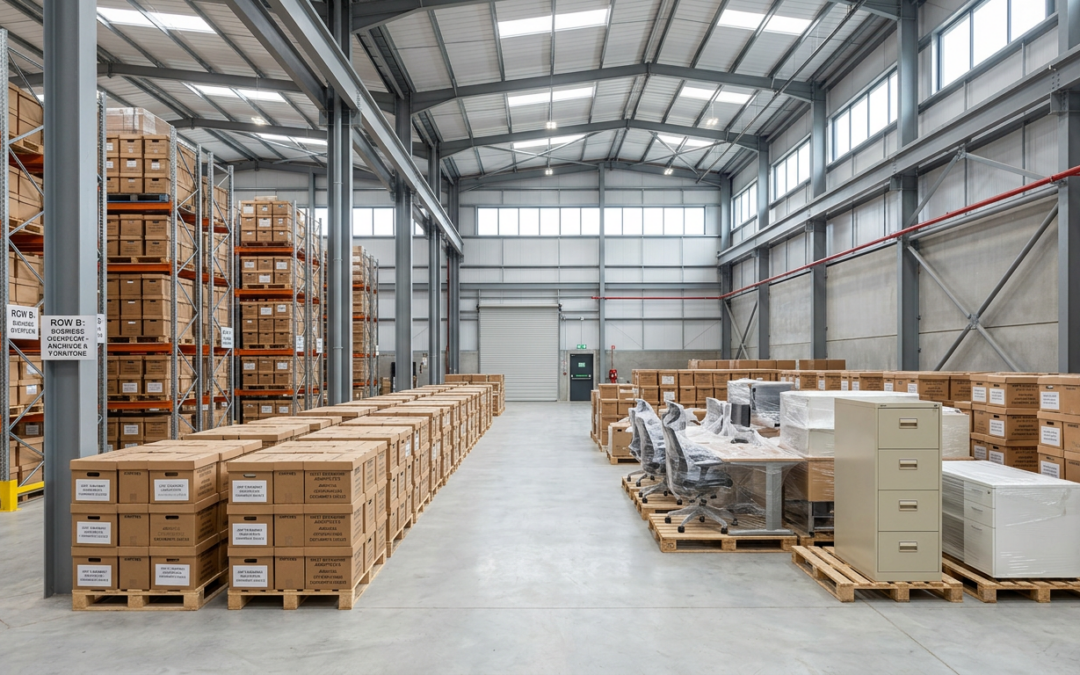
Greenham Business Park businesses do not need to sign a five-year lease every time they run out of space. When seasonal stock arrives early, when that big order exceeds your warehouse capacity, or when your archive boxes start competing with your active inventory, flexible storage provides a practical solution that does not lock you into long-term property commitments.
The reality of finding business storage Newbury companies rely on is that space demands fluctuate. You might need 500 square feet for three months during peak season, then nothing for the rest of the year. Traditional commercial property agreements were not designed for this kind of flexibility, but your business needs it anyway.
Why Warehouse Expansion Does Not Always Make Financial Sense
Signing a new warehouse lease sounds straightforward until you calculate the actual costs. Most commercial properties around Greenham Business Park require minimum 12-month commitments, often longer. You are paying for space whether you use it or not, and that comes before factoring in business rates, utilities, and insurance.
Consider a typical scenario where your e-commerce business experiences a surge during Q4. You need extra space for November and December, maybe into January. A warehouse lease forces you to pay for that space through October the following year. That represents ten months of unnecessary expense for three months of genuine need.
Self-storage changes this equation completely. You rent space by the month, scaling up when orders increase and scaling down when they do not. No wasted capacity; no paying for empty floor space while you wait for your lease to expire.
The cost difference becomes even starker when you factor in the hidden expenses of warehouse space. Business rates on commercial property can add 30% to 50% to your base rent. You will need separate insurance. Many commercial landlords require professional indemnity cover. Then there are utilities; heating a large warehouse space through winter is not cheap, even if you are only using half of it. This warehouse lease commitment often drains capital that could be better spent on growth.
What Greenham Business Park Companies Actually Store
The businesses we work with store everything from archived documents to seasonal inventory. One local engineering firm uses storage for equipment they only need quarterly, such as calibration tools, specialist machinery, and presentation materials for trade shows. Rather than cluttering their main workshop, these items sit in a secure unit, accessible whenever needed.
Retail businesses manage seasonal inventory fluctuations differently now. Instead of cramming Christmas inventory into back rooms from September onwards, they keep it in storage and collect it in batches. This keeps shop floors clear, reduces theft risk, and means staff are not climbing over boxes of decorations while trying to serve customers.
Document storage represents another major use case. Legal requirements mean businesses must retain certain records for six years or more. That equates to a lot of filing cabinets taking up expensive office space. Moving archived documents to storage frees up room for desks, meeting spaces, or anything that actually generates revenue.
Here is something less obvious: businesses store furniture between office reconfigurations. Open-plan layouts come and go. Hot-desking becomes assigned seating again. Rather than selling perfectly good desks and chairs only to buy new ones 18 months later, companies store them. It is cheaper than replacing everything when workplace trends inevitably cycle back.
How Storage Units Compare To Traditional Warehouse Costs
Let us use real numbers. A 100 sq ft storage unit costs significantly less per month than equivalent warehouse space, with no business rates, no utility bills, and no long-term commitment. For a Greenham Business Park business needing overflow space for six months, the savings typically run into thousands of pounds.
Warehouse space near Newbury averages £8 to £12 per square foot annually, before additional costs. That 500 sq ft unit you need? You are looking at £4,000 to £6,000 per year in base rent alone. Add business rates (roughly 50% of rateable value), utilities (£100 to £200 monthly for a small unit), and insurance, and your annual cost easily exceeds £7,000 to £9,000.
Storage units operate on a completely different cost structure. Monthly rates include security, insurance options, and access during extended hours. No surprise bills. No rate increases mid-contract. You know exactly what you will pay, and you only pay for the months you actually need the space.
The flexibility matters more than you might think. Imagine signing a 12-month warehouse lease in January, then losing your biggest client in March. You are contractually obligated to pay for nine more months of space you do not need. With monthly storage, you simply give notice and stop paying. The financial risk drops dramatically.
Security Features That Protect Business Inventory
Security concerns often stop businesses from considering storage, but modern facilities offer protection that rivals or exceeds typical warehouse security. Newbury Self Store implements multiple security layers specifically designed to protect business assets.
CCTV coverage monitors the entire facility 24/7. Not just entry points, but every corridor and every access route. The footage is recorded and retained, creating a complete audit trail of who accessed the facility and when. This level of monitoring would cost thousands to install in a private warehouse.
Individual unit alarms add another security layer. Each unit has its own alarm system, separate from the facility’s main security. Someone cannot simply walk past your unit and try the door; any unauthorised access triggers an immediate alert.
Access control systems track every entry. You receive a unique code that logs when you arrive and leave. This creates accountability and ensures only authorised personnel can access the facility. For businesses with multiple staff members needing access, additional codes can be issued, each tracked separately.
Think of it like this: warehouse security often means a padlock on a roller door. Storage facility security means cameras watching you approach, an access code to enter the building, another code for your specific floor, and an individual alarm on your unit. Which would you trust more with £50,000 worth of stock?
Accessing Your Stock When You Actually Need It
Extended access hours solve one of the biggest frustrations with traditional storage. Most facilities offer access from early morning until late evening, seven days a week. This matters enormously when you need to collect stock for an unexpected order or when your delivery schedule does not align with standard business hours.
Drive-up access changes how quickly you can move inventory. Container storage allows you to reverse a van directly to your unit, load or unload, and leave. No trolleys through corridors. No lifts. No carrying boxes across car parks in the rain. You are in and out in minutes, not hours.
For businesses managing regular inventory rotation, this efficiency compounds. One local retailer collects stock every Monday and Thursday morning. The entire process takes 20 minutes; drive up, unlock, load the van, lock up, drive away. Try doing that with a warehouse on the other side of town during rush hour.
The access flexibility also supports unexpected situations. A client calls with an urgent order at 4pm Friday. Your main warehouse is packed. But you can access your storage unit until 8pm, collect what you need, and fulfil the order before close of business. That responsiveness often makes the difference between winning and losing customers.
Scaling Storage Space As Business Demands Change
Business growth rarely follows a smooth trajectory. You might need extra space for three months, then nothing for six, then suddenly require double your original capacity. Storage facilities accommodate this variability in ways that traditional property simply cannot.
Upgrading or downgrading units takes days, not months. When your space requirements increase, you move to a larger unit. When they decrease, you move to a smaller one. The process is straightforward because the facility wants to match you with the right space; empty units do not generate revenue, so they are motivated to help you find the optimal size.
This scalability particularly benefits businesses with seasonal patterns. Garden centres need massive space in spring, minimal space in winter. Storage allows them to rent a large unit March through June, then downsize to a small unit for the rest of the year. They are not paying for unused capacity during slow months.
One e-commerce business we work with demonstrates this perfectly. They started with a 50 sq ft unit for commercial stock overflow. As their business grew, they upgraded to 100 sq ft, then 200 sq ft. Each transition happened within a week. No estate agents. No legal fees. No disruption to their operation. Try doing that with commercial property.
What Items Businesses Should Store Off-Site
Not everything belongs in storage, but many items make perfect sense to keep off-site. Understanding which is which saves money and optimises your main business premises for activities that actually generate revenue.
Archive document retention tops the list. If you are legally required to keep it but have not looked at it in two years, it belongs in storage. This includes old invoices, completed project files, historical employee records, and expired contracts. Box them properly, label them clearly, and move them out.
Seasonal inventory represents another obvious category. Christmas stock in July, summer furniture in January, seasonal promotional materials outside their relevant months; all of this clutters your active workspace without serving any immediate purpose. Store seasonal stock until you need it.
Equipment used occasionally but not regularly fits this category perfectly. That generator you need twice a year. The exhibition stand you use for trade shows. Specialist tools for specific projects. These items are too expensive to dispose of but too bulky to keep in your main premises.
Excess furniture and fixtures also work well in storage. When you renovate your office or shop, you do not need to immediately decide what to do with the old furniture. Store it while you evaluate whether the new layout actually works. If it does not, you have not burned your bridges. If it does, you can sell or donate the stored items at your leisure.
How To Calculate Your Actual Space Requirements
Businesses consistently overestimate how much storage space they need, then pay for unused capacity. A more methodical approach saves money and prevents you from renting space you will never fill.
Start by physically measuring what you plan to store. Stack boxes as you would in a unit. Measure the length, width, and height of the stack. This gives you the actual cubic footage you need, not a guess. Most businesses find they need 30% to 40% less space than they initially thought.
Account for access paths. You cannot fill a storage unit completely because you need to reach items at the back. Allow for a narrow walkway if you will need to access different boxes at different times. If everything goes in at once and comes out at once, you can pack more densely.
Consider vertical space carefully. Storage units typically have 8 to 10 foot ceilings. Sturdy shelving units let you use this height effectively, potentially halving the floor space you need. One local business stores archived documents in a 50 sq ft unit that would require 100 sq ft if they just stacked boxes on the floor.
Think about your access patterns. Will you need items frequently? Store them near the front. Are some boxes permanent archives? They can go at the back. Planning your layout before you move in prevents the frustrating situation of needing something that is buried behind everything else.
The packaging you use affects space efficiency too. Uniform box sizes stack better than random containers. Proper packing materials prevent crushing, which lets you stack higher. It is worth investing in quality boxes and supplies; the space savings often pay for the materials within the first month.
Managing Multiple Storage Units For Growing Operations
As businesses expand, they often need multiple storage solutions simultaneously. One unit for archives, another for seasonal stock, perhaps a third for equipment. Managing this effectively requires organisation, but the flexibility outweighs the complexity.
Create a master inventory system that tracks which items are in which unit. A simple spreadsheet works; list the unit number, what is stored there, and when items were added or removed. This prevents the maddening experience of knowing you have something in storage but not knowing where.
Label everything clearly and consistently. Use a numbering system: Unit 1, Box 1; Unit 1, Box 2; Unit 2, Box 1. When you need something specific, you can check your inventory, identify the exact box, and go straight to it. This saves hours of searching through multiple units.
Consider dedicating units to specific purposes rather than mixing everything together. One unit for documents, one for inventory, one for equipment. This separation makes access more efficient; when you need stock, you only visit the inventory unit. When you need old records, you only visit the archive unit.
The Environmental Cost Of Unused Warehouse Space
Here is something businesses rarely consider: the environmental impact of heating, lighting, and maintaining warehouse space you do not fully use. A half-empty warehouse still requires full environmental control, full lighting, and full security. That represents wasted energy with a carbon cost.
Storage units only consume energy when you access them. The facility maintains security and basic environmental control, but individual units are not heated to 20°C year-round. The lights are not on 24/7. The environmental footprint per square foot is substantially lower than traditional warehouse space.
For businesses with sustainability commitments, this matters. Using storage for overflow means your main premises can be right-sized for your actual daily operations. You are not heating 1,000 square feet when you only actively use 600. The reduction in energy consumption directly translates to reduced carbon emissions.
When Storage Makes More Sense Than Warehouse Expansion
Not every business needs a warehouse. Many would benefit more from keeping their main premises compact and using storage for everything else. The question is not whether storage can replace a warehouse; it is whether you actually need a warehouse in the first place.
Service businesses with equipment rarely need warehouses. Contractors, maintenance companies, and professional services firms often store tools, materials, and equipment they do not use daily. A storage unit costs a fraction of warehouse rent and provides everything they actually need: security, access, and dry space.
Businesses in growth phases benefit enormously from storage flexibility. When you are not sure if your current growth rate will sustain, committing to a three-year warehouse lease represents enormous risk. Storage lets you scale up gradually, testing demand before making major property commitments.
Companies downsizing or restructuring face the opposite problem; too much space under contract. Storage provides a temporary home for excess inventory or equipment while you work through your existing lease obligations. It acts as a bridge solution that prevents you from paying for two properties simultaneously.
Making The Transition From Warehouse To Storage
Switching from traditional warehouse space to a storage solution requires planning, but the process is more straightforward than most businesses expect. The key is treating it as a project with clear phases rather than trying to move everything at once.
Start by auditing what you currently store. Walk through your warehouse and categorise everything: active inventory, occasional-use items, archives, equipment, and things you probably should have disposed of years ago. This audit often reveals you are paying warehouse rent to store items with no business value.
Move archives first. These items need access least frequently, so they are the easiest to relocate without disrupting operations. Box them systematically, label them clearly, and move them to storage. You will immediately reclaim warehouse space and prove the concept works.
Transition seasonal items next. If it is currently summer, move your winter stock to storage. When winter approaches, swap them. This rotation becomes routine quickly, and you will wonder why you ever paid year-round warehouse rent for items you only need six months annually.
How Newbury Self Store Supports Business Flexibility
Businesses around Greenham Business Park need storage solutions that work with their operational reality, not against it. Newbury Self Store provides the flexibility, security, and access that modern businesses require.
The monthly contract structure eliminates the risk of long-term property commitments. You are not guessing how much space you will need in 18 months. You are addressing how much space you need right now, with the freedom to adjust as circumstances change.
Extended access hours accommodate real business schedules. Early morning collections before your shop opens. Evening deliveries after your office closes. Weekend inventory counts when your staff are available. Storage access works around your business, not the other way around.
The security infrastructure protects your assets without requiring you to install and maintain expensive systems. CCTV, alarms, access control; it is all included. You benefit from commercial-grade security at a fraction of what it would cost to implement independently.
Planning Your Storage Strategy For Maximum Efficiency
Effective business storage involves more than just renting a unit and filling it with boxes. Strategic planning multiplies the value you get from every square foot and every pound you spend.
Create zones within your unit. Active items near the door. Archives at the back. Equipment on one side, inventory on the other. This organisation prevents the frustrating search through everything to find one specific item.
Invest in proper shelving. The cost of industrial shelving units pays for itself within months by letting you use vertical space effectively. Items stored on shelves stay cleaner, remain more accessible, and reduce the risk of damage from stacking too high.
Maintain an inventory system from day one. It is easy to think you will remember what is in storage, but you will not. Six months later, when you need something specific, that inventory list becomes invaluable. Update it every time you add or remove items.
Schedule regular reviews of what you are storing. Every quarter, evaluate whether items still need to be there. Can archived documents be securely destroyed? Can old equipment be sold? Regular culling prevents you from paying to store things with no ongoing value.
Greenham Business Park businesses have better options than signing long-term warehouse leases every time they need extra space. The operational benefits extend beyond cost savings. Extended access hours, drive-up convenience, and the ability to scale space requirements as your business evolves create flexibility that traditional warehouse agreements simply cannot match.
For businesses ready to explore how storage can support their operations, call 01635 581 811 or contact our team to discuss your specific requirements.