
 01635 581 811
Renting a storage unit for the first time feels a bit like buying luggage for a trip you have never taken. You know you need space, but determining exactly how much creates a challenge. Too small and you are cramming belongings into every corner, risking damage to fragile items. Too large and you are paying for empty floor space month after month.
Most first-time storage users overestimate their needs by at least one unit size. That is not surprising when you are staring at a list of dimensions on a website, trying to picture whether 50 square feet will swallow your spare bedroom furniture or leave you playing Tetris with boxes. The difference between choosing correctly and guessing wrong can cost you hundreds of pounds over a typical six-month rental period.
Here is what practically happens when you get the size wrong: you either pay for unused space, which is the most common mistake, or you end up renting a second unit mid-way through your storage period because everything does not fit. Both scenarios waste money.
Understanding Storage Unit Sizes in Real Terms
Storage facilities describe units in square feet, but that measurement does not tell you much when you are standing in your living room wondering if your sofa will fit. A 50-square-foot unit might sound generous until you realise it is roughly the size of a large garden shed, about 5 feet by 10 feet. That is enough for a few boxes and perhaps a bicycle, but not much more.
The jump to a 75-square-foot unit, typically 5 feet by 15 feet, gives you space for the contents of a small bedroom. This includes a single bed frame, chest of drawers, several boxes, and maybe a few small appliances. It is the size many students choose when storing belongings over the summer break.
Move up to 100 square feet, usually 10 feet by 10 feet, and you are looking at a single garage-sized space. This handles a one-bedroom flat’s worth of furniture if you pack strategically. Most people can fit a sofa, dining table, mattress, and 15 to 20 boxes comfortably.
150 square feet, often 10 feet by 15 feet, accommodates a two-bedroom property’s contents, including white goods like washing machines and fridges. This is where families downsizing or moving abroad typically start.
Beyond that, 200-square-foot units and larger handle three-bedroom houses or small business inventory. These spaces often surprise first-time storage users with how much room they actually provide; you could park a car inside most of them.
The Real Cost of Getting It Wrong
Let us talk numbers. The difference between a 75-square-foot unit and a 100-square-foot unit at most facilities runs about £20 to £30 per month. That sounds manageable until you multiply it over six months, which is £120 to £180, or a year, where it reaches £240 to £360.
Now imagine you have chosen the 100-square-foot unit but only needed 75 square feet. You are not just paying for empty space; you are paying for climate control, security, and access to square footage you will never use. That is money that could have covered your packaging materials or gone toward your house deposit.
The opposite scenario costs even more. One family I assisted rented a 75-square-foot unit for their house move, convinced they could make it work. Three weeks later they were back, needing an additional 50-square-foot unit for the overflow. They ended up paying for two units, totalling 125 square feet, when a single 100-square-foot unit would have been cheaper and far more convenient.
How to Actually Calculate What You Need
Forget trying to visualise square footage. Here is the practical approach that works.
Make a physical inventory. Walk through every room you are storing items from and write down each piece of furniture. Categories do not help. “Bedroom furniture” is too vague. “Double bed frame, two bedside tables, one wardrobe, one chest of drawers” gives you something to work with.
Measure your largest items. You do not need to measure everything, but knowing the dimensions of your sofa, wardrobe, or dining table prevents nasty surprises. A 7-foot sofa will not fit through a 5-foot unit doorway, regardless of floor space.
Count your boxes honestly. Most people underestimate how many boxes they will need. A three-bedroom house typically generates 40 to 60 boxes when you pack properly. Each standard removal box takes up about 3 cubic feet. Stack them, and you will fit roughly 20 to 25 boxes per 25 square feet of floor space if you build to ceiling height.
Account for awkward items. Bicycles, golf clubs, skis, garden tools; these do not stack neatly. They eat up more space than their actual size suggests. Add 10% to 15% to your estimate if you are storing sporting equipment or tools. Consulting a detailed storage unit capacity guide can also help you visualise how these awkward items fit into standard dimensions.
Think vertical, not just horizontal. Storage units typically have 8 to 10 foot ceilings. You are not limited to floor space. Sturdy shelving units or properly stacked boxes can double your effective storage capacity. A 50-square-foot unit with good vertical organisation often holds more than a poorly packed 75-square-foot space.
Common First-Timer Mistakes That Cost Money
Leaving furniture assembled creates significant waste. That bed frame takes up twice as much space when it is still together. Dining tables with removable legs stack flat against walls. Take 30 minutes to disassemble what you can; it will save you a unit size.
Storing items in original packaging often leads to inefficiency. Retail boxes are designed for shipping and display, not storage efficiency. They are oversized, oddly shaped, and waste space. Repack items into uniform box sizes that stack cleanly. Using professional packaging supplies ensures your boxes are durable enough to be stacked high without crushing the contents at the bottom.
Not using the full height wastes money. I have seen 100-square-foot units with everything spread across the floor and the top four feet completely empty. That is like paying for a two-storey house and only living downstairs.
Storing air is another frequent error. Half-empty boxes, mattresses lying flat instead of on their side, empty suitcases; all of these store air instead of belongings. Fill suitcases with clothes or linens. Pack boxes full but not so heavy they are unsafe. Stand mattresses upright.
Failing to create access paths causes problems later. You have rented a 100-square-foot unit and filled every inch. Brilliant, until you need the box at the back in three months. Leave a narrow centre aisle if you will need regular access. It costs slightly more space upfront but prevents the need to unpack and repack everything later.
Size Recommendations for Common Scenarios
Student Belongings Storage: When planning student belongings storage, remember that a 35 to 50 square foot unit usually handles a typical university room’s contents. That is your desk, chair, bedding, clothes, books, and small electronics. If you are keeping a bike or sports equipment, consider jumping to 50 to 75 square feet to accommodate student belongings storage without crushing your items.
House Moves: For house moves with a gap between properties, calculate one unit size up from what you think you need. Moving is chaotic, and you will inevitably have more than expected. A two-bedroom flat typically needs 100 to 150 square feet. A three-bedroom house requires 150 to 200 square feet. First-time storage users often forget about the garage or loft contents, which can add significant volume.
Decluttering: For decluttering before selling, most people store 30% to 40% of their belongings to make their home look more spacious for viewings. For a three-bedroom house, that is usually 100 to 150 square feet. You are storing personal photos, excess furniture, kids’ toys, and hobby equipment. Secure personal storage solutions provide the perfect off-site location to keep these items safe while you conduct viewings.
Business Needs: For business inventory or equipment, requirements vary. A small e-commerce business with 200 to 300 product units typically needs 75 to 100 square feet. Tradespeople storing tools and materials usually start at 50 to 75 square feet. Proper business inventory organisation is critical here; using shelving units allows you to maximise the vertical space and keep stock accessible.
Long-Term Travel: For long-term storage during extended travel, think about what you truly need to keep accessible versus what can stay packed for months. A furnished one-bedroom flat’s contents fit comfortably in 75 to 100 square feet if you are not planning to access anything regularly.
The Smart Way to Confirm Your Choice
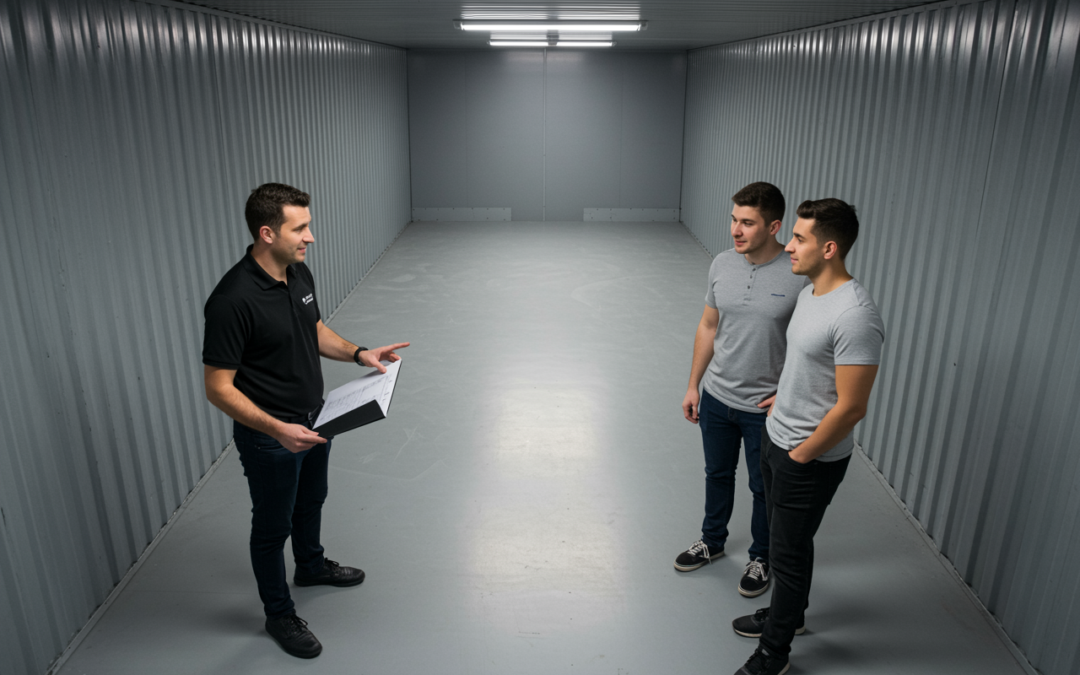
Most reputable facilities offer unit viewings. Take them up on it. Do not just peek through the door; step inside with a tape measure and your inventory list. Visualise where your sofa goes, how your boxes will stack, whether your wardrobe fits.
If viewings are not possible, ask for photographs showing units with furniture in them, not just empty spaces. A bare room looks completely different from one with actual belongings.
Consider starting with a slightly smaller unit than you think you need, with the option to upsize if necessary. Many facilities, including Newbury Self Store, allow you to change unit sizes with reasonable notice. It is easier to move up a size than to commit to paying for unused space for months.
Here is a practical example from our facility. A couple downsizing from a three-bedroom house to a two-bedroom flat were not sure whether they needed 150 or 200 square feet. They started with 150, packed efficiently using proper shelving, and realised they had room to spare. They saved £30 to £40 monthly by not overcommitting.
When Bigger Actually Saves Money
Sometimes renting a larger unit costs less in the long run. If you are storing valuable furniture or delicate items, cramming them into a too-small space risks damage. Repairing a scratched antique table or replacing a cracked mirror costs more than a few months of extra storage fees.
Similarly, if you will need regular access to stored items, the extra space for an access aisle justifies the cost. Spending an hour unpacking and repacking a cramped unit every time you need something is not just frustrating; if you are taking time off work to do it, that is lost income.
For businesses, having extra space for growth often makes sense. If you are storing inventory and expect to increase stock levels within three months, starting with adequate flexible business storage units prevents the disruption of moving everything to a larger unit mid-season. Effective business inventory organisation often requires a bit more floor area to function smoothly.
Accessible container storage options offer another solution for those needing significant space. These provide drive-up access and can be more cost-effective than multiple smaller units if you are storing the entire contents of a house.
Packing Smart to Maximise Space
Poor packing wastes storage space, which wastes money. Furniture with empty drawers is a missed opportunity. Boxes packed loosely mean you need a larger unit than necessary.
Using uniform box sizes prevents instability and wasted gaps. Mismatched boxes create dangerous stacks that are prone to toppling. Standard moving boxes stack efficiently and make the most of vertical space. Label everything clearly on multiple sides; you will thank yourself when you need to retrieve specific items without unpacking everything.
Here is an analogy that helps. Packing a storage unit is like loading a dishwasher. There is the way most people do it, throwing things in randomly, and there is the efficient way, with plates vertical, bowls nested, and glasses in rows. The same physical space holds vastly different amounts depending on your approach.
Questions to Ask Before You Commit
Can you change unit sizes mid-rental? Flexibility matters. Your storage needs might shift as your situation changes.
What is the real access width? A unit described as 10 feet wide might have a 6-foot doorway. If your sofa is 7 feet long, that is a problem.
Are there height restrictions? Some facilities have lower ceilings in certain units, limiting your vertical storage potential.
What is included in the price? Climate control, security features, and insurance vary. A cheaper unit without climate control might cost more if humidity damages your belongings.
Is there a minimum rental period? Some facilities require 3 to 6 month commitments. If you only need storage for one month, that changes the calculation.
Making Your Final Decision
Start with your detailed inventory and honest box count. Match that against the size descriptions, adding 10% to 15% buffer for awkward items and access space. If you are between two sizes and plan to pack efficiently using uniform box sizes, choose the smaller option. If you are rushed, disorganised, or storing items you will need regular access to, size up.
The goal is not to find the absolute minimum space your belongings can physically squeeze into. It is to find the right balance between cost and practicality, enough room to store everything safely and accessibly, without paying for empty space you will never use.
First-time storage users who take time to calculate properly typically save 15% to 25% compared to those who guess. That is the difference between a 100-square-foot unit and a 75-square-foot unit over six months, around £120 to £180 back in your pocket.
If you are still uncertain after measuring and calculating, call 01635 581 811 or contact our team to discuss your specific situation.