
 01635 581 811
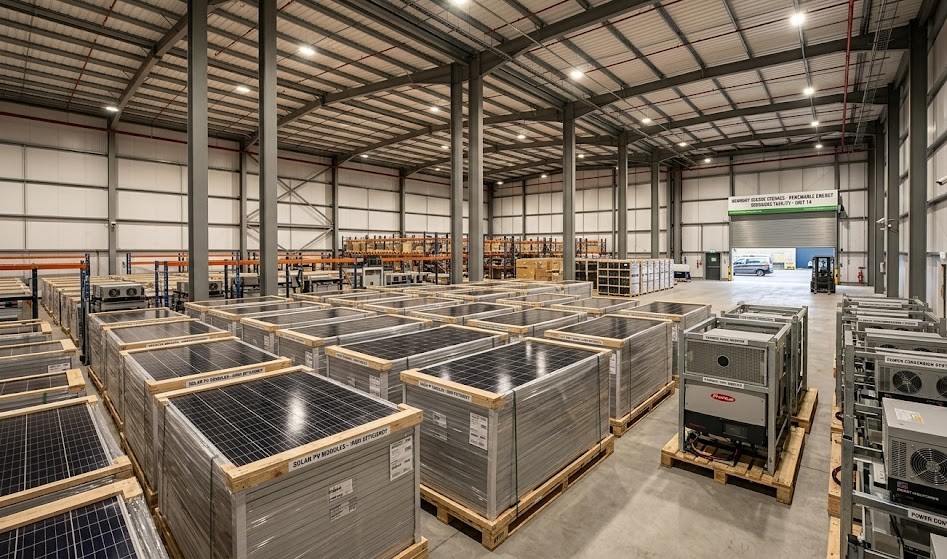
The renewable energy sector has exploded across the UK, with solar installations growing by 42% year-on-year according to Solar Energy UK’s 2024 report. For installers, this boom brings a practical challenge: where do you safely store thousands of pounds worth of solar panels, inverters, mounting systems, and specialised equipment between jobs?
Most renewable energy installers operate from residential properties or small workshops that simply weren’t designed to house fragile photovoltaic modules or bulky battery storage units. A single commercial solar project might require 30-50 panels, each measuring roughly 2 metres by 1 metre, plus mounting rails, electrical components, and safety gear. That’s not fitting in a garage alongside your van.
Proper renewable energy installer storage isn’t just about space. Solar panels are delicate, expensive assets that can suffer micro-cracks from improper stacking or temperature fluctuations. Inverters contain sensitive electronics. Your reputation depends on arriving at installation sites with pristine, fully functional equipment. One cracked panel or corroded connection can delay a project by days and cost you hundreds in replacement parts.
Why Standard Storage Won’t Work for Solar Equipment
Think of solar panels like oversized, extremely expensive biscuits. Stack them wrong, and they crack. Store them in damp conditions, and the electrical components corrode. Leave them in direct sunlight (ironically), and the protective backing can degrade before you’ve even installed them.
Standard garage storage creates multiple risks. Panels leaning against walls can warp over time. Equipment stored on damp concrete floors absorbs moisture. Temperature swings between freezing nights and warm days cause expansion and contraction that damages seals and connections.
Here’s what actually happens: A small installation company in Berkshire stored 20 panels in their garden shed over winter whilst building up projects for spring. They’d wrapped the panels in tarpaulins, which seemed adequate protection. However, the shed wasn’t insulated, and temperatures fluctuated from -3°C at night to 12°C on sunny afternoons. When they unwrapped the panels in March for their first residential installation, visual inspection revealed no obvious damage. However, during electrical testing before installation, they discovered that micro-cracks had formed across six panels from the repeated thermal stress. These hairline fractures weren’t visible to the naked eye but significantly reduced panel efficiency and violated warranty terms. That’s £1,200 in wholesale value lost before they’d earned a penny on the job. Additionally, they had to delay the installation by five days whilst sourcing replacement panels, costing them £380 in labour for the rescheduled work and damaging their reputation with a client who’d taken time off work specifically for the installation date.
Professional business storage solves these problems with climate-controlled environments, proper racking systems, and security that protects your investment.
The Real Costs of Poor Equipment Storage
Let’s talk numbers. A standard 400W solar panel costs between £150-250 wholesale. A quality inverter runs £800-2,500 depending on capacity. Battery storage systems? £3,000-8,000 for residential units.
Now multiply that by the inventory you need to maintain for ongoing projects. Most installers keep stock for 3-5 jobs simultaneously to avoid supply chain delays. That’s easily £15,000-30,000 in equipment sitting somewhere.
Poor storage creates three expensive problems:
Physical damage from improper stacking or environmental exposure can write off 10-15% of your inventory annually. That’s £2,000-4,500 in direct losses.
Warranty invalidation occurs when manufacturers discover equipment was stored incorrectly. Most solar panel warranties specifically exclude damage from improper storage conditions.
Project delays happen when you discover damaged equipment on installation day. You’ll lose the day’s labour costs (typically £300-500 for a two-person crew), plus you’ll need to reschedule with the client, damaging your professional reputation.
One installer calculated they’d lost £6,400 in a single year from storage-related issues before switching to proper warehousing. The storage costs? £2,100 annually. The maths isn’t complicated.
What Solar Equipment Actually Needs
Solar panels require specific storage conditions that most makeshift solutions can’t provide. The modules need to remain vertical or at a slight angle – never flat-stacked beyond manufacturer recommendations (usually 10-12 panels maximum). They must stay dry, ideally at 15-25°C with humidity below 75%.
Inverters and electrical components need protection from moisture, dust, and temperature extremes. These devices contain circuit boards and connections that corrode rapidly in damp conditions. Even condensation from temperature fluctuations can create problems.
Mounting systems – the aluminium rails and brackets – are less delicate but bulky. A typical residential installation requires 30-40 metres of rail plus numerous brackets and fixings. These need organised storage so you can quickly locate and load the correct quantities for each job.
Battery storage units are the most demanding. Lithium-ion batteries require cool, dry conditions and must be stored at specific charge levels (typically 50-60%) to prevent degradation. They’re also heavy – a 10kWh home battery weighs around 100kg.
Safety equipment rounds out your inventory: harnesses, ladders, electrical testing gear, and specialised tools. These items need secure, accessible storage where they won’t be damaged or stolen.
Sizing Your Storage Requirements
Here’s a practical framework for calculating space needs based on your operation size:
Small installers (1-2 residential jobs per month) typically need 100-150 square feet. This accommodates 30-40 panels, 2-3 inverters, mounting systems for current projects, and safety equipment. Think of it as roughly the size of a small bedroom.
Medium operations (3-5 jobs monthly or occasional commercial work) require 200-300 square feet. You’re storing 60-100 panels, multiple inverter types, diverse mounting systems, and possibly battery storage units. This is comparable to a large garage.
Larger companies (consistent commercial work or 6+ residential installations monthly) need 400+ square feet with proper racking systems. You’re managing inventory for multiple simultaneous projects, bulk purchasing advantages, and potentially demo equipment for sales purposes.
Don’t forget vertical space. Proper racking systems let you store panels vertically and safely, dramatically increasing capacity. A 200 square foot unit with 8-foot ceilings and appropriate racking can accommodate 100+ panels when organised correctly.
Personal storage principles apply here too – start with slightly more space than you think you need. Equipment inventory tends to grow as your business expands, and cramped storage leads to damage and disorganisation.
Climate Control: Essential or Excessive?
For solar equipment, climate control isn’t a luxury – it’s insurance. Here’s why: Solar panels are manufactured with precise tolerances. The photovoltaic cells, encapsulant layers, and backing materials all expand and contract with temperature changes. Extreme fluctuations accelerate degradation.
A panel stored in an unheated shed might experience temperatures from -5°C on winter nights to 30°C on summer afternoons. That’s a 35-degree swing causing constant expansion and contraction. Over months, this creates micro-cracks in the cells and weakens the laminate bonds.
Inverters are even more sensitive. The electronic components and capacitors inside can fail from moisture exposure or extreme temperatures. Inverters that spent one winter in a damp garage can arrive at installation sites with corroded connections and failed start-up tests.
Climate-controlled storage maintains consistent temperature (typically 15-20°C) and manages humidity. This costs more – usually 20-30% above standard units – but protects equipment that represents 60-70% of your project costs.
Consider it this way: Spending an extra £30-50 monthly on climate control protects £20,000+ in inventory. One prevented equipment failure pays for a year of climate control costs.
Security Considerations for High-Value Equipment
Solar equipment’s attractive to thieves. Panels are relatively easy to sell, and a van-load represents several thousand pounds of street value. Your storage facility needs proper security measures.
Look for facilities offering 24/7 CCTV coverage with cameras positioned to capture both entry points and individual unit doors. Motion-sensor lighting deters opportunistic theft. Individual unit alarms add another security layer – these trigger if someone accesses your unit outside your normal hours.
Gated access with unique entry codes means there’s a digital record of everyone entering the facility. This matters for insurance purposes if theft does occur.
Consider your own security practices too. Don’t store complete installation kits ready to go – keep panels separate from inverters and electrical components. A thief wants quick, easy targets. Making them piece together a complete system reduces your unit’s appeal.
Insurance companies increasingly require specific security standards for high-value equipment storage. Check your policy requirements before committing to a facility. Some insurers offer premium reductions for storage meeting certain security certifications.
Organisation Systems That Actually Work
Here’s a scenario: You’ve got an installation scheduled for 8am tomorrow. You need 24 specific panels, mounting rails, an inverter, and associated hardware. Can you locate and load everything in 30 minutes, or will you spend two hours hunting through disorganised storage?
Effective organisation starts with zoning. Divide your storage space into clear areas: panels by wattage/model, inverters by type, mounting systems, electrical components, safety equipment, and consumables (fixings, cable, etc.).
Label everything. Not just boxes – individual items where practical. Use a simple coding system: “Panel-400W-Longi-20” tells you it’s a 400-watt Longi panel, and you have 20 in stock. Update quantities as you remove items.
Implement a “first in, first out” system for panels. Older stock should be used first to prevent any sitting in storage beyond reasonable timeframes. Position newer deliveries behind existing inventory.
Create a loading zone near your unit entrance. When you’ve got a job scheduled, pre-stage equipment the day before. This prevents rushed morning loading sessions where items get damaged or forgotten.
Invest in proper racking. Industrial shelving units designed for panel storage cost £200-400 but prevent thousands in damage. They keep panels vertical, properly spaced, and easily accessible. The packaging materials you use for protection matter too – corner protectors and panel separators prevent scratching and pressure damage.
Managing Inventory Flow and Project Scheduling
Smart installers use their storage unit as a business hub, not just a dumping ground. This requires treating inventory as a managed asset.
Maintain a digital inventory system – even a simple spreadsheet works. Record what you have, where it’s located in your unit, and which project it’s allocated to. This prevents over-ordering and helps you spot slow-moving stock.
Schedule regular inventory reviews. Monthly checks let you identify damaged items before they reach installation sites. You’ll also spot missing components early enough to reorder without delaying projects.
Consider your storage location strategically. A unit that’s 15 minutes further from your home but 20 minutes closer to your typical project areas saves time overall. Calculate drive times to your common installation zones when choosing facilities.
Some installers operate a “buffer stock” system: maintain minimum quantities of your most-used components (standard panels, common inverter models, mounting rails) so you can respond quickly to new opportunities. This requires more storage space but reduces lead times from 2-3 weeks to same-day.
Seasonal planning matters too. Solar installations peak in spring and summer when weather’s favourable and daylight hours are longer. Build inventory in late winter, then run it down through the busy season. This matches your storage costs to your revenue cycle.
Drive-Up Access and Loading Efficiency
Loading 30 solar panels, mounting equipment, and tools into your van isn’t a one-person job. It’s also not something you want to do via a lift or up stairs.
Container storage with drive-up access transforms your loading process. Back your van directly to your unit door and load efficiently. What might take 45 minutes with multiple trips becomes a 15-minute operation.
This matters more than you might think. If you’re loading for a job three times weekly, drive-up access saves roughly 90 minutes per week – that’s 75 hours annually you can bill to clients instead of wasting on inefficient loading.
Ground-level access also reduces damage risk. Carrying panels through corridors or into lifts creates opportunities for bumps and drops. Direct van-to-storage transfer keeps equipment safer.
Consider the loading process itself. Panels should be loaded vertically or at an angle in your van, never flat-stacked. Having storage that allows you to move them directly from vertical storage to vertical transport maintains proper handling throughout.
Scaling Your Storage as Your Business Grows
Most renewable energy installers start small – a few residential jobs monthly whilst building reputation and client base. Your storage needs will evolve as you grow.
Start with adequate space for current operations plus 30-40% growth capacity. This typically means beginning with a 150-200 square foot unit even if you could squeeze into something smaller. You’ll grow into it faster than you expect.
Flexible rental terms matter here. Monthly contracts let you upsize without penalty as your inventory expands. Some facilities offer priority access to larger units for existing customers, which beats scrambling for new storage mid-growth phase.
Plan your organisation system for scalability from day one. Use modular racking that you can add to rather than replace. Implement inventory management practices that work for 50 panels or 500.
Watch for the inflection point where dedicated warehouse space becomes economical. This typically occurs around £40,000-50,000 in monthly revenue when you’re managing multiple simultaneous projects and need daily storage access. Until then, professional storage facilities offer flexibility without the overhead of leasing commercial premises.
Making the Storage Investment Decision
Here’s the calculation that matters: What does poor storage actually cost you versus what would proper storage cost?
Add up your annual losses from damaged equipment, warranty issues, and project delays. Most installers who track this carefully find it’s 5-10% of their equipment spending. On £30,000 annual equipment purchases, that’s £1,500-3,000 lost.
Compare this to storage costs. A 200 square foot climate-controlled unit typically runs £150-250 monthly (£1,800-3,000 annually) depending on location. The costs roughly balance, but proper storage eliminates the stress, reputation damage, and unpredictability of equipment failures.
Factor in the business benefits: better organisation speeds up loading, professional inventory management reduces over-ordering, and secure storage often qualifies for insurance premium reductions. These indirect benefits can add another £1,000-1,500 in annual value.
The decision becomes clearer when you’re comparing proper storage to alternatives like renting commercial premises (£800-1,500+ monthly) or continuing to use inadequate residential space (with all its associated costs and limitations).
Protecting Your Investment and Your Reputation
Renewable energy installation’s a reputation business. Clients are making significant investments in their properties and trusting you to deliver quality work with reliable equipment. Arriving with damaged panels or faulty inverters doesn’t just cost you the immediate job – it damages your credibility and future referrals.
Professional storage protects both your financial investment in equipment and your reputation investment in your business. It demonstrates you’re serious about quality and reliability, not running a casual operation from a garden shed.
The renewable energy sector’s growing rapidly, but it’s also becoming more competitive. Installers who operate professionally – with proper equipment management, efficient processes, and reliable service – will capture the growing market. Those who cut corners on fundamentals like equipment storage will struggle with quality issues and operational inefficiency.
Your storage solution should support your business growth, not constrain it. Start with appropriate space, implement proper organisation systems, and treat your equipment inventory as the valuable business asset it represents. The installers who get this right build sustainable, profitable businesses that can scale with the renewable energy opportunity ahead.
Newbury Self Store understands that renewable energy installers need storage protecting delicate solar panels, not generic warehouse space. You need facilities where solar equipment stays at controlled temperatures, where renewable energy installer storage remains organized for efficient project loading, and where security protects your substantial equipment investments. We know that your solar installations equipment isn’t just stock – it’s the foundation of sustainable energy solutions that help clients reduce their environmental impact.
If you’re currently storing panels in your garage, inverters in your spare room, and mounting systems wherever they’ll fit, it’s time to evaluate whether this approach truly serves your business goals. The cost of proper storage’s real, but the cost of poor storage – in damaged equipment, lost time, and missed opportunities – is almost always higher. Make the investment that protects your assets and positions your business for growth.
Contact us to discuss storage solutions designed for renewable energy professionals. Proper renewable energy installer storage protects your investment and ensures every solar installation starts with pristine, fully functional equipment ready to deliver clean energy for decades.