
 01635 581 811
Running a successful handyman business means juggling dozens of tools, materials, and equipment across multiple jobs. You’ve probably experienced the frustration of arriving at a client’s home only to realise the specific drill bit you need is back in the van – or worse, still at yesterday’s job site. When your livelihood depends on efficiency and professionalism, disorganised tool storage isn’t just inconvenient. It costs you time, money, and client trust.
The reality for most handymen is that space becomes the limiting factor long before ambition does. Your garage overflows with power tools, your van’s packed to the roof, and that spare bedroom your partner tolerates is now a maze of paint tins and plumbing supplies. This chaos doesn’t just affect your workflow – it impacts your ability to take on larger projects, respond quickly to emergency callouts, and present yourself as the reliable professional you are through proper handyman tool storage.
Why Tool Organisation Matters More Than You Think
Consider this: if you spend just 10 minutes per job searching for misplaced tools or materials, that’s nearly an hour wasted across six jobs. Multiply that by five working days, and you’ve lost almost a full working day each week to disorganisation. That’s a day you could’ve spent earning money or, perhaps more importantly, taking a well-deserved break.
Beyond time loss, there’s the financial impact. Tools left in damp conditions rust and fail. Materials stored improperly become unusable – think of warped timber, dried-out adhesives, or corroded fixings. Then there’s the reputational cost when you can’t complete a job because you don’t have the right equipment to hand.
Professional organisation isn’t about being obsessive. It’s about creating systems that work when you’re tired, rushed, or juggling three jobs in one day.
The Real Cost of Inadequate Storage
A handyman in Newbury – let’s call him Mark – ran a thriving business from his two-bedroom flat. His tools lived in the hallway, spare bedroom, and under the kitchen sink. He’d been operating this way for four years, managing 15-20 small jobs monthly whilst building a solid reputation for reliability. When a lucrative contract came through to refurbish three rental properties simultaneously – worth £15,000 total with £4,500 profit after materials and labour – he had to turn it down. Why? He couldn’t separate and organise the materials and specialist tools needed for overlapping timelines across three properties. The job went to a competitor who could demonstrate proper inventory management through organized storage facilities. That single missed opportunity cost Mark approximately £4,500 in direct revenue. More significantly, it cost him the relationship with a property management company that could’ve provided steady work for years – they subsequently awarded the competitor an ongoing maintenance contract worth £2,000+ monthly. Mark calculated his inadequate storage had cost him over £30,000 in lost opportunities over the following year alone.
Storage challenges create several hidden costs:
Duplicate purchases: When you can’t find a tool quickly, you buy another one. Most handymen own at least three tape measures and multiple sets of screwdrivers simply because they couldn’t locate the originals when needed.
Damaged equipment: Power tools stored in cold, damp garages deteriorate faster. Batteries lose capacity, motors corrode, and wooden handles crack. You’ll replace these items years earlier than necessary.
Insurance complications: Many home insurance policies don’t adequately cover business equipment stored at residential properties. If your tools are stolen or damaged, you might find yourself significantly underinsured.
Vehicle wear: Overloading your van with everything you might possibly need puts strain on suspension, increases fuel consumption, and makes driving more hazardous.
Creating a Functional Tool Storage System
Think of your tool storage like a professional kitchen. A chef doesn’t keep every pot, pan, and ingredient within arm’s reach – they organise by frequency of use and type of task. Your storage system should follow similar logic.
Start by categorising your equipment into three groups: daily essentials, weekly regulars, and occasional specialists. Your daily essentials – basic hand tools, common drill bits, measuring equipment, safety gear – should be immediately accessible in your van. Weekly regulars might include specific power tools for recurring job types. Occasional specialists are those items you need perhaps once or twice a month.
Here’s where business storage becomes invaluable. Rather than cramming everything into your vehicle or sacrificing your home space, a dedicated storage unit provides a professional base of operations. You can stock it with your weekly regulars and occasional specialists, organised on shelving systems that let you see and access everything quickly.
Setting Up Your Storage Unit for Maximum Efficiency
The difference between a storage unit that works and one that becomes another cluttered mess comes down to initial setup. Rushing this process creates problems that compound over time.
Shelving’s non-negotiable. Floor storage means items at the bottom become inaccessible. Industrial metal shelving units with adjustable heights let you customise the space for different equipment sizes. Position the heaviest items at waist height – this protects your back and makes loading your van safer.
Clear plastic storage boxes transform organisation. Unlike cardboard boxes that deteriorate and hide contents, clear containers let you identify what’s inside without opening them. Label each box on multiple sides with its contents and the date you last checked it. Group items logically – all plumbing supplies together, all electrical components together, all decorating materials together.
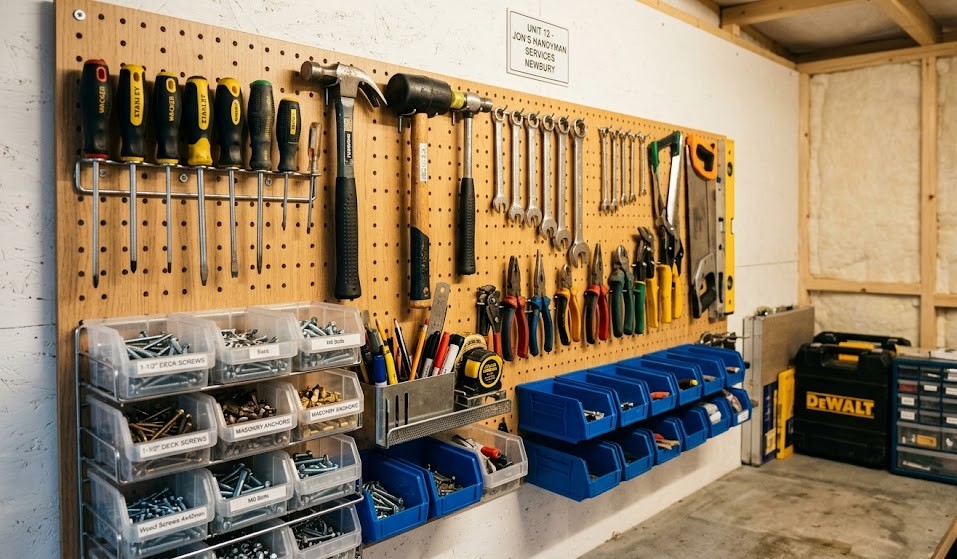
Create a tool shadow board for frequently used hand tools. This isn’t just about looking professional (though it does). When each tool has a designated outline on the wall, you immediately notice what’s missing before you leave for a job. It’s like a visual inventory system that takes seconds to check.
Climate matters for certain materials. Adhesives, sealants, and some paints deteriorate in extreme temperatures. If you’re storing temperature-sensitive materials, consider how the unit’s conditions might affect them. Wood-based materials also benefit from consistent conditions to prevent warping.
The Van-to-Storage Workflow
Your storage unit shouldn’t be a static archive. It’s an active part of your working system. Develop a routine that keeps both your van and storage unit organised.
At the end of each working week, spend 30 minutes restocking. Return tools and materials from completed jobs to the storage unit. Restock your van with supplies for the following week’s scheduled jobs. This regular rhythm prevents the gradual chaos that occurs when you’re constantly borrowing from your storage without returning items.
Keep a job box system in your storage unit. These are pre-packed boxes for common job types. For example, a basic plumbing job box might contain pipe cutters, PTFE tape, various washers, jointing compound, and spare compression fittings. When a plumbing job comes in, you grab the relevant box rather than assembling supplies from scratch. After the job, you restock the box and return it to storage.
This approach works particularly well for emergency callouts. When someone rings at 6pm with a burst pipe, you can’t afford to spend 20 minutes gathering supplies. Your pre-packed emergency boxes mean you’re on the road in minutes.
Material Storage Best Practices
Different materials demand different storage approaches. Getting this wrong doesn’t just create mess – it creates waste – like the difference between storing wine in a proper cellar versus leaving bottles in a hot shed where temperature swings ruin the contents.
Timber and sheet materials must be stored flat or properly supported to prevent warping. Lean them at too steep an angle for too long, and they’ll develop permanent bends. Use vertical storage racks that support the material along its length, or stack flat with spacers between sheets to allow air circulation.
Liquids and chemicals need careful consideration. Store paints and solvents away from heat sources and ensure lids are tightly sealed. Keep them at ground level – if a container leaks, you want it contained rather than dripping onto items below. Group flammable materials together and away from electrical equipment.
Fixings and small components multiply rapidly. Before long, you’ve got jars of screws, boxes of nails, bags of wall plugs, and packets of washers scattered everywhere. Invest in a proper organiser system with multiple small drawers. Sort by size and type, and label clearly. The 30 seconds you save not searching for the right screw size adds up significantly over a year.
Power tool batteries require special attention. Lithium-ion batteries (used in most modern cordless tools) shouldn’t be stored fully charged or completely flat. The ideal storage charge is around 40-50%. They also prefer moderate temperatures – extreme heat or cold reduces their lifespan. If you’re storing batteries long-term, check and top them up every few months.
Inventory Management for Handymen
You don’t need expensive software to manage inventory effectively. A simple spreadsheet or even a notebook works if you maintain it consistently.
Record three key pieces of information for each significant tool: purchase date, current location (van or storage), and condition notes. For materials, track quantity on hand, reorder level, and supplier details. This takes about 10 minutes per week to maintain but prevents both stockouts (turning up to a job without necessary materials) and overstocking (buying duplicates of items you already own).
Set calendar reminders to review your inventory quarterly. This is when you identify tools that need servicing, materials approaching expiry dates, and equipment you no longer use that could be sold to free up space and generate cash.
Security Considerations
Your tools represent a significant investment – potentially thousands of pounds for an established handyman. Protecting this investment matters.
When choosing storage, security features should be a primary consideration. Look for facilities with comprehensive CCTV coverage, individual unit alarms, and controlled access systems. Personal storage facilities that cater to business users often understand these requirements better than general storage providers.
Don’t rely solely on the facility’s security. Add your own deterrents. Engrave or mark tools with your postcode and business name using an ultraviolet pen. Photograph all significant equipment and keep a record of serial numbers. If tools are stolen, this documentation dramatically improves recovery chances and insurance claims.
Consider your insurance carefully. Standard home insurance rarely covers business equipment adequately, and many policies exclude coverage for items stored off-premises. Specialist trade insurance typically provides better protection and isn’t as expensive as you might expect – often less than £20 per month for comprehensive tool cover.
Scaling Your Business Through Better Organisation
Here’s what most handymen don’t realise: organisation isn’t just about efficiency in your current operation. It’s about creating the foundation for growth.
When you have proper systems in place, taking on an apprentice or subcontractor becomes feasible. You can send them to a job with confidence because you know exactly what equipment’s available and where to find it. Your storage unit becomes a central hub where team members can access what they need without disturbing your home life.
Organised storage also enables you to take on larger, more complex projects. That kitchen renovation requiring specialist tools for three different trades? You’ve got the space to store everything and the system to track it all. The six-week project managing a property refurbishment? You can separate and organise materials by phase without your van becoming a chaotic jumble.
The packaging you use for storing smaller components also matters when you’re scaling up. Professional storage solutions – sturdy boxes, proper labels, protective wrapping for delicate items – present a more professional image when clients see you unloading equipment.
Seasonal Storage Strategies
Handyman work often has seasonal variations. Exterior painting and garden work peak in summer. Heating repairs surge in winter. Gutter cleaning spikes in autumn. Your storage system should accommodate these fluctuations.
During off-peak seasons for particular services, move those tools and materials to less accessible areas of your storage unit. Bring summer equipment forward as spring approaches. This seasonal rotation keeps your most relevant equipment easily accessible whilst maximising space efficiency.
It’s also the ideal time for maintenance. That pressure washer you used constantly through summer? Strip it down, clean it thoroughly, and store it properly before winter. Your winter heating tools? Service them in summer when you’re not relying on them daily. This preventive approach extends equipment life and prevents the frustration of discovering broken tools when you urgently need them.
The Storage Unit as Business Hub
Forward-thinking handymen use their storage unit as more than just a place to keep tools. It becomes a genuine business hub.
Set up a small workbench area for maintenance and repairs. Rather than servicing tools in your kitchen or garage (causing domestic friction), you’ve got a dedicated space. You can leave a partially disassembled tool overnight without anyone complaining.
Create a small office corner with a desk, chair, and filing system for paperwork. Invoices, receipts, instruction manuals, and business documents all have a proper home. This separation between business and personal life becomes increasingly important as your operation grows.
Some handymen even use their storage unit for client meetings when discussing larger projects. It demonstrates professionalism and capability – showing organised, well-maintained equipment reassures clients they’re hiring someone competent and reliable.
Making the Transition
Moving from chaotic tool storage to an organised system feels overwhelming. Where do you even start?
Begin with a complete inventory. Yes, it’s tedious, but you can’t organise what you don’t know you have. Set aside a weekend morning, get every tool and material in one place, and list everything. You’ll probably discover duplicates you’d forgotten about and identify items you no longer need.
Next, decide what stays in your van permanently and what moves to storage. Your daily essentials remain mobile. Everything else goes to storage. Be honest about frequency of use – that specialist tile cutter you’ve used twice in three years doesn’t need van space.
When setting up your storage unit, invest time in the initial organisation. Proper shelving, clear boxes, labels, and logical grouping might take a full day to establish, but it saves hours every subsequent week. Think of it like laying foundations for a building – cutting corners here creates problems that persist.
Professional Standards
Organised tool and material storage isn’t about being fastidious or obsessive. It’s about respecting yourself, your handyman business, and your clients enough to work systematically rather than chaotically.
The handymen who thrive aren’t necessarily the most skilled with tools – they’re the ones who turn up prepared, complete jobs efficiently, and present themselves professionally. That reliability stems directly from having systems that work even when you’re tired, rushed, or juggling multiple priorities.
Moving to dedicated business storage represents an investment in your business’s future. It’s not an expense – it’s the infrastructure that enables you to work smarter, take on better projects, and build the reputation that sustains long-term success.
Newbury Self Store understands that handyman services need storage supporting efficient operations, not generic warehouse space. You need facilities where power tools stay organized, where handyman equipment remains accessible for quick loading, and where tool storage systems let you find everything within minutes. We know that your tools aren’t just equipment – they’re the foundation of professional services that clients depend on.
When you’re ready to transform how you operate, contact us to discuss storage solutions that fit your specific trade requirements. Your tools are the foundation of your livelihood. They deserve better than being jumbled in the back of a van or scattered across your home. Give them – and yourself – the organised system that turns good handymen into exceptional ones.