
 01635 581 811
Every spark trade professional knows the frustration of hunting for a specific cable gauge at 7am when you’re already meant to be on-site. You’ve got hundreds of metres of various cables, boxes of switches, junction boxes stacked somewhere in the van, and that one special fitting you need is buried under three months of accumulated gear. The cost isn’t just the time wasted – it’s the diesel burned driving back to base, the client waiting, and the professional reputation taking a hit.
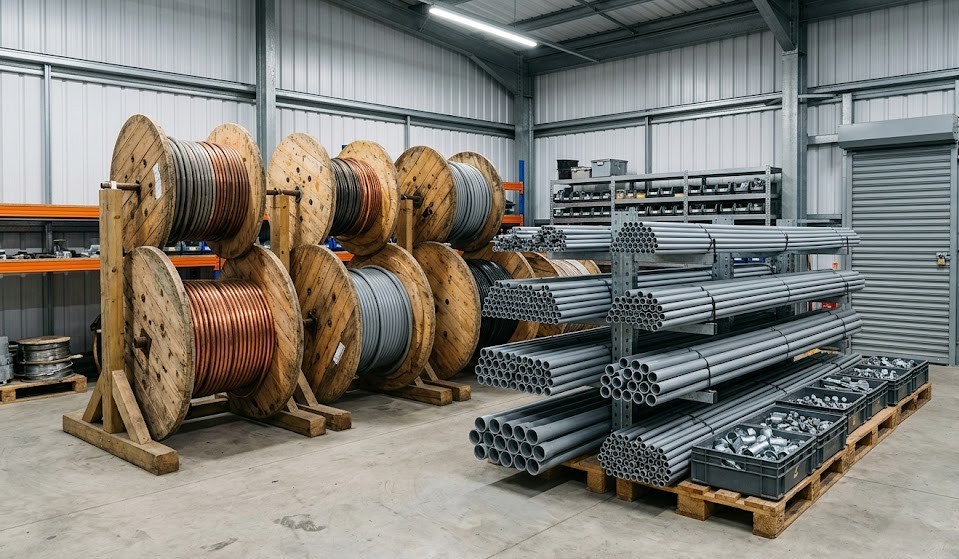
For electricians running lean operations, the challenge of storing bulk cable and electrical fittings efficiently can make or break your monthly margins. Buy in bulk and you’ll save 20-30% on materials, but where do you put 500 metres of 2.5mm twin and earth when your lock-up garage is already rammed? This isn’t just about finding space – it’s about creating electrician cable storage that protects your investment, speeds up job prep, and stops you buying duplicates of items you already own but can’t locate.
Why Bulk Buying Makes Financial Sense (When You’ve Got the Space)
Electrical wholesalers offer substantial discounts on volume purchases. A single 100-metre drum of cable might cost £85, but buy five drums and the unit price drops to £72. Over a year, those savings add up to thousands of pounds – money that could cover your vehicle insurance or fund that new test meter you’ve been eyeing.
The problem? Most electricians operate from home, a small workshop, or a shared yard where space commands a premium. You can’t justify bulk buying if half your stock ends up damaged from damp, crushed under other gear, or simply forgotten because you can’t see what you’ve got.
One Reading electrician bought twenty LED downlight kits on offer at £15 each (normally £25), planning to save £200 on future jobs. He stored them in his shed, stacking them with other materials. Eighteen months later, whilst quoting a job requiring downlights, he bought new ones at full price because he’d forgotten about the stored kits. When he eventually discovered them during a clear-out, moisture had corroded half the terminals, rendering ten kits unusable. Between the forgotten £300 purchase, the £250 spent on replacements, and the £150 lost to corrosion damage, his “saving” had cost him £400. Proper storage with proper inventory management would’ve prevented every bit of that loss.
Smart storage turns bulk buying from a gamble into a genuine competitive advantage. When you know exactly what stock you’re holding, where it’s located, and that it’s in perfect condition, you can quote jobs confidently, complete them faster, and avoid emergency trips to the trade counter where you’ll pay full retail.
The Hidden Costs of Poor Cable Storage
Copper cable isn’t just heavy – it’s valuable. Thieves know this. Leave drums in an unsecured van overnight in certain areas and you’re inviting trouble. But beyond theft, poor cable storage creates multiple cost centres that erode your profits without you necessarily noticing.
Cable damage from incorrect storage’s more common than most electricians admit. Store drums on their side and the weight compresses the cable unevenly, potentially damaging the insulation. Stack them carelessly and the bottom drums get crushed. Leave them in a damp garage and you’re introducing moisture that can compromise connections down the line.
Then there’s the time tax. If you spend fifteen minutes per job hunting for the right cable or fitting, and you complete four jobs per day, that’s an hour of billable time lost daily. Over a year, that’s roughly 250 working hours – more than six working weeks – spent rummaging rather than earning. At an average charge-out rate of £45 per hour, you’ve just identified where £11,250 of potential revenue disappeared.
Duplicate purchasing’s another silent profit killer. Without clear visibility of your stock, you’ll inevitably buy items you already own. How many electricians have three boxes of 20mm glands because they couldn’t remember if they had any left? It’s like packing for a holiday and buying travel-sized toiletries at the airport because you forgot you already packed them – except it happens weekly and costs significantly more.
What Electricians Actually Need to Store
Let’s be specific about what we’re dealing with. The typical self-employed or small electrical contracting business needs to accommodate:
Bulk cable on drums: 1.5mm and 2.5mm twin and earth, 1.0mm three-core and earth, armoured cable for outdoor installations, coaxial and data cables. A single 100-metre drum of 2.5mm T&E weighs around 15kg and measures roughly 400mm in diameter. If you’re holding five different cable types in bulk, you’re looking at significant weight and space requirements.
Boxed cable and flex: Smaller quantities of specialist cables, heat-resistant flex for immersion heaters, fire-rated cable, bell wire. These boxes are typically 300mm x 300mm x 200mm and stack reasonably well, but they need protection from crushing.
Conduit and trunking: Lengths of 20mm and 25mm conduit, plastic trunking in various sizes. These are awkward to store because of their length (typically 3 metres) and tendency to roll around if not secured properly.
Fittings and accessories: Junction boxes, back boxes (25mm and 35mm depths), consumer unit components, MCBs and RCDs, cable clips, grommets, glands, and connectors. Individually small, collectively they represent thousands of pounds of stock that needs systematic organisation.
Lighting stock: Downlight kits, emergency lighting, LED strips, transformers, and drivers. These are often boxed but vulnerable to damage from impact or moisture.
Think of your stock like a professional kitchen’s mise en place – everything in its place, immediately accessible, and in perfect condition. A chef wouldn’t store fresh herbs under a bag of potatoes, and you shouldn’t store precision electrical components under a pile of cable drums.
Why Standard Domestic Storage Falls Short
Your garage seems like the obvious answer until you actually try using it. Domestic garages weren’t designed for trade storage. They’re typically damp (concrete floors, poor ventilation), insecure (standard up-and-over doors can be forced in under a minute), and already occupied by the family’s overflow belongings.
Moisture’s the primary enemy of electrical equipment. Condensation forms when temperature fluctuates, which happens constantly in an unheated garage. That condensation settles on metal components – terminals, screws, clips – causing surface corrosion. You might not notice it immediately, but when you come to use a fitting six months later and find the brass terminals have a green patina, you’ve got a component you can’t install in good conscience.
Temperature extremes affect certain products too. Adhesive cable clips lose their stickiness after repeated freeze-thaw cycles. Plastic conduit can become brittle in sustained cold. While these aren’t catastrophic failures, they create quality issues that reflect poorly on your work.
Security concerns escalate when neighbours and passing opportunists know you’re storing valuable copper cable. Even if you’ve got a decent padlock, a determined thief with an angle grinder can access a domestic garage in minutes. The noise might wake you, but they’ll be gone before you’ve got downstairs.
How Business Storage Solves the Electrician’s Dilemma
Purpose-built business storage addresses every weakness of domestic storage whilst adding capabilities that transform how you operate. The key advantages aren’t just about having more space – they’re about having the right space with the right features.
Climate control eliminates moisture problems entirely. Units maintain consistent temperature and humidity levels year-round, preventing condensation formation. Your brass terminals stay bright, your cable insulation remains flexible, and your electronic components stay within manufacturer specifications. This isn’t a luxury – it’s basic stock protection that prevents hundreds of pounds of waste annually.
Proper security infrastructure includes 24-hour CCTV coverage, perimeter fencing, individual unit alarms, and controlled access systems. Your stock’s safer than it would be in most domestic garages, which matters both for insurance purposes and your peace of mind. You’re not lying awake wondering if someone’s helping themselves to your cable drums.
Flexible access hours mean you can collect materials at 6am before heading to a job, or drop off unused stock at 8pm after finishing late. You’re not constrained by office hours or dependent on someone else being available to let you in. This operational flexibility’s worth more than it might initially seem – it’s the difference between making a 7am start time and arriving at 8.30am because you had to wait for the trade counter to open.
Scalability matters as your business grows. Start with a smaller unit for essential stock, then upgrade to a larger space as your operation expands. You’re not locked into a long-term commercial lease for a workshop you might outgrow or underutilise. The flexibility to scale up or down with three months’ notice gives you operational agility that fixed premises can’t match.
Sizing Your Storage Requirements Accurately
Most electricians overestimate how much space they need because they’re thinking about the chaos of their current storage, not the volume of actual stock. Let’s work through a realistic example.
A typical electrician’s inventory:
- Five cable drums (requiring roughly 1 square metre of floor space when properly stacked)
- Twenty boxes of various fittings and accessories (0.5 square metres on shelving)
- Conduit and trunking (stored vertically in a corner, minimal footprint)
- Lighting stock and specialist items (another 0.5 square metres on shelving)
Add in access space to move around and retrieve items, and you’re looking at 15-25 square metres (roughly 160-270 square feet) for comfortable working storage. That’s smaller than many electricians initially think, especially once you introduce proper shelving and systematic organisation.
For a small electrical contracting business with two or three vans on the road, double that requirement to around 35-50 square metres. The principle remains the same – systematic organisation dramatically reduces the space needed compared to the “pile it in and hope” approach most trades start with.
Start smaller than you think you need. It’s easier to upgrade to a larger unit after three months than to pay for unused space. Plus, starting with limited space forces you to organise properly from day one, establishing habits that’ll benefit you even when you do expand.
Organising Cable Storage for Maximum Efficiency
Here’s where the analogy of a well-run warehouse applies, even if your “warehouse” is a 20-square-metre storage unit. Professional logistics operations don’t achieve efficiency through size – they achieve it through systems – like how you pack for a fishing trip where you don’t throw random tackle in a bag hoping for the best, but check what you’re targeting and select specific gear accordingly.
Store cable drums vertically on their edges, not flat. This protects the cable from compression damage and makes labels immediately visible. Use heavy-duty shelving rated for the weight (a 100-metre drum of 2.5mm T&E weighs around 15kg, but larger drums can exceed 50kg). Position the most frequently used cables at waist height – you shouldn’t be bending down or reaching up for items you access weekly.
Implement a clear labelling system that’s visible from the access aisle. Industrial-style labels showing cable type, gauge, and remaining metres prevent you from unwrapping drums to check what they are. Update the remaining metres after each job – it takes thirty seconds but saves you from turning up to a job with insufficient cable.
Group related items logically. All lighting cables together, all power cables together, all data cables together. This seems obvious, but you’d be surprised how many electricians store items in the order they acquired them rather than by category. Your brain shouldn’t have to work hard to remember where things are – the system should be intuitive.
Create a “job prep zone” near the unit entrance where you can lay out materials for upcoming work. This might just be a folding table, but it transforms how you prepare for jobs. Instead of loading the van in a rush at 6.30am, you can spend thirty minutes the evening before selecting exactly what you need, checking quantities, and loading systematically.
Protecting Fittings and Small Components
Small electrical fittings represent disproportionate value relative to their size. A box of quality MCBs might be 150mm x 100mm x 80mm but contain £200 worth of components. Lose track of these items and you’re haemorrhaging money without realising it.
Invest in a proper small parts storage system – either a multi-drawer cabinet or clear plastic storage boxes on shelving. The key’s visibility and accessibility. You need to see what you’ve got at a glance and retrieve it without unpacking three other boxes.
Categorise by function and frequency of use. Keep everyday items like cable clips, grommets, and common back boxes in the most accessible locations. Specialist fittings for occasional jobs can go on higher shelves or towards the back. This is the same principle supermarkets use – high-turnover items at eye level, specialist products require a bit more effort to locate.
Consider a checkout system where you note what you’ve taken for each job. This sounds bureaucratic, but it takes two minutes and provides crucial data. After three months, you’ll know exactly which items you use most frequently (so you can bulk buy them confidently) and which slow-moving stock’s tying up capital unnecessarily.
The packaging you use for small components matters more than you’d think. Clear plastic boxes with secure lids prevent spillages and make identification instant. Cardboard boxes are cheaper initially but deteriorate over time and don’t protect contents from impacts if something heavy gets stacked on top.
The Real Cost Comparison: Storage vs Alternatives
Let’s examine the actual numbers, because storage costs need to justify themselves against alternatives.
Option 1: Rent a small commercial workshop. In the Newbury area, expect to pay £600-900 per month for a basic unit with roller shutter access. Add business rates (potentially £1,200-1,800 annually), utilities (£100+ monthly), and buildings insurance. Annual cost: £9,000-13,000.
Option 2: Use domestic garage/shed. Appears free, but factor in the opportunity cost. That space could be used for the family car (saving wear and tear from street parking), home gym equipment, or genuine domestic storage that improves household quality of life. Plus, you’re accepting compromised security, moisture issues, and the limitations discussed earlier. Hidden annual cost through damage and inefficiency: £1,500-2,500.
Option 3: Dedicated business storage unit. A 25-square-metre unit with climate control and 24-hour access typically costs £200-280 per month in the Newbury area. No rates, no utilities, no maintenance obligations. Annual cost: £2,400-3,360.
The financial case for business storage becomes compelling when you factor in the operational benefits. You’re not just paying for space – you’re paying for security, climate control, flexibility, and the mental bandwidth that comes from having your business properly organised.
When Container Storage Makes More Sense
For larger electrical contracting businesses or those holding substantial stock for specific projects, container storage offers distinct advantages. These units provide drive-up access, meaning you can reverse your van directly to the door and load materials without carrying them across a car park.
Container storage works particularly well if you’re storing bulk cable drums and conduit that are heavy and awkward to transport. The ability to use a sack truck or pallet jack straight from storage to vehicle eliminates manual handling that’s both time-consuming and a potential injury risk.
The trade-off’s typically less sophisticated climate control than internal units, though modern containers with proper insulation perform better than many electricians expect. For items that aren’t moisture-sensitive (conduit, trunking, certain fittings), this is perfectly adequate. For electronic components and precision items, you’d want internal storage.
Consider a hybrid approach – container storage for bulk materials and heavy items, with a smaller internal unit for valuable components and anything requiring climate control. This optimises cost whilst ensuring everything’s stored appropriately.
Building a Stock Management System That Actually Works
The storage unit’s just infrastructure – the real efficiency comes from how you manage what’s in it. You don’t need complicated software; you need a system you’ll actually maintain.
Start with a simple inventory list – a spreadsheet showing item description, quantity, location within the unit, and reorder level. Update it weekly, not daily (daily’s too onerous and you won’t maintain it). The location column’s crucial: “Shelf 2, third box from left” is infinitely more useful than just “in storage.”
Photograph your storage layout on your phone. When you’re at a supplier deciding whether to buy something, you can check the photo to see if you’ve already got it rather than relying on memory. This simple habit prevents duplicate purchases that can easily cost £50-100 per month.
Implement a “one in, one out” rule for slow-moving items. If you buy a new box of specialist fittings, commit to using the existing stock first. This prevents accumulation of items you’ll never realistically use, which ties up capital and clutters your system.
Set quarterly review dates where you assess what’s not moving. Be ruthless. That box of fittings you bought for a specific job three years ago but never used? Sell it on eBay or a trade forum at 50% of cost. Getting £40 back for something gathering dust is better than letting it sit there indefinitely.
Making Storage Work with Your Workflow
The best storage system integrates seamlessly with how you actually work, not how you think you should work. Be honest about your patterns and build around them.
If you typically plan jobs the evening before, set up your electrician cable storage so you can access it after 6pm without restriction. Spend thirty minutes selecting materials, checking quantities, and loading the van properly. You’ll start the next day with confidence rather than that nagging worry you’ve forgotten something.
If you prefer morning preparation, choose storage with early access (6am or earlier) and locate it close to your typical first job area. The extra ten minutes of drive time to collect materials needs to be offset by reduced travel time to the job site.
Create job-specific kits for recurring work types. If you regularly install consumer units, keep a plastic crate with the common components you need (MCBs, RCDs, earth bars, labels, etc.). When that job type comes up, you grab the crate plus the specific items for that installation. This is how professional photographers work – a basic kit that covers 80% of requirements, plus specific additions for particular shoots.
The Long-Term Business Impact
Proper storage infrastructure isn’t just about tidiness – it’s about building a business that’s more valuable, more profitable, and more enjoyable to run. After twelve months of systematic storage and stock management, electricians typically report several tangible improvements.
Faster job completion because you’re not making mid-job trips to suppliers. That means more jobs per week without working longer hours. If you can fit in one additional small job per week at £200, that’s £10,400 additional annual revenue from pure efficiency gains.
Improved cash flow because you’re buying in bulk when prices are favourable rather than buying retail in emergencies. The difference between planned bulk purchasing and emergency retail buying’s typically 25-30%. On £15,000 of annual material costs, that’s £3,750-4,500 staying in your pocket.
Professional credibility improves when you consistently arrive on time with the right materials. Clients notice. They refer you to friends. You can charge slightly more because you’re reliable. This reputational benefit compounds over years.
Newbury Self Store understands that electricians need cable storage supporting efficient operations, not generic warehouse space. You need facilities where bulk cable stays protected, where electrical fittings remain organized, and where you can access materials quickly before early morning jobs. We know that your electrical equipment isn’t just stock – it’s the foundation of professional installations that clients depend on.
If you need help determining the right storage size for your electrical business or want to discuss security features and access options, contact us to discuss how we can support your operations. Proper electrician cable storage protects your investment and ensures every job starts with organized, accessible materials.