
 01635 581 811
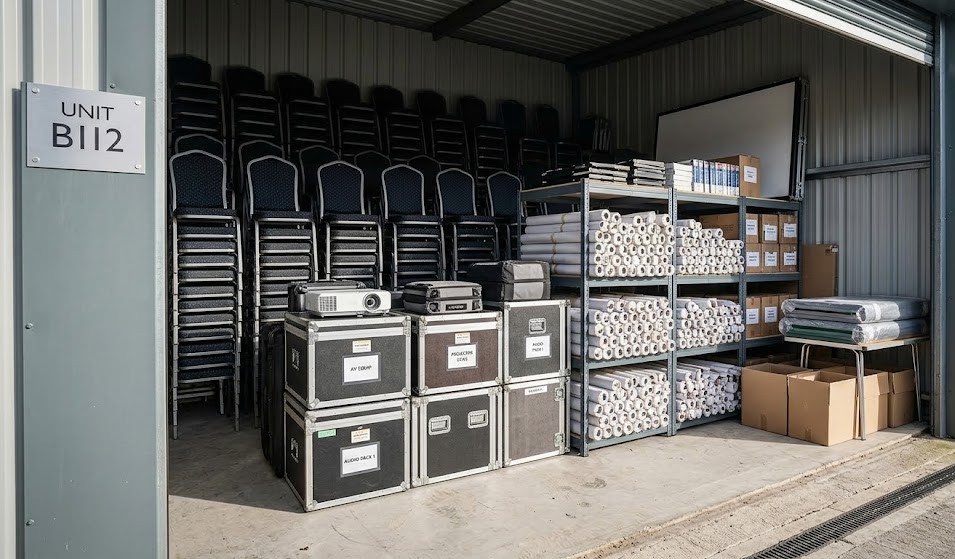
Training companies face a unique logistical puzzle that most businesses never encounter. You’re not just managing inventory – you’re coordinating laptops, projectors, first aid dummies, safety harnesses, catering equipment, and printed materials across multiple course locations, often with just hours between sessions. One day you’re delivering manual handling training in Reading, the next you’re running fire safety courses in Thatcham, and by Friday you need everything set up for a two-day leadership workshop in Newbury.
The challenge isn’t just about having the right kit. It’s about knowing where everything is, ensuring it’s in working order, and getting it to the next location without turning your car into a permanent storage unit or losing half your equipment in the process. When a client books a course with 48 hours’ notice, you can’t afford to spend three hours hunting through boxes in your garage for the correct training manuals.
Flexible training company equipment storage between course locations transforms how training companies operate, cutting setup time, protecting expensive equipment, and creating a professional buffer zone that lets you scale without chaos.
Why Training Companies Need More Than Just a Spare Room
Most training businesses start the same way. Equipment lives in a spare bedroom, the garage, or the boot of your car. For the first dozen courses, this works. Then you win a contract with a corporate client who needs monthly sessions. Suddenly you’re buying duplicate equipment because you can’t find the original, or you’re cancelling evening plans to reorganise boxes before tomorrow’s course.
The problem multiplies when you employ associate trainers. They need access to standardised equipment packs, but you can’t give everyone a full set – the cost would be ridiculous. You end up playing equipment coordinator, meeting trainers in car parks to hand over boxes, or worse, discovering mid-course that someone’s turned up without the vital demonstration materials.
Here’s what changes when training companies outgrow home storage:
Equipment gets damaged. Projectors don’t belong in damp garages. Laptops shouldn’t live in car boots where temperature swings from freezing to baking. Training mannequins for first aid courses deteriorate when stored improperly. One ruined piece of kit before a high-value course costs more than months of proper storage.
Time disappears into logistics. You’re spending billable hours packing, unpacking, and searching for training equipment instead of developing new courses or winning clients. When you calculate the actual cost of this time, home storage becomes remarkably expensive.
Scaling becomes impossible. You can’t take on more courses if you’re already at capacity managing the equipment you have. The training business plateaus not because demand isn’t there, but because your logistics can’t handle growth.
What Training Equipment Actually Needs
Different training specialisms demand different storage approaches, but the fundamentals remain consistent. Your equipment needs to be accessible, organised, protected, and ready to deploy at short notice.
Technical training equipment – laptops, tablets, projectors, sound systems – requires climate control. Electronics hate moisture and temperature extremes. A projector that’s been sitting in a cold garage needs warm-up time, and condensation can cause failures. These items also need security. A single laptop theft might not break the bank, but losing ten devices loaded with course materials and client data creates serious problems.
Physical training materials – mannequins, safety equipment, demonstration tools – need space and organisation. First aid training dummies aren’t small, and if they’re crushed under boxes of paperwork, they won’t look professional when you unpack them in front of a corporate client. Harnesses and safety equipment must be stored correctly to maintain certification standards.
Consumables and printed materials need dry, accessible storage. Training manuals, workbooks, certificates, and stationery can’t arrive at course locations damp or dog-eared. You also need enough space to stock up when you get good printing deals, rather than paying premium prices for rush orders before each course.
Catering and comfort items – urns, coffee supplies, extension leads, flip charts – are the unglamorous essentials that make courses run smoothly. They’re also the items most likely to be forgotten when you’re storing everything chaotically.
Think of your storage space as a deployment centre, not a dumping ground. Everything should have a logical place, and you should be able to load a car for any course type in under 30 minutes.
How Professional Storage Changes Your Operations
Imagine this scenario: A facilities manager from a manufacturing company calls on Tuesday afternoon. They’ve had a workplace incident – nothing serious, but it’s highlighted gaps in their first aid training. Can you run a course for 20 people on Thursday?
With proper equipment storage systems, this becomes straightforward rather than stressful. Your equipment’s organised by course type. You know exactly what’s in stock, what condition it’s in, and where to find it. You can confirm the booking immediately, collect what you need, and focus on delivering excellent training rather than scrambling for supplies.
This is what changes when training companies adopt dedicated equipment storage:
Course-specific packing becomes systematic. You create standardised equipment lists for each training type. First aid courses need mannequins, training defibrillators, bandages, and scenario cards. Manual handling courses need demonstration weights, lifting aids, and safety posters. Everything for each course type lives together, clearly labelled. Your associate trainers can collect pre-packed kits without your involvement.
Equipment maintenance improves dramatically. When everything has a proper home, you notice when items need replacing or repairing. Batteries get charged between courses. Projector bulbs get checked. Training materials get updated when new regulations come in. This systematic approach prevents the nightmare of discovering broken equipment when you’re packing the night before a course.
Vehicle logistics simplify. Your car stops being a mobile warehouse. You load up for specific courses, deliver the training, and return equipment to storage afterwards. This extends vehicle life, reduces fuel costs from carrying unnecessary weight, and means your car’s available for normal business use without unpacking boxes first.
Inventory control becomes possible. You can implement simple stock management – even just a spreadsheet – that tracks what you own, where it is, and when it needs replacing. This prevents duplicate purchases and helps with insurance documentation.
Organising Storage for Quick Deployment
The difference between adequate storage and excellent storage lies in organisation. Having space means nothing if you still can’t find what you need quickly. Professional training companies treat their storage units like well-run stockrooms, not overflow car parks – like the difference between a professional kitchen where every tool has its place and a cluttered home kitchen where you’re always searching for the right utensil.
Zone your space by course type. Dedicate specific areas to different training specialisms. Health and safety equipment in one section, technical training kit in another, soft skills materials in a third. Within each zone, use shelving units rather than stacking boxes on the floor. Shelving lets you see what you have and access items without moving everything else.
Label obsessively. Every box, every shelf, every equipment case should be clearly labelled with its contents and the course types it’s used for. Use a consistent labelling system – handwritten labels on random boxes don’t cut it when you’re in a hurry. Printed labels or a label maker creates professional clarity.
Create deployment checklists. Keep laminated checklists for each course type in your storage space. When you or an associate trainer needs to pack for a first aid course, the checklist ensures nothing gets forgotten. These lists also help when restocking after courses – you can quickly identify what’s been used and needs replacing.
Implement a booking-out system. If multiple trainers use the same storage, you need to know what’s out on courses and what’s available. This can be as simple as a whiteboard showing equipment status or a shared digital calendar. The system prevents double-booking equipment and the chaos of turning up to pack for a course only to discover someone else has the kit you need.
Maintain a returns area. When equipment comes back from courses, it shouldn’t go straight back on shelves. Create a returns zone where items get checked, cleaned, and assessed before being restocked. This quality control step prevents damaged or incomplete equipment from being packed for the next course.
One health and safety training company uses colour-coded boxes – red for first aid, blue for manual handling, green for fire safety. They’d been struggling with a 90-minute packing time before each course, often discovering missing items mid-pack. After implementing the colour-coded system with clearly labelled shelving, they reduced packing to 20 minutes per course. Over a year running 180 courses, that saved them 210 hours – the equivalent of five working weeks. They calculated the time savings alone paid for 18 months of storage costs, and that’s before factoring in eliminated stress and improved reliability.
The Security Question for High-Value Training Kit
Training equipment represents substantial investment. A basic first aid training setup might cost £2,000-£3,000. Technical training equipment with laptops, projectors, and specialist software can easily reach £10,000-£15,000. Health and safety training equipment, particularly for working at height or confined spaces, adds up quickly.
This equipment needs proper security, not just for insurance purposes but for business continuity. Losing your training kit means cancelling courses, disappointing clients, and damaging your reputation whilst you replace everything.
24/7 monitored security should be non-negotiable for training companies. Look for storage with CCTV coverage, alarm systems, and secure access controls. Individual unit alarms provide additional protection for high-value equipment. These security measures also help with insurance – many insurers offer better rates when equipment’s stored in professionally secured facilities rather than domestic premises.
Access flexibility matters too. Training courses often run early mornings, evenings, or weekends. You need storage that accommodates these schedules without paying premium rates for out-of-hours access. Extended access hours or 24/7 availability means you can collect equipment when it suits your course schedule, not when the storage facility decides to be open.
Insurance documentation becomes simpler when you have a fixed, secure storage location. Insurers want to know where your equipment lives, how it’s protected, and what security measures are in place. Professional storage facilities provide documentation that satisfies insurance requirements far more easily than trying to explain your garage security arrangements.
Scaling Your Training Business Without Logistics Chaos
Growth creates different problems. When you’re running 50 courses a year, you can probably manage with improvised systems. When you’re running 200 courses with multiple trainers, improvisation fails.
Dedicated storage enables delegation. You can give associate trainers access to collect equipment without your involvement. They arrive, use their access code, collect the pre-packed kit for their course type, and deploy. After the course, they return equipment to the designated returns area. You’re no longer the bottleneck in your own business.
Bulk purchasing becomes viable. When you have proper storage space, you can take advantage of good deals on consumables. Buy training manuals in bulk when the price is right. Stock up on first aid supplies. Order promotional materials for multiple courses. This reduces per-course costs and ensures you’re never caught short.
Equipment redundancy becomes affordable. As you grow, having backup equipment stops being a luxury and becomes essential. A spare projector, backup laptops, duplicate first aid mannequins – these items prevent single points of failure. With adequate storage, you can maintain this redundancy without turning your home into a warehouse.
Specialisation becomes possible. When you’re not constrained by storage space, you can diversify your training offerings. Add new course types, invest in specialist equipment, develop niche training programmes. Each new specialism needs its own equipment set, and proper storage makes this expansion manageable rather than overwhelming.
Seasonal and Contract-Based Storage Needs
Training demand isn’t constant throughout the year. Many companies run intensive training programmes at specific times – new staff inductions in September, compliance refreshers before year-end, safety training before busy seasons. Your storage needs flex with these patterns.
Contract work creates spikes. Win a contract to train 300 staff over three months, and suddenly you need triple your normal equipment levels. You’re running multiple courses simultaneously, possibly with different trainers in different course locations. This isn’t the time to be juggling equipment between courses or making do with inadequate supplies.
Flexible storage arrangements let you scale up for contracts without long-term commitments to space you won’t always need. You might need a larger unit for the contract duration, then scale back afterwards. This flexibility prevents you from either turning down lucrative work because you can’t handle the logistics, or paying for excess space year-round.
Seasonal equipment has different needs. Some training equipment only gets used during specific periods. Outdoor safety training kit might be summer-focused. Certain industry-specific courses might cluster around compliance deadlines. This seasonal equipment needs storage that keeps it in good condition during off-periods without cluttering your active deployment area.
The Real Cost of Inadequate Equipment Storage
Training companies often delay investing in proper storage because the immediate costs are visible whilst the benefits seem intangible. But inadequate storage has very tangible costs that most training businesses don’t properly calculate.
Time costs compound daily. If you spend an extra hour per course on equipment logistics – finding items, packing, unpacking, reorganising – that’s 200 hours annually for a company running 200 courses. At a billable rate of £50-£100 per hour, you’re losing £10,000-£20,000 in opportunity cost. Proper storage typically costs a fraction of this.
Equipment replacement accelerates. Poorly stored equipment deteriorates faster. Electronics fail from temperature and moisture damage. Training materials get crushed or damp. Safety equipment degrades when stored improperly. You’re replacing items years earlier than necessary, and often at inconvenient times – right before courses when you’re paying premium prices for rush delivery.
Professional image suffers. Turning up to corporate training with equipment that looks like it’s been stored in a shed doesn’t inspire confidence. Creased materials, dusty equipment, or items that don’t work properly because they’ve been poorly stored all damage your professional reputation. Clients notice, even if they don’t comment directly.
Growth stalls. When equipment logistics consume increasing amounts of time, you hit a ceiling. You can’t take on more courses because you’re already overwhelmed managing what you have. The training business plateaus not from lack of demand, but from operational constraints that proper storage would eliminate.
Choosing Storage That Works for Training Companies
Not all storage facilities suit training company needs. Location, access, and facility standards matter enormously when you’re regularly collecting and returning equipment on tight schedules.
Proximity to your operating area is crucial. Storage that’s 30 minutes away might seem acceptable until you’re making multiple trips weekly. Calculate the real time cost – driving time, loading, unloading – and you’ll realise that slightly more expensive storage that’s 10 minutes away actually costs less in total.
Drive-up access eliminates hassles. Training equipment isn’t always light or compact. First aid mannequins, boxes of materials, technical equipment – you need to load vehicles efficiently. Container storage with direct vehicle access means you can reverse up to your unit and load directly, rather than trolleying equipment through corridors or dealing with lifts.
Climate control protects investments. For training companies storing electronics, printed materials, or equipment that needs to maintain calibration, climate-controlled storage isn’t optional. Temperature and humidity stability prevents damage and ensures everything works reliably when you need it.
Facility standards reflect on your training business. Clean, well-maintained, professionally run storage facilities indicate that your equipment’s being properly cared for. This matters for insurance, for your own peace of mind, and occasionally for client audits if you’re working with larger organisations that want to verify your operational standards.
Making Storage Work as Part of Your Training Operations
The most successful training companies treat storage as an integral part of their operational infrastructure, not an afterthought. They invest time in setting up systems that save hours later.
Create equipment packs for each course type. Rather than storing individual items, bundle everything needed for specific courses into complete packs. A first aid training pack contains everything from mannequins to certificates. A manual handling pack includes all demonstration equipment and materials. These packs can be grabbed and deployed immediately.
Schedule regular maintenance sessions. Block out time monthly to visit your storage, check equipment condition, update materials, restock consumables, and reorganise as needed. This proactive approach prevents the gradual descent into chaos that happens when storage gets neglected.
Document everything. Maintain an inventory spreadsheet showing what equipment you own, where it’s stored, its condition, and when it needs replacing. Include purchase dates and costs for insurance purposes. This documentation seems tedious until you need to make an insurance claim or quickly check if you have enough equipment for a large contract.
Train your team on the system. If associate trainers use your storage, they need to understand the organisation system, the booking-out process, and the returns procedure. A simple written guide and a quick walkthrough prevents confusion and maintains the system’s integrity.
When Your Training Business Outgrows Current Arrangements
You’ll know it’s time to upgrade your storage when the same problems keep recurring. You’re constantly searching for equipment. You’ve cancelled or nearly cancelled courses because you couldn’t find essential items. Your car’s become a permanent storage unit. You’re turning down work because logistics feel overwhelming.
These aren’t signs of failure – they’re signs of success. Your training business has grown beyond its initial setup, and your operational infrastructure needs to catch up.
Newbury Self Store understands that training companies need more than empty space – you need systems that support rapid deployment, secure facilities that protect high-value equipment, and flexible arrangements that accommodate contract-based demand spikes. We know that your training equipment isn’t just kit – it’s the foundation of your professional reputation and your ability to deliver excellent courses.
Whether you’re a sole trader running 50 courses annually or a growing company with multiple trainers and specialisms, proper business storage supports your operations rather than complicates them. Professional storage isn’t an expense – it’s infrastructure that enables growth, protects investments, and frees your time to focus on what training companies actually do: delivering excellent training that changes how people work.
Contact us to discuss your training company’s specific storage requirements. We’ll help you create storage solutions that match your operational patterns, protect your equipment investments, and give you the logistical foundation to scale your training business confidently.