
 01635 581 811
Private tutors accumulate an astonishing amount of teaching materials over the years. Textbooks from different exam boards, carefully laminated flashcards, manipulatives for maths lessons, science equipment, art supplies, past papers organised by year and topic – it adds up fast. Before you know it, your spare room resembles a small classroom, and you’re tripping over boxes of resources you haven’t touched in months.
The challenge isn’t just the volume. It’s the constant cycle of needing certain teaching resources for specific students, then storing them away until the next academic year. You can’t simply throw everything out because that carefully annotated set of GCSE biology revision cards took hours to create. But keeping everything at home means living in perpetual clutter, and good luck finding that specific worksheet when a student needs it tomorrow.
This is where strategic private tutor resource storage makes a tangible difference. Not just shoving boxes in a garage, but creating a system that protects your investment in educational materials whilst freeing up your living space.
Why Private Tutors Need Dedicated Storage Space
Running a tutoring business from home sounds convenient until you’re hosting a Year 11 student in your dining room whilst your family wants dinner. The professional boundaries blur, and the physical boundaries of your home start feeling inadequate.
Teaching resources aren’t like office files that fit neatly in a drawer. You’ve got poster-sized periodic tables, three-dimensional geometry models, musical instruments for theory students, and that collection of vintage literature texts you picked up at car boot sales. Each subject you teach multiplies the storage problem.
Many private tutors work with seasonal demand patterns. Summer sees an influx of students preparing for September exams or catching up after poor results. January brings the GCSE and A-Level revision rush. Between these peaks, you’re storing materials that take up valuable space but generate no income whilst they sit idle.
Climate and condition matter tremendously. Paper-based resources deteriorate in damp garages. Laminated materials can warp in fluctuating temperatures. Electronic equipment needs protection from moisture. That’s before considering the security aspect – quality teaching materials represent hundreds or thousands of pounds of investment.
What Teaching Materials Actually Need Storage
Let’s be specific about what accumulates:
Printed and paper resources:
- Textbooks spanning multiple exam boards (AQA, Edexcel, OCR, WJEC)
- Revision guides organised by subject, level, and year group
- Past papers with mark schemes, often spanning 5-10 years
- Workbooks and practice materials for different abilities
- Reference books and subject-specific literature
- Laminated flashcards and revision cards
- Printed worksheets filed by topic
- Display posters and visual aids
- Annotated examples and model answers
- Personalised resources you’ve developed over years
Subject-specific equipment:
- Science: Models, specimens, basic lab equipment, safety gear
- Maths: Manipulatives, geometric tools, calculators, measuring equipment
- Languages: Audio materials, cultural artefacts, dual-language books
- Music: Instruments, sheet music, recording equipment
- Art: Supplies, portfolios of example work, display materials
Technology and teaching aids:
- Laptops, tablets, and charging equipment
- Whiteboards and easels
- Projectors or display screens
- Audio equipment for language teaching
- Specialist software and subscriptions on physical media
Think of it like this: if a primary school teacher’s classroom is your benchmark, you’re essentially storing the equivalent of 3-4 different classrooms’ worth of materials to serve students across multiple subjects and levels.
The Real Cost of Home Storage Chaos
Here’s what actually happens when tutors try managing everything at home without a proper system.
Time wastage becomes chronic. You spend 15 minutes searching for that specific worksheet before a lesson. Multiply that across 20 students per week, and you’ve lost five hours – nearly a full working day – just hunting for materials. That’s five students you could’ve taught instead.
Materials get damaged or lost. That box of carefully organised Year 9 maths resources? It’s been in the loft for eight months, and now the damp’s got to it. The lamination’s peeling, and some worksheets are unusable. You’ll need to recreate or replace them, costing time and money.
Professional image suffers. When a parent visits to discuss their child’s progress, they see stacks of teaching materials in your hallway. It doesn’t scream “professional educational service.” First impressions matter, especially when parents are investing significantly in their child’s education.
Family space gets compromised. Your partner wants to use the spare room as a home office. Your children need space for their own studies. But it’s full of your teaching resources, creating domestic tension that’s entirely avoidable.
One tutor specialised in 11+ preparation and GCSE English. She’d accumulated resources over seven years, filling two bedrooms in her three-bedroom house. When her family expanded with a second child, she faced a choice: stop taking students in certain age groups, limit her business growth, or find a storage solution. She chose personal storage, organised her materials by term and student level, and now accesses what she needs on a rolling basis. The monthly cost was £120, but she calculated she’d saved 8-10 hours monthly in searching time – worth over £400 at her tutoring rate. Her home feels like a home again, and her tutoring business actually grew by 30% because she could work more efficiently and take on additional students in age groups she’d previously turned away.
Organising Materials Before Storage
You can’t just box everything up randomly and hope for the best. Effective private tutor resource storage starts with ruthless organisation.
Audit everything first. Go through every resource and ask: Have I used this in the past year? Is it current with exam specifications? Could I easily recreate this if needed? Be honest. That set of worksheets from 2015 based on the old syllabus? They’re not coming back into rotation.
Sort by access frequency. Some materials you’ll need weekly – current term resources, frequently used revision aids, core textbooks. Others are seasonal – exam-specific materials used only in spring, or summer catch-up resources. A third category’s archive material: things you might need occasionally but not regularly.
Categorise systematically:
- Box by subject and level (Year 7 Maths, GCSE Biology, A-Level History)
- Use clear plastic storage boxes so you can see contents at a glance
- Label everything comprehensively – not just “English” but “GCSE English Lit – Poetry Anthology 2015-2025”
- Maintain a master inventory spreadsheet listing box numbers and contents
- Photograph the contents of each box before sealing
Protect materials properly. Use acid-free storage for paper materials you’re keeping long-term. Seal electronics in bags with silica gel packets. Wrap delicate items individually. This isn’t excessive – it’s protecting your professional assets.
Think of your storage system like a library. Librarians don’t just pile books randomly. They catalogue, organise by subject and reference number, and create systems that let them locate any book within minutes. Your teaching resources deserve the same respect.
Choosing the Right Storage Solution
Not all storage options suit tutoring materials equally well.
Home storage limitations are real. Lofts get hot in summer and cold in winter – terrible for paper and electronics. Garages often have moisture issues. Spare rooms might work temporarily, but they’re not a long-term solution if you need that space for living.
Self-storage offers specific advantages for private tutors:
Climate control protects paper-based resources. Books, worksheets, and printed materials stay in consistent temperature and humidity, preventing warping, mould, and deterioration. This matters when you’re storing teaching materials worth hundreds of pounds and countless hours of preparation time.
Security means peace of mind. Quality teaching resources, especially specialist equipment and technology, represent significant investment. Proper security systems, CCTV, and individual unit locks protect these assets far better than a home garage.
Flexible access suits tutoring schedules. You need to collect next week’s materials on Sunday evening, or grab exam papers on a Wednesday afternoon between students. Extended access hours accommodate your working pattern.
Scalability matches business growth. Start with a smaller unit for archive materials. As your tutoring business expands into new subjects or levels, you can upgrade to larger space. You’re not locked into a fixed home storage footprint.
When considering business storage, think about access patterns. If you’re collecting materials weekly, proximity matters more than cost savings from a distant facility. If you’re storing archive materials accessed once per term, you can prioritise cost over convenience.
Practical Storage Strategies for Different Teaching Specialisms
Different subjects create different storage challenges for private tutors.
Academic subjects (English, Maths, Sciences, Humanities): These generate massive paper trails. Organise by exam board first, then by specification year, then by topic. Store current academic year materials separately from archive materials. Keep digital backups of everything you’ve created yourself, but store physical copies of purchased materials and annotated resources.
Creative subjects (Art, Music, Drama): Bulky materials and equipment need more space. Art supplies require organisation by medium – keep paints separate from papers, store canvases vertically to prevent warping. Musical instruments need climate control and careful packing. Drama resources including props and costumes need protection from pests.
Languages: Audio materials, cultural resources, and dual-language texts multiply quickly across different languages. Organise by language first, then by level. Keep listening materials with their transcripts. Store cultural artefacts carefully – they’re often irreplaceable.
Practical subjects (Science practicals, Technology): Safety equipment, models, and demonstration materials need careful storage. Check regulations around storing any chemicals or materials with safety considerations. Keep equipment manuals with the equipment itself.
Setting Up Your Storage Unit Efficiently
Once you’ve got your storage space, maximise its effectiveness.
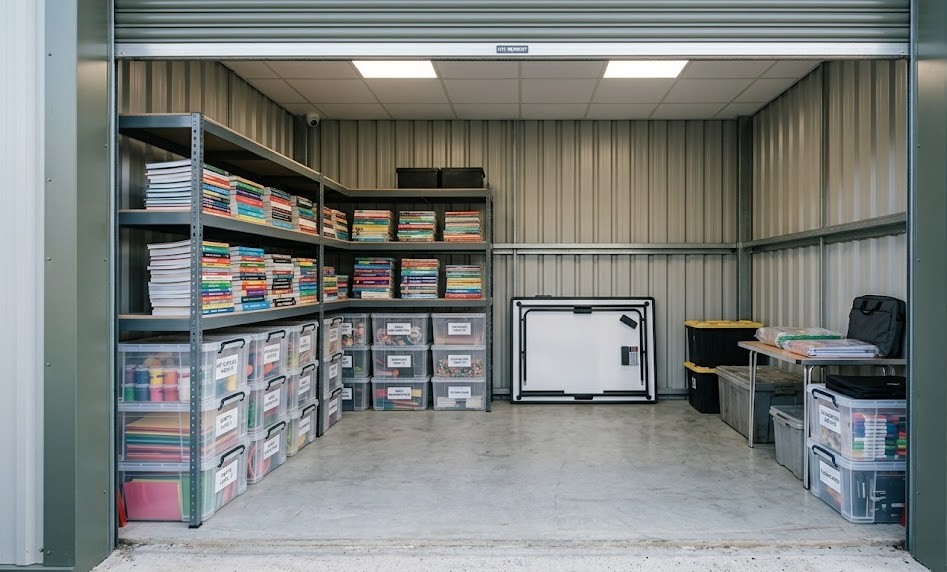
Plan the layout strategically. Place frequently accessed materials near the front. Stack archive boxes at the back. Create a central aisle if space allows, with materials organised logically on either side.
Use vertical space intelligently. Shelving units transform storage capacity. Heavy boxes of textbooks go on lower shelves. Lighter materials like laminated flashcards can go higher. Label shelves clearly so you know what’s where without moving everything.
Protect everything properly. Even in climate-controlled storage, use dust covers for equipment. Elevate boxes slightly off the floor using pallets or boards. This protects against any moisture and improves air circulation.
Maintain clear inventory systems. Keep your master spreadsheet updated. When you remove materials, note it. When you add new resources, log them. This saves enormous time and prevents duplicate purchases because you’ve forgotten what you already own.
Create a retrieval system. Use numbered boxes corresponding to your inventory. Keep a “current term” section that rotates seasonally. Have a small box for “urgent retrieval” items you might need unexpectedly.
Quality packaging materials make a significant difference. Proper storage boxes, bubble wrap for delicate items, and archive-quality materials for long-term storage protect your investment far better than random cardboard boxes from the supermarket.
Seasonal Access Patterns for Tutors
Tutoring follows predictable seasonal patterns that should inform your storage strategy.
September-October: High demand as students settle into new academic years. You need current-year textbooks, introductory materials, and baseline assessment resources readily accessible.
November-February: Steady teaching with increasing focus on mock exams. Past papers, revision materials, and exam technique resources move to the front of your storage.
March-May: Peak exam season. Everything’s about revision, practice papers, and last-minute preparation materials. This is your busiest access period.
June-August: Post-exam lull, then summer catch-up students. You’re rotating out exam materials and bringing in remedial resources, catch-up materials, and preparation for next academic year.
Plan your storage organisation around these cycles. Before each season, do a bulk retrieval of that term’s materials. This is more efficient than multiple trips for individual resources.
When to Consider Larger Storage Solutions
Some tutoring businesses outgrow standard storage units.
Signs you need more space:
- Multiple sets of the same materials for different tutors
- Group teaching equipment like multiple whiteboards
- Administrative materials and business records
- Marketing materials and display equipment for education fairs
Container storage offers drive-up access for larger operations. When you’re loading equipment for a group revision session or rotating seasonal educational materials in bulk, being able to drive right up to your storage makes the process far more practical.
Making Storage Work for Your Tutoring Business
The goal isn’t just storing stuff. It’s creating a system that makes your tutoring business more efficient and professional.
Calculate your actual costs. Compare the monthly storage cost against the value of your time spent searching for materials, the space freed up at home, and the professional image improvement. Most tutors find storage pays for itself within a few months through improved efficiency alone.
Build storage costs into your pricing. If storage’s a legitimate business expense that improves service delivery, factor it into your hourly rates. Parents pay for professional, organised tutoring – storage’s part of delivering that.
Review your system regularly. Every summer, audit what you’ve actually accessed. Materials untouched for two years probably don’t need keeping. Exam specifications change, curricula evolve, and holding onto outdated resources just costs money.
Use storage as a business development tool. When you can confidently tell parents you have comprehensive resources for their child’s specific exam board and level, that’s a selling point. When you can quickly access specialist materials, you can take on students you might otherwise turn away.
Creating Your Storage Action Plan
Stop thinking about this and start doing it. Here’s your practical next steps:
This week: Audit your current teaching resources. Identify what you use regularly versus what’s gathering dust. Create a rough inventory.
Next week: Research storage options in your area. Consider size requirements based on your audit. Factor in access frequency and climate control needs.
Within a month: Visit potential storage facilities. Check security, access hours, and unit conditions. Get quotes for appropriate sizes.
Before next term: Implement your storage solution. Organise materials logically, pack them properly, and create your master inventory. Set up your storage unit with shelving and clear labelling.
The tutors who succeed long-term don’t just teach well – they run efficient, professional operations. Storage’s part of that operational excellence. It’s not an expense; it’s an investment in working smarter.
Newbury Self Store understands that private tutors need more than empty space – you need climate-controlled facilities that protect paper resources, flexible access that works around your teaching schedule, and organized solutions that help you find materials quickly. We know that your teaching resources aren’t just boxes – they’re years of professional development and the tools that help students achieve their potential.
Your teaching materials represent years of professional development and significant financial investment. They deserve better than damp garages and cluttered spare rooms. With proper storage and organisation, you’ll spend less time hunting for materials and more time doing what you do best: helping students achieve their potential.
If you’re ready to reclaim your home space and professionalise your tutoring operation, contact us to discuss storage solutions that actually work for education professionals. Sometimes the best teaching resource is simply knowing where everything is when you need it.