 01635 581 811
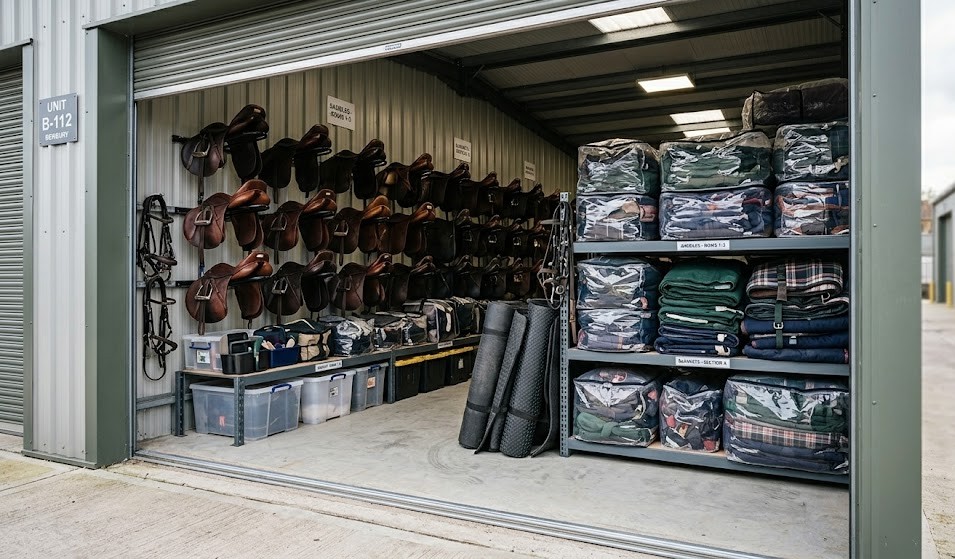
The racehorse training industry demands precision, organisation, and meticulous care of expensive equipment. With racing saddles costing upwards of £2,000, specialised bridles at £300-£500, and delicate racing silks requiring careful storage, trainers face a constant challenge: where to store it all safely when space at the yard becomes scarce.
Racing yards near Newbury know this problem intimately. Between seasonal equipment changes, multiple horses requiring individual tack, and the accumulation of retired gear that’s too valuable to discard, storage space disappears quickly. The tack room that seemed spacious in year one becomes impossibly cramped by year three.
Professional trainers and yard managers increasingly turn to dedicated racehorse equipment storage solutions to protect their investments and maintain operational efficiency. The right approach doesn’t just create space – it extends equipment lifespan, improves workplace safety, and allows businesses to scale without compromising on standards.
Why Racehorse Equipment Requires Specialist Storage Considerations
Racing tack differs fundamentally from standard equestrian equipment. The materials are more delicate, the fit tolerances tighter, and the financial stakes considerably higher. A poorly stored racing saddle can develop mould, lose its shape, or suffer leather degradation that makes it unsafe within months.
Temperature fluctuations pose the primary threat. Leather requires stable conditions between 15-20°C with humidity levels around 40-50%. Drop below this, and leather dries out, cracks, and becomes brittle. Exceed it, and you’re inviting mould, mildew, and metal corrosion on buckles and stirrups.
Consider what happens during a typical British winter. A tack room in an unheated stable block might see temperatures swing from 2°C overnight to 12°C during the day. That’s exactly the cycle that destroys leather goods. The moisture condenses, penetrates the material, then evaporates – repeating this process dozens of times across a season.
Racing silks present their own challenges. These lightweight, often silk or synthetic garments can’t be folded carelessly or crushed under weight. Colours fade when exposed to direct sunlight, and improper storage leads to permanent creasing that looks unprofessional on race day.
A typical racing yard’s equipment inventory includes:
- 25-30 saddles (racing, exercise, breaking-in varieties)
- 40+ bridles and headcollars
- 100+ sets of boots and bandages
- 15-20 sets of racing colours
- Spare girths, stirrup leathers, reins
- Grooming equipment and clipping supplies
- Veterinary supplies and medications
- Seasonal equipment (rugs, fly masks, coolers)
Stack all that in a standard tack room, and you’ve got a recipe for damaged goods and workplace chaos.
Common Storage Challenges Facing Racing Yards
Space constraints hit hardest during peak training seasons. From October through April, when National Hunt racing dominates the calendar, racing yards operate at maximum capacity. Every horse needs multiple sets of racing equipment, and there’s simply nowhere to put it all.
One Lambourn trainer described the problem perfectly: “We had bridles hanging three-deep on hooks, saddles stacked on top of each other, and boots stuffed into every corner. Finding the right piece of kit took ten minutes. We were wasting an hour a day just searching for equipment.” The chaos wasn’t just inconvenient – it was costing them valuable training time every single day.
Security concerns escalate with valuable equipment. A single racing saddle represents a month’s wages for many stable staff. Bridles with specialised bits can cost £400-£600. Leave these items in an accessible tack room, and you’re vulnerable to theft – particularly at yards visible from public roads or bridleways.
Insurance companies increasingly require proof of secure tack storage for high-value equipment. Some policies now mandate specific security measures: locks rated to British Standard BS3621, alarmed premises, or storage in buildings with limited access. Standard tack rooms often don’t meet these requirements.
Seasonal equipment rotation creates another headache. Summer fly masks, lightweight racing sheets, and cooling equipment must be stored somewhere during winter months. Heavy rugs, winter boots, and all-weather gear need space during summer. Without proper storage, these items pile up in corridors, offices, or worse – in damp outbuildings where they deteriorate.
The problem compounds for trainers who’ve expanded their operations. What worked for ten horses becomes unmanageable with twenty. But building additional tack rooms costs £15,000-£30,000 and requires planning permission. That’s a significant investment when you’re unsure whether your current horse numbers represent permanent growth or temporary expansion.
How Professional Storage Solutions Protect Your Investment
Dedicated storage facilities offer climate-controlled environments that standard stable blocks can’t match. Purpose-built units maintain consistent temperature and humidity levels year-round, eliminating the conditions that destroy leather and fabric.
Think of it like storing fine wine. You wouldn’t keep a £500 bottle in a garden shed where temperatures swing wildly. The same principle applies to a £2,000 saddle. Controlled conditions preserve the material, maintain suppleness, and prevent the degradation that makes equipment unsafe or unsightly.
Personal storage facilities near racing centres provide secure, accessible space specifically designed for valuable items. Units come with individual locks, 24-hour security monitoring, and insurance-approved protection that satisfies even the strictest policy requirements.
Flexible sizing solves the expansion problem elegantly. Start with a smaller unit for off-season equipment, then upgrade if your yard grows. No planning permission, no construction costs, no permanent commitment. One trainer uses a 50 square foot unit during summer, expanding to 100 square feet for winter when bulky rugs and equipment accumulate.
The financial calculation makes sense when you factor in equipment replacement costs. A well-maintained racing saddle lasts 10-15 years. Store it poorly, and you’re replacing it in 5-7 years. That’s a £2,000 expense you’ve brought forward by nearly a decade – all because you tried to save £100 monthly on proper storage.
Organising Tack and Equipment for Maximum Efficiency
Proper organisation transforms storage from a dumping ground into a functional system. The goal isn’t just to fit everything in – it’s to create a setup where any team member can locate specific items within 60 seconds.
Start by categorising equipment by function and frequency of use. Daily-use items (racing saddles, standard bridles, boots) need immediate accessibility. Seasonal equipment can sit further back. Retired or backup gear goes to the deepest storage areas.
Zone your storage:
- Active tack zone: Current racing and exercise equipment
- Seasonal storage: Off-season rugs, fly gear, or winter equipment
- Backup and spares: Extra girths, leathers, older saddles kept as reserves
- Supplies area: Grooming products, cleaning materials, spare parts
Label everything. Use a simple coding system – horse name or number, equipment type, date last serviced. When you’ve got 30 bridles, you can’t rely on visual recognition alone. A small label maker costs £20 and saves hours of frustration.
Saddle storage requires particular care. Never stack saddles directly on top of each other – this distorts the tree and ruins the shape. Use proper saddle racks that support the entire panel, or invest in saddle covers that protect from dust whilst allowing leather to breathe. If you’re storing saddles long-term, stuff the seat with acid-free tissue paper to maintain shape.
Bridles should hang from rounded hooks that won’t create pressure points or permanent creases in the leather. Coil reins loosely rather than wrapping them tightly. Check all stored bridles quarterly – leather needs regular inspection even when not in use.
For racing colours and silks, use garment bags that protect from light and dust but allow air circulation. Never store silks in plastic bags – trapped moisture creates the perfect environment for mildew. Cedar blocks or lavender sachets deter moths without the chemical smell of mothballs.
Climate Control Requirements for Different Equipment Types
Not all equipment demands the same environmental conditions, but understanding these requirements prevents costly mistakes. Leather goods (saddles, bridles, boots) need stable temperatures between 15-20°C with 40-50% humidity. Too dry, and leather cracks. Too humid, and mould develops.
Apply leather conditioner before long-term storage – this creates a protective barrier and maintains suppleness. But don’t over-condition. Excess product attracts dust and can actually accelerate deterioration. A thin, even coat every 3-4 months suffices for stored items.
Synthetic tack tolerates wider temperature ranges but still benefits from climate control. Extreme heat can warp synthetic materials, whilst severe cold makes them brittle. The bigger concern’s UV exposure – sunlight degrades synthetic fibres rapidly, causing colours to fade and materials to weaken.
Textiles (rugs, bandages, saddle cloths) need dry, well-ventilated storage. Wash and completely dry everything before storage – even slightly damp items develop mould within weeks. Use breathable storage bags rather than sealed plastic containers. Air circulation prevents musty odours and moisture accumulation.
Metal components (bits, stirrups, buckles) require low humidity to prevent rust and corrosion. Store bits separately in cloth bags or wrapped in acid-free tissue. A light coating of mineral oil protects stainless steel during extended storage. Check stored metal items every few months and remove any corrosion immediately with appropriate metal polish.
The packing materials you choose matter as much as the storage environment. Acid-free tissue paper, breathable garment bags, and proper saddle covers aren’t expensive luxuries – they’re essential protection for valuable equipment.
Security Measures for High-Value Racing Equipment
Racing equipment theft costs the industry hundreds of thousands annually. Saddles disappear from supposedly secure tack rooms, bridles vanish during race meetings, and entire trailers of equipment get stolen from yards. Professional storage facilities offer security that most racing yards simply can’t match.
Look for facilities with 24-hour CCTV monitoring, not just cameras that record footage no one reviews until after a theft. Active monitoring means someone’s watching, and suspicious activity gets challenged immediately. Individual unit alarms add another layer – any unauthorised access triggers an immediate response.
Access control systems track who enters the facility and when. This creates an audit trail that both deters theft and helps recover items if something does go missing. Many facilities now use smartphone-based access, eliminating the problem of lost keys or shared access codes.
Insurance companies recognise this enhanced security. Some insurers offer reduced premiums for equipment stored in approved facilities versus standard tack rooms. Check your policy – the storage cost might be partially offset by lower insurance rates.
For particularly valuable items (championship saddles, custom-made tack, historical equipment), consider photographic documentation before storage. High-resolution photos showing unique characteristics, maker’s marks, and serial numbers make recovery possible if theft occurs and prove ownership for insurance claims.
Seasonal Storage Strategies for Racing Yards
The racing calendar creates predictable storage needs. National Hunt yards face peak demand from October through April, whilst Flat racing operations run hardest from March through October. Smart trainers use this rhythm to optimise their storage approach.
Winter equipment to store during summer:
- Heavy winter rugs and blankets
- All-weather exercise equipment
- Spare winter boots and bandages
- Bulky waterproof gear
This equipment won’t be needed for months. Storing it off-site frees up valuable tack room space for summer operations whilst protecting items from unnecessary handling and dust accumulation.
Summer equipment to store during winter:
- Lightweight summer sheets
- Fly masks and fly boots
- Cooling equipment
- Thin exercise rugs
One Newmarket trainer calculated she reclaimed 40% of her tack room space through seasonal rotation. That’s the difference between cramped, chaotic storage and a functional workspace where staff can actually find what they need. She now rotates equipment like clockwork twice annually, and her team’s efficiency has improved dramatically.
The business storage approach works particularly well for professional training yards. Treat equipment storage as a business expense that improves operational efficiency, just like investing in better facilities or training equipment. The cost-per-month becomes negligible when measured against time saved and equipment preserved.
Inventory Management and Equipment Tracking
Professional yards maintain detailed equipment inventories – not because they enjoy paperwork, but because it prevents chaos and financial losses. When you’re managing tack for 20+ horses, memory alone won’t suffice.
Track these details for each item:
- Equipment type and description
- Purchase date and cost
- Assigned horse or general use
- Current location (yard or storage)
- Condition and service history
Simple spreadsheet software handles this perfectly. Update it monthly, or whenever equipment moves between locations. This takes 15 minutes but prevents the scenario where you’re searching for a specific saddle that’s actually been in storage for three months.
Barcode or QR code systems suit larger operations. Attach small, durable tags to each item, then scan them in and out as they move between yard and storage. Several equestrian-specific inventory apps now offer this functionality, with cloud-based systems accessible from your phone.
Regular audits catch problems early. Schedule quarterly equipment checks – physically verify everything on your inventory list, assess condition, and note items needing repair or replacement. This sounds tedious until you discover a £1,500 saddle developing mould that would’ve been irreparable in another month.
Cost-Benefit Analysis: Storage Versus Expansion
Yard expansion seems like the obvious solution to storage problems, but the numbers often don’t support it. Building a proper tack room costs £20,000-£40,000 depending on size and specifications. Add climate control, security systems, and proper fittings, and you’re approaching £50,000.
Planning permission adds months to the timeline and isn’t guaranteed, particularly in rural areas with strict development controls. Even if approved, construction disrupts yard operations for weeks.
Compare this to dedicated storage. A 100 square foot climate-controlled unit costs roughly £120-£180 monthly in the Newbury area. That’s £1,440-£2,160 annually. You’d need to store equipment for 23-35 years before matching the cost of building a new tack room.
The flexibility matters too. If your business contracts – you lose owners, reduce horse numbers, or shift focus – you’re stuck with an expensive building you don’t need. Storage contracts run month-to-month. Scale up or down based on actual requirements.
Equipment lifespan extension provides hidden value. Proper storage conditions can double the usable life of leather goods. If better storage means replacing saddles every 12 years instead of 6, you’ve saved £2,000 per saddle. For a yard with 20 saddles, that’s £40,000 in avoided replacement costs over a decade – like having an insurance policy that pays out in preserved equipment rather than cash.
Choosing the Right Storage Facility for Racing Equipment
Location matters significantly. You need regular access to stored equipment, particularly during seasonal transitions when you’re rotating gear in and out. Facilities within 15 minutes of your training yards offer the best balance of convenience and cost.
Access hours determine operational flexibility. Twenty-four-hour access means you can retrieve forgotten items before early morning training sessions or store equipment after evening duties. Restricted access facilities cost less but limit flexibility.
Unit size calculation requires honest assessment. Measure your equipment volume, then add 20% for growth and accessibility. Cramming everything into the smallest possible unit defeats the purpose – you need space to organise properly and access items without unpacking everything.
Container storage works well for yards storing large volumes or bulky items. Drive-up access simplifies loading and unloading, particularly when moving seasonal equipment in bulk. Ground-level units eliminate stairs and lifts – crucial when you’re carrying armfuls of heavy winter rugs.
Visit facilities before committing. Check cleanliness, security measures, and actual climate control (ask to see temperature logs, not just marketing claims). Talk to existing customers if possible – they’ll tell you about access problems, security issues, or maintenance concerns that don’t appear in promotional materials.
Protecting Leather Goods During Long-Term Storage
Leather care before storage determines whether your tack emerges ready to use or requires extensive restoration. The process takes time but preserves equipment worth thousands of pounds.
Deep clean everything before storage. Remove all dirt, sweat, and grime using appropriate leather cleaners. Pay special attention to areas where leather contacts the horse – salt from dried sweat accelerates deterioration. Rinse thoroughly and allow to dry completely.
Apply quality leather conditioner once the tack’s clean and dry. Use products specifically formulated for equestrian leather – these maintain suppleness without over-softening or creating sticky residue. Work conditioner into all areas, including hard-to-reach spots around buckles and stitching.
Inspect hardware closely. Check stitching for wear, examine buckles for cracks or weakness, and verify that all components remain secure. Address any repairs before storage – problems only worsen during extended periods of non-use.
Store saddles on proper racks that support the entire panel without creating pressure points. Cover with breathable saddle covers that protect from dust whilst allowing air circulation. Never use plastic covers – trapped moisture creates perfect conditions for mould.
Hang bridles from rounded hooks, ensuring no sharp edges create permanent creases. Stuff browbands and nosebands with tissue paper to maintain shape. Coil reins loosely rather than wrapping tightly – this prevents permanent kinks in the leather.
Check stored leather goods every 8-12 weeks. Look for any signs of mould, excessive drying, or pest damage. Apply a light coat of conditioner if leather feels dry. This quarterly maintenance takes minimal time but prevents deterioration that would otherwise go unnoticed until items return to active use.
Making Storage Work for Your Racing Operation
The racing industry’s demanding schedule leaves little room for equipment problems. When you need specific tack, you need it immediately – not after an hour of searching through chaotic storage or discovering items have deteriorated beyond use.
Professional storage solutions transform equipment management from a constant headache into a streamlined system. Climate-controlled conditions preserve your investment, proper organisation saves time daily, and enhanced security protects against theft and insurance complications.
For yards operating near capacity, storage provides expansion space without construction costs or planning battles. For seasonal operations, it offers flexible solutions that scale with actual needs rather than forcing permanent commitments.
The calculation ultimately comes down to valuing your time and protecting your assets. Equipment worth £50,000-£100,000 deserves storage conditions that preserve its condition and usable lifespan. The operational efficiency gained through proper organisation pays dividends every single day.
Newbury Self Store understands that racing equipment needs more than just empty space. You need climate control that protects expensive leather goods, security that satisfies insurance requirements, and flexible access that matches the unpredictable demands of training yards. We know that your saddles, bridles, and racing colours aren’t just equipment – they’re essential tools of your trade and significant financial investments.
Contact us to discuss storage solutions tailored to racing yards and equestrian operations. Whether you’re managing a small string or a large training establishment, the right storage approach protects your equipment, streamlines your operations, and supports your business growth without the commitment and expense of permanent expansion.