
 01635 581 811
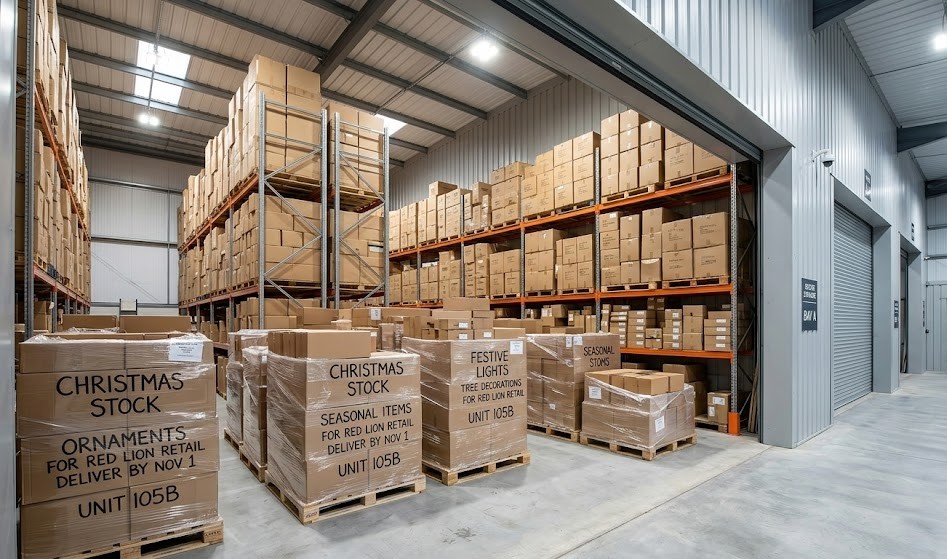
The Christmas trading period accounts for up to 40% of annual revenue for seasonal retailers. Yet most businesses enter their busiest quarter with storage chaos, stock crammed into every available corner, inventory systems breaking down, and valuable selling time lost to hunting for products.
Smart storage planning separates retailers who thrive during peak season from those who merely survive it. The difference isn’t just about having more space. It’s about creating systems that let you access stock quickly, rotate inventory efficiently, and keep your retail floor stocked when customers are ready to buy.
Why seasonal retailers need dedicated storage solutions
Running a seasonal retail business from a single premises creates predictable problems. During quiet months, you’re paying for space you don’t need. When peak season arrives, you’re drowning in stock with nowhere to put it.
Consider a garden centre preparing for Christmas. In September, you’ve got autumn plants, garden tools, and outdoor furniture still selling. By October, you need space for artificial trees, decorations, lights, and seasonal gifts. Without proper seasonal retail storage planning, you’re either refusing stock (and losing sales) or creating a customer experience that feels cramped and chaotic.
Business storage gives you the flexibility to scale space with demand. You’re not locked into a 12-month lease on square footage you’ll only need for three months. Instead, you pay for what you use, when you use it.
The eight-week pre-Christmas storage timeline
Most seasonal retailers start thinking about Christmas storage too late. Here’s what actually works, based on watching hundreds of businesses navigate peak season successfully.
Twelve weeks before peak (early October): Audit your current space honestly. Measure what you’ve got, not what you think you have. Walk your premises with a tape measure and photograph every storage area. You’ll discover corners you’d forgotten and realise that “spare room” is actually full of last year’s unsold stock.
Calculate your peak inventory volume. Look at last year’s stock levels at your busiest point, then add 20% if you’re growing. Most retailers underestimate by at least 30% because they forget about packaging materials, display equipment, and the reality that stock doesn’t arrive in neat, stackable boxes.
Ten weeks before peak (mid-October): Book your storage space now. Flexible storage options fill up as other seasonal businesses make the same calculations you’re making. Waiting until November means accepting whatever’s left, not choosing what works best for your operation.
Think of it like booking accommodation for a popular holiday weekend. The best options go first, and late bookers pay premium prices for substandard choices.
Eight weeks before peak (early November): Start moving slow-moving stock out. Anything that won’t sell during your peak period needs to leave your retail space. Garden furniture in a Christmas shop, summer clothing in a winter boutique, or last season’s decorations that didn’t sell, these items are taking up prime real estate.
This is also when you should move your packaging supplies and backup stock to external storage. You need the materials close enough to access quickly, but they don’t need to occupy your most expensive square footage.
Organising storage for maximum efficiency
Here’s where most seasonal retailers create unnecessary work for themselves. They treat storage like a dumping ground rather than an extension of their retail operation.
Zone your storage by access frequency: Create three distinct zones, daily access, weekly access, and archive. Your daily zone sits closest to the entrance and contains fast-moving stock that you’ll replenish on the shop floor constantly. Weekly access holds backup inventory and items you’ll need regularly but not every day. Archive storage contains items you might need but probably won’t, think replacement parts, extra display equipment, or slow-moving product lines.
A toy retailer we worked with reorganised their festive stock storage this way and cut their stock retrieval time by 60%. Instead of hunting through random boxes, staff knew exactly which zone contained what they needed. During their busiest week, that time saving meant an extra 15 hours of selling time across the team.
Label everything with brutal clarity: “Christmas stock” tells you nothing useful at 9pm when you’ve run out of snow globes and have customers waiting. “Snow globes, medium, 24 units, Aisle 3” tells you exactly what you need to know.
Use a consistent labelling system with these elements: product name, size/variant, quantity, and storage location. Photograph the contents of each box before sealing it. Store these photos in a shared folder that all staff can access from their phones.
Create clear pathways: Your storage unit isn’t a game of Tetris where you pack every millimetre. You need walkways wide enough for a person carrying boxes to move safely. Stack boxes no more than three high unless you’re using proper racking. Leave the most frequently accessed items at waist height, you’ll save your back and your time.
Managing inventory flow during peak season
The biggest mistake seasonal retailers make isn’t about storage space, it’s about inventory movement. You’ve got stock in storage, stock in transit, stock on the shop floor, and stock in the back room. Without systems, you lose track of what you’ve actually got.
Implement a simple stock movement log: Every time stock moves from storage to retail premises, someone records it. This doesn’t need complicated software, a shared spreadsheet works perfectly. Record the date, what moved, how many units, and who moved it.
This log becomes invaluable when you’re trying to work out why you’ve apparently run out of something you know you ordered. Usually, it’s sitting in storage because no one realised you needed it on the shop floor.
Schedule regular stock reviews: Every Monday morning, review what sold well the previous week and what’s running low. Make a collection list for that day or the next. This scheduled approach beats the chaos of emergency trips to storage when you discover you’ve run out of your best-selling item on a Saturday afternoon.
Build buffer stock into your retail space: Don’t operate on a just-in-time basis during peak season. Keep at least three days’ worth of fast-moving stock on your premises. This buffer protects you from unexpected demand spikes and means you’re not making daily storage runs during your busiest period.
Security considerations for high-value seasonal stock
Christmas stock often means high-value items, electronics, jewellery, premium decorations, or designer gifts. Storing these items requires more thought than dumping boxes in a unit and hoping for the best.
Look for storage with proper security features: 24-hour CCTV, individual unit alarms, and controlled access. Your insurance likely requires specific security standards for high-value stock, so check your policy before choosing storage.
Consider splitting high-value stock between locations. Don’t store your entire Christmas electronics inventory in one place. If something goes wrong, theft, fire, or flood, you haven’t lost everything.
Keep detailed inventory records with serial numbers for valuable items. Photograph everything. If you need to make an insurance claim, “we lost some stock” gets you nowhere. “We lost 15 units of Product X, serial numbers listed, photos attached, purchase invoices enclosed” gets you paid.
Cost management and space optimisation
Storage costs money, but running out of stock during peak season costs more. The question isn’t whether to invest in seasonal retail storage, it’s how to make that investment work efficiently.
Calculate your storage ROI properly: Compare storage costs against the revenue from stock you couldn’t otherwise hold. If storage costs £200 per month but lets you stock an extra £5,000 worth of products that generate £2,000 profit, you’re making £1,800 you wouldn’t have made otherwise.
Most seasonal retailers discover that storage pays for itself within the first two weeks of peak trading. The real cost isn’t the storage, it’s the lost sales from inadequate space.
Optimise your space usage: Invest in basic shelving units. A storage unit with proper racking holds approximately 40% more stock than the same space with boxes stacked on the floor. The shelving costs a few hundred pounds but transforms how much you can store and how easily you can access it.
Use uniform box sizes where possible. Standardised packaging stacks better, wastes less space, and makes inventory management simpler. When everything comes in random-sized boxes, you create gaps and instability. Quality packaging materials help maintain organisation throughout peak season.
Plan for the post-Christmas transition: Your storage needs don’t end on December 25th. You’ll have returns, unsold stock, and display equipment that needs storing until next year. Factor this into your festive stock storage planning from the start.
Many retailers keep storage for an extra month post-Christmas to handle this transition period smoothly. It’s easier to return your retail space to normal trading when you’re not simultaneously trying to work out where to put 200 unsold artificial trees.
Common storage mistakes that cost sales
Watch any seasonal retailer during peak season and you’ll spot the same problems repeatedly. Here’s what actually goes wrong and how to avoid it.
Mistake one: Storing stock too far from your retail premises. That storage unit 30 miles away seemed like a bargain until you realised you’re spending two hours on stock runs three times a week. Calculate the true cost including travel time, fuel, and the opportunity cost of not being in your shop during trading hours.
Mistake two: Poor organisation creating invisible stock. You’ve got the products customers want, but you can’t find them quickly enough. By the time you’ve located the item, the customer has left. This happens when boxes aren’t labelled clearly, similar items are stored in multiple locations, or there’s no inventory system tracking what’s where.
Mistake three: Underestimating packaging and display materials. You’ve calculated space for stock but forgotten that you need boxes, tissue paper, bags, ribbon, and all the other materials that make retail work. These supplies take up significant space, and running out during peak season creates unnecessary stress.
Mistake four: No backup plan for unexpected demand. Last year, a particular product line barely sold. This year, it’s your bestseller because a social media influencer featured it. Without storage space for additional stock, you miss the opportunity. Flexible festive stock storage arrangements let you scale up quickly when demand surprises you.
Working with storage facilities effectively
Getting the most from your storage arrangement requires more than just paying the bill each month. Here’s how to build a relationship that works for your business.
Communicate your access patterns: If you know you’ll need daily access during the first three weeks of December, tell the facility in advance. They can assign you a unit closer to the entrance or ensure staff availability matches your schedule.
Understand access policies thoroughly: Can you access your unit 24/7? Are there restrictions during certain hours? What happens if you need emergency access outside normal times? These details matter when you discover you’ve run out of stock at 8pm on a Saturday.
Ask about delivery acceptance: Some facilities will accept deliveries on your behalf, which can be invaluable during peak season. Instead of coordinating delivery times around shop opening hours, suppliers can deliver directly to storage. This requires advance arrangement and clear communication, but it simplifies logistics significantly.
For retailers managing multiple product lines throughout the year, personal storage options can complement business storage, particularly for smaller inventory volumes or when you need to separate different aspects of your operation.
Technology and systems for storage management
You don’t need expensive software to manage storage effectively, but you do need systems. Here’s what actually works for small to medium seasonal retailers.
Use cloud-based inventory tracking: A simple spreadsheet in Google Sheets or Microsoft 365 lets multiple staff members see what’s in storage in real-time. Create columns for product name, quantity, location within storage, date added, and date removed. Update it every time stock moves.
Implement barcode scanning if you’re handling significant volume: Once you’re managing hundreds of product lines, manual tracking becomes unreliable. Basic barcode scanners cost under £100 and integrate with simple inventory software. The time saving during stock takes alone justifies the investment.
Photograph your storage layout: Take photos of your storage unit from multiple angles every time you reorganise it. Store these photos where staff can access them easily. When someone needs to collect specific items, they can see exactly where to look before making the trip.
The reality of scaling for growth
Here’s what happens when seasonal retailers get storage planning right: they grow. Not just in revenue, but in capability and confidence.
A homeware retailer we worked with started with a small storage unit three years ago. They were nervous about the commitment and unsure whether they really needed it. First Christmas, their revenue increased 35% because they could stock properly for the first time. Second year, they took a larger unit and added new product lines they’d previously avoided because of space constraints. Third year, they were operating from two retail locations with container storage supporting both.
The storage wasn’t the cause of their growth, their product selection, customer service, and business acumen drove that. But seasonal retail storage removed a constraint that had been limiting their potential. They could say yes to opportunities instead of turning them down because they had nowhere to put the stock.
Making your storage decision
Peak season planning starts now, not in November when you’re already overwhelmed. The retailers who thrive during Christmas are those who treated festive stock storage as a strategic business decision, not an emergency expense.
Calculate your space needs honestly, adding buffer for growth and unexpected opportunities. Visit potential storage facilities in person, photos don’t tell you about access ease, security feel, or how helpful the staff actually are. Ask other retailers about their experiences; most are surprisingly willing to share what worked and what didn’t.
Remember that storage costs are temporary, but lost sales during peak season represent permanent missed opportunities. Every customer who leaves because you don’t have stock is a customer who might not return. Every hour spent hunting for inventory is an hour not spent serving customers or growing your business.
The question isn’t whether you can afford proper seasonal retail storage planning for Christmas. It’s whether you can afford not to. For seasonal retailers, the difference between adequate space and cramped chaos often determines whether peak season feels like an opportunity or an ordeal.
Contact us to discuss storage solutions that match your peak season requirements. The conversation takes 15 minutes, but the planning you do now shapes your entire Christmas trading period.