 01635 581 811
Many find themselves in this situation: after a move or during a home organisation project, items are placed into a self-storage unit. Months later, an urgent need arises for a specific document, seasonal clothing due to an unexpected weather change, or a sentimental item stored for safekeeping. Upon opening the storage unit, a daunting wall of anonymous brown boxes appears. The immediate question of “Which one is it?” leads to a frustrating search, displacing items, and transforming a quick retrieval into a prolonged effort. This scenario is a common experience. However, there is a straightforward and highly effective method to prevent this storage challenge permanently, and it centres on mastering the art of Labeling Items for your personal storage.
The Unsung Hero of Stress-Free Storage: Why Proper personal storage labeling is Your Secret Weapon
When in the midst of packing, labelling can often seem like an additional task for which energy is lacking. Yet, your future self will undoubtedly appreciate the effort of dedicating a few extra minutes per box. Proper Personal Storage Labeling extends beyond merely affixing a name to a box; it is an investment in future peace of mind.
Consider the last time you were unable to locate something you were certain you possessed. The associated anxiety and wasted time searching can be considerable. That is the “Where on Earth is That?!” moment many try to avoid. A well-labelled box acts as a clear guide amidst potential disarray, directing you efficiently to the required item.
The time-saving benefit is significant. Instead of lifting multiple heavy boxes and inspecting each one, a quick scan of clear labels provides immediate identification. This is not merely convenient; it substantially reduces the stress frequently associated with accessing stored items. Guesswork is eliminated, as is unnecessary unpacking and repacking.
Furthermore, knowing the exact contents of each box helps protect your valuable belongings. If a box is clearly marked “Fragile: Antique Glassware,” both you and anyone assisting will naturally handle it with increased care. This practice prevents accidental damage that might occur when the contents of a box are unknown. Ultimately, excellent labelling makes all future interactions with your stored items, whether a complete removal or retrieval of a seasonal item, significantly smoother. You are effectively providing a flawless set of instructions for your future self.
Gearing Up for Labelling Success: Your Pre-Packing Toolkit for labelling items
Before considering what information to include on a label, it is crucial to discuss the necessary tools and an essential preliminary step. Establishing a proper setup from the beginning will render the entire process of Labeling Items more effective and potentially even enjoyable.
More Than Just a Marker: Essential Labelling Supplies
Having the correct supplies readily available can transform labelling from a tedious chore into a streamlined activity.
- Choosing the Right Labels: It is advisable not to economise on labels. Opt for labels large enough for clear writing and possessing strong adhesive that will not detach in varying temperatures or humidity levels. Waterproof labels are a good consideration if there is any risk of dampness, although this is less of a concern in a high-quality indoor unit.
- Pens and Markers That Go the Distance: Select good quality permanent markers. Black is a standard choice, but possessing a few colours can be advantageous for categorisation. Ensure they write clearly and will not smudge or fade over time. Fine-tip permanent markers can be excellent for adding smaller details.
- Optional Extras: A handheld label maker can provide a very neat, professional, and highly legible finish. Coloured dot stickers or coloured tape can supplement written labels for immediate category identification. Clear packing tape can also be applied over paper labels to protect them from scuffs or moisture.
- The All-Important Inventory List (Digital or Physical): This is the optimal companion to your labelling system. It can be a simple notebook, a spreadsheet, or a dedicated application. This will be discussed further, but ensure it is prepared from the outset.
Should you need to acquire these items, it is often efficient to get everything in one place. You can find a comprehensive selection of Packaging materials at Newbury Self Store, from sturdy boxes to protective wrap, ensuring your items are well-protected from the start and ready for clear labelling.
The “Before You Box It” Golden Rule: Declutter First!
While this may seem unrelated to labelling, it is a fundamental step. It is counterproductive to spend time carefully packing and Labeling Items that are not needed, cherished, or do not have a definite future use. Storing unnecessary items not only incurs costs for storage space but also complicates your labelling and retrieval process. An increased number of boxes translates to more labels to create and more items to sift through on your inventory list. Therefore, before any item is placed into a box, conduct a thorough sort-out. Be decisive; donate, sell, or recycle items you no longer require. A refined collection of belongings is considerably easier to manage and label.
Mastering the Art of Personal Storage Labeling: Techniques That Truly Work
You have your supplies, you have decluttered effectively, and you are prepared to pack. Now, attention turns to the main activity: the actual Personal Storage Labeling. These techniques will convert your boxes from enigmatic containers into easily identifiable assets.
Specificity is King: Ditch the Vague Descriptions when labeling items
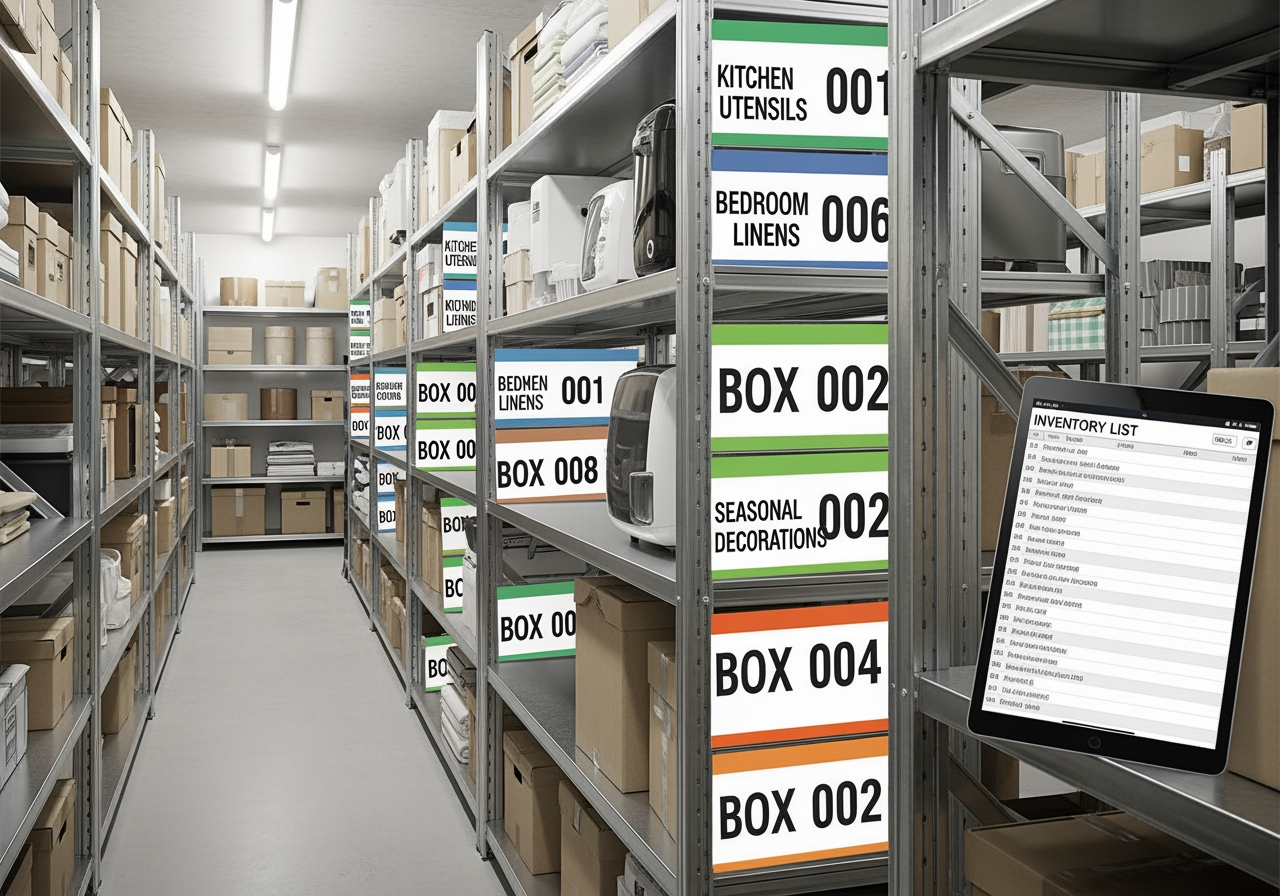
This is arguably the most critical advice. A label that merely states “Kitchen” or “Bedroom Stuff” offers minimal improvement over no label at all. When confronted with ten boxes all marked “Kitchen,” determining which one contains the essential coffee maker versus the special occasion china becomes a challenge. Aim for descriptive clarity. For instance:
- Instead of “Books,” try “Living Room: Fiction Novels A-M” or “Office: Business & Marketing Books.”
- Instead of “Clothes,” try “Bedroom: Winter Sweaters & Scarves” or “Attic: Kids’ Outgrown Clothes – Ages 5-7.”
- A superb example for kitchen items would be “Kitchen Box 3: Bakeware – Muffin Tins, Cake Pans, Cookie Sheets.”
The more detail you can concisely include, the more effective the label. Consider what specific information will assist in identifying the contents without needing to open the box.
The Power of a Numbering System: Your Organisational Blueprint for personal storage labeling
A simple numbering system, when utilised in conjunction with an inventory list, is exceptionally effective. Assign each box a unique number. This can be done sequentially (1, 2, 3…) or by creating a system such as “Living Room – Box 1,” “Kitchen – Box 1,” and so forth. Consistency is paramount. This number then corresponds to an entry on your master inventory list, where you can detail the contents more comprehensively than space on the label might permit. This method is particularly useful for miscellaneous boxes that are difficult to categorise easily. For example, “General Household – Box 17” might contain, according to your inventory, a spare lampshade, a collection of foreign currency, and old university textbooks.
Unleash Your Inner Organiser with Colour-Coding
For those who are visually oriented, colour-coding is an excellent enhancement to your Labeling Items strategy. This can be as straightforward or as detailed as you prefer.
- Assign colours to rooms: Blue labels for bathroom items, green for the kitchen, yellow for the office, and so on.
- Use coloured tape: A strip of brightly coloured duct tape on each box can make identifying categories from a distance much simpler.
- Coloured boxes: If purchasing new boxes, you could even choose different coloured storage bins for various types of items.
- Coloured dot stickers: These can be added alongside your main label to denote sub-categories or priorities (e.g., a red dot for “Open First”).
This visual shorthand allows for the quick location of the type of box required, often before you are close enough to read the label text.
Consistent Label Placement: Seeing is Believing (and Finding!)
If your boxes are stacked high or arranged compactly, labels are rendered useless if they are only on one side, or worse, on the top and obscured by another box.
- Label multiple sides: Aim to place a label on at least two adjacent sides of the box, ideally three if practical. This ensures that, regardless of how the box is positioned, a label should be visible.
- Consider the top: If boxes are likely to be stacked and viewed from above, a label on the top is essential.
- Avoid seams and tape: Do not place labels directly over the seams where the box flaps meet, as they can be damaged when the box is opened. Also, ensure the surface is clean and dry before applying the label for optimal adhesion. If using paper labels, you can tape over them with clear packing tape for additional protection and longevity.
Special Mentions: Fragile, Heavy, and “Open Me First”
Certain items require additional care or priority access. Ensure these stand out:
- “FRAGILE”: Use large, bold lettering (perhaps in red) on all sides of boxes containing breakables. Pre-printed “FRAGILE” tape is also available.
- “HEAVY”: If a box is particularly cumbersome, mark it clearly. This serves as a courtesy to anyone assisting with moving it and as a reminder to yourself to lift correctly.
- “OPEN ME FIRST” / “ESSENTIALS”: For boxes containing items needed immediately upon arrival at a new home or those accessed frequently from storage (such as a kettle, tea bags, basic toiletries if moving), make them highly visible.
Seasonal Savvy: Labelling for the Long Haul and easier item retrieval
Many individuals use personal storage for seasonal items such as Christmas decorations, summer clothing, gardening equipment, or ski gear. Labelling these clearly with the season or specific holiday (e.g., “Christmas Decorations – Tree Ornaments & Lights,” “Summer Wardrobe – Women’s Size 12,” “Garden – Spring Planting Tools”) simplifies retrieval when the time comes. This prevents the need to search through winter coats in July when looking for beach towels.
The Master Inventory List: Your Storage Unit’s GPS for labeled items
Even with the most meticulous Personal Storage Labeling, a master inventory list serves as your ultimate organisational instrument. It functions as the central database of your storage, providing a comprehensive overview of everything stored. Consider it the detailed map to your labelled treasures.
Digital vs. The Trusty Notebook: Choosing Your Inventory Style
The method for creating your inventory is a personal choice, but here are some popular options:
- Spreadsheets (Google Sheets, Microsoft Excel): These are highly effective. You can create columns for box number, room, contents, keywords, and even the approximate location within your unit. They are searchable, easy to edit, and can be accessed from multiple devices if stored in the cloud.
- Dedicated Inventory Apps: Numerous applications are designed specifically for home inventory and storage. Many allow for the addition of photos, scanning of barcodes (if your boxes have them), and easy searching.
- The Traditional Notebook: For some, traditional pen and paper remain preferable. Select a sturdy notebook, write legibly, and consider making a photocopy to keep in a separate, safe place.
The most effective method is the one you will consistently use and update.
What to Include: The Anatomy of an Effective Inventory
A genuinely useful inventory list should include, at a minimum:
- Box Number/Identifier: This corresponds directly to the number on your box label.
- Broad Category: E.g., Kitchen, Office, Children’s Toys, Sentimental.
- Detailed List of Contents: List the key items within the box. It is not necessary to list every single paperclip, but “Office Box 3: Stapler, Hole Punch, Spare Notepads, Client Files 2020-2022” is incredibly helpful. The more detail provided, the less physical searching will be required.
- Room of Origin/Destination (Optional but useful for moves): E.g., “Master Bedroom,” “Living Room.”
- Condition (Optional): Useful for valuables or antiques, e.g., “Antique Vase – Perfect Condition.”
- Date Packed (Optional): Can be useful for items that might degrade over time or for tracking revisions.
A Picture Paints a Thousand Words (and Saves Hours of Searching)
This is a professional tip. Before sealing each box, take a quick photograph of its contents with your smartphone. These photos can then be linked to your digital inventory list (some applications do this automatically) or simply stored in a dated folder. When wondering if your favourite serving dish is in “Kitchen Box 4” or “Kitchen Box 5,” a quick glance at the photo can save you from opening both. You can also take wide shots of your packed unit to remember the general layout.
Organising Your Unit for Optimal Label Visibility & Access to your labeling items
Your excellent Labeling Items system functions best when the labels are actually visible. Therefore, the arrangement of your boxes within your unit is critical. For instance, our Personal Storage solutions at Newbury Self Store offer clean, dry, and secure spaces, providing the perfect environment to keep your well-labelled belongings organised and in top condition.
- Create Pathways: If your unit is sufficiently large, attempt to leave a small aisle or walkway to access boxes at the back without needing to move everything at the front.
- Labels Facing Outwards: This may seem obvious, but it can be overlooked in the rush to pack a unit tightly. Always try to position boxes so that at least one labelled side is facing outwards and is easily readable.
- Heavy Items at the Bottom, Lighter on Top: This is for safety and stability, but also ensure labels on lower boxes are not completely obscured.
- Frequently Needed Items at the Front: If you anticipate needing regular access to certain boxes, place them in the most accessible part of your unit, near the door.
- Consider Uniform Box Sizes: Using boxes of a similar size can make stacking more stable and predictable, simplifying the maintenance of clear sightlines to your labels.
Keeping Your System Alive: Maintaining Labels and Lists Over Time for your personal storage labeling
Your labelling and inventory system is not a one-time task, especially if you access your storage unit regularly or if items are stored for an extended period.
- Updating Labels: If you permanently remove items from a box, or add new ones, take a moment to update the label and your inventory list. A quick annotation or a new sticky note can prevent future confusion.
- Damaged Labels: Occasionally, a label might become scuffed or detached. If this is noticed, replace it as soon as possible while the contents are still fresh in your memory.
- Inventory Reviews: If you access your unit to retrieve or add something, take a moment to cross-check with your inventory. This helps maintain its accuracy.
The small effort of maintenance yields significant long-term benefits, ensuring your system remains reliable. There is considerable satisfaction in knowing that months, or even years later, you can enter your storage unit and locate exactly what you need within minutes.
Your Smooth Storage Journey Starts Here
Dedicating time to implement these best practices for Labeling Items will significantly improve your personal storage experience. This means no more stressful searches and no more wasted time; just efficient, easy access to your belongings whenever required. This level of organisation provides a remarkable sense of control and peace of mind, whether storing a few precious items or the contents of an entire house.
These principles are not exclusive to personal use; they are equally valuable for anyone utilising our Business Storage options for essential company stock or archives, or even larger equipment within our spacious Container Storage solutions. An effective system is universally beneficial.
Feeling inspired to organise your storage? Or perhaps you are at the commencement of your storage journey and wish to start correctly? You can explore the full range of storage solutions and features available on our Newbury Self Store. If you have any enquiries regarding the optimal unit size for your needs, our packaging supplies, or any other matter, please do not hesitate to get in touch directly via our Contact Us, where our team can answer your questions or help you book the ideal unit. Our friendly team at Newbury Self Store is always available to assist you in making your storage experience as smooth and efficient as possible.