
 01635 581 811
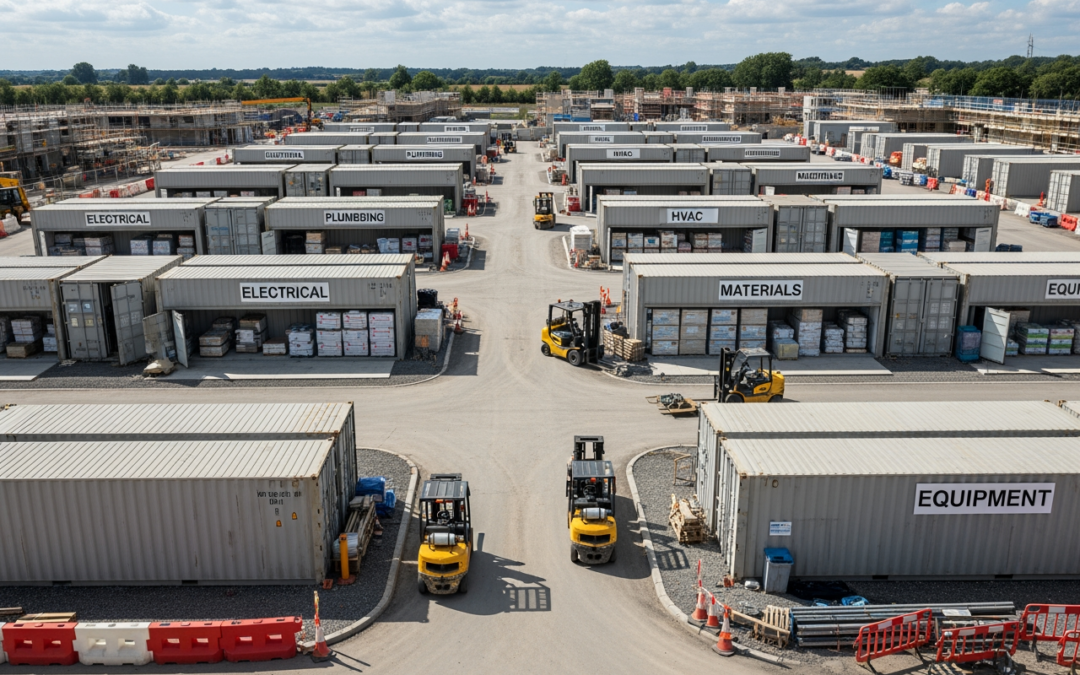
Many involved in large-scale construction projects have experienced the frustration of a chaotic site, where desperately searching for one crucial component, buried under a mountain of miscellaneous items, is a common occurrence. Suppose you are managing a large-scale construction project. In that case, you will know that site organisation, or the distinct lack of it, can significantly impact your timelines, budget, and even your team’s morale. It is a familiar scene: valuable materials exposed to the unpredictable British weather, tools disappearing, and precious time wasted simply looking for things. There is, however, a smarter way. It is time to consider moving beyond just positioning a few containers on site and, instead, developing a dedicated Container Storage System.
Why Your Large-Scale Construction Project Demands More Than Just a Container; It Needs a System!
Let’s be direct: a shipping container is an exceptionally versatile steel box. But on a sprawling, complex construction site, merely having a container does not constitute a strategy; it often just becomes a larger box in which to lose things. A true Container Storage System, by contrast, is a thoughtfully planned, organised, and managed approach to site storage that can transform your project’s efficiency.
Consider a typical day without such a system. Young Tom, the apprentice, is dispatched for a specific type of fixing. He might spend 45 minutes rummaging through three disorganised containers, eventually emerging dusty, frustrated, and without the required item. Meanwhile, expensive machinery, like a crane costing hundreds per hour, sits idle, waiting. This is not merely an inconvenience; it is a direct hit to your bottom line.
So, what do we mean by a “Container Storage System”? It encompasses:
- Strategic Placement: Positioning containers where they logically support workflow.
- Logical Organisation: Ensuring everything inside has a designated, accessible spot.
- Robust Security: Protecting your valuable assets from theft and damage.
- Efficient Management: Knowing what you possess, where it is located, and who holds responsibility.
The core benefits of a well-implemented container storage system for large projects are too significant to disregard:
- Boosting on-site efficiency and reducing downtime: When operatives can locate what they need quickly, work progresses smoothly. Less time searching translates to more time building.
- Enhancing security for valuable materials and equipment: Construction sites are frequently targets for theft. A secure, well-managed Construction Container System acts as a formidable deterrent, safeguarding everything from copper piping to expensive power tools.
- Optimising site space and maintaining a safer working environment: A tidy site is inherently a safer site. Organised container storage reduces clutter, minimises trip hazards, and fosters a more professional atmosphere.
- Cost savings in the long run: Reduced losses from theft or weather damage, fewer project delays due to missing items, and optimised labour all contribute to a healthier budget.
Investing a little time and thought into creating a proper system will pay dividends throughout the entire lifecycle of your construction project.
Stage 1: Strategising Your Construction Container System Blueprint
Before you even contemplate ordering your first container, a comprehensive plan is essential. A well-thought-out blueprint is the foundation of an effective Container Storage System. This stage is dedicated to asking the right questions and anticipating the diverse needs of your project.
- Conducting a Thorough Needs Assessment for Your Container Storage System: What Are You Storing, and Why?
This is the fundamental groundwork. You cannot design an effective storage solution if you do not precisely know what items require storage. Begin by inventorying everything that will need secure keeping. This includes not just large items, but also smaller, critical components.- Inventorying materials: List out everything from bulk items like cement bags, insulation rolls, and timber, to smaller yet crucial components such as fixings, electrical fittings, and plumbing supplies. Do not forget plant and machinery parts.
- Categorising items: Group your inventory logically. Common categories include hand tools, power tools, personal protective equipment (PPE), site consumables (tape, markers, etc.), high-value materials, weather-sensitive items, welfare supplies, and even segregated waste.
- Understanding quantities and turnover rates: How much of each item will you need on site at any given time? How quickly will it be used up and replenished? This information will influence the size and number of containers, as well as their internal layout.
- Considering access frequency for different items: Items needed daily should be more readily accessible than those required only for specific, later phases of the project.
- Relatable Scenario: Imagine this scenario: It is a Tuesday morning, rain is pouring down, and you urgently need a specific pallet of specialist waterproof sealant. The site manager vaguely recalls its arrival last week, but it is now lost within a dark, damp container amidst a sea of unsorted deliveries. That is the kind of costly delay a proper needs assessment for your Construction Container System helps you to avoid. Knowing it is a high-priority, weather-sensitive item means it would have been logged, stored appropriately, and easily locatable.
- Selecting the Optimal Site Locations: Placement is Paramount.
Where you position your containers is just as crucial as their contents. Poor placement can lead to bottlenecks, safety hazards, and wasted time.- Accessibility for deliveries and operatives: Can delivery lorries easily reach the containers? Can operatives access them safely and efficiently, even with trolleys or small plant?
- Ground stability and preparation: Containers are heavy, particularly when full. Ensure the ground is level and stable to prevent sinking or tilting. Consider using hardcore, railway sleepers, or concrete pads. No one wants their secure storage slowly subsiding into the mud!
- Security zoning and visibility: Place high-value storage containers in well-lit areas, preferably within sight of the site office or covered by CCTV. Creating a designated, perhaps fenced-off, container zone can also enhance security.
- Proximity to work areas versus site congestion: You want containers close enough to the action to be convenient, but not so close that they obstruct movement or create hazards. It is a careful balancing act.
- Planning for future phases of construction: The ideal spot now might impede groundwork for phase two. Think ahead and plan container locations that will function throughout the project or can be easily and safely relocated if necessary.
- Choosing Your Arsenal: The Right Containers for the Right Job.
Not all containers are identical, and different needs demand different solutions. Fortunately, providers like us at Newbury Self Store offer a variety of options. You can explore a wide array of choices on our container storage section, which details different sizes and types suitable for your project.- Standard sizes and their applications:
- 10ft containers: Ideal for smaller tools, high-value items, or as a dedicated store for a specific trade (e.g., “Electrician’s Store”).
- 20ft containers: The workhorse of many sites. Versatile for a mix of materials, tools, and equipment.
- 40ft containers: Excellent for bulk storage, longer items like piping or timber, or for creating larger organised internal spaces.
- Specialised containers: For unique challenges, you might consider:
- High-cube containers: Offer extra height for taller items or more volumetric storage.
- Open-top containers: Useful for loading bulky or awkward items by crane.
- Tunnel containers: With doors at both ends, allowing for drive-through access or easier first-in, first-out (FIFO) inventory systems.
- Considering modifications: Do you need extra personnel doors for easier access? Louvred ventilation for items that need airflow? Insulation for temperature-sensitive materials? Some providers can offer basic modifications.
- When you examine the options, for instance, those detailed on our Newbury Self Store container storage, you will see the flexibility available. Having a conversation with our team about your specific large-scale project needs can help you pinpoint the perfect mix of units for your Container Storage System.
- Standard sizes and their applications:
- Fortifying Your Assets: Security Protocols for Your Container Storage System.
A container provides a good starting point for security, but it is not impenetrable without additional measures, especially on a busy construction site.- Robust locking mechanisms: Do not rely on a simple padlock. Invest in high-security container locks, such as CISA locks or lockboxes that shield the padlock from bolt cutters.
- The role of on-site CCTV and lighting: Well-placed cameras and security lighting covering your container area are strong deterrents. Ensure they are operational and regularly checked.
- Access control: Who is given keys? Keep a strict log. Consider using coded locks or key safes for better control, especially if multiple teams need access.
- Perimeter security for the container zone: If feasible, fencing off the container storage area with controlled access points adds another layer of security.
- Navigating the Paperwork: Legal, Safety, and Local Authority Considerations.
This aspect is often overlooked but is essential. Do not allow your Container Storage System to become a compliance headache.- Understanding Health & Safety Executive (HSE) guidelines: Ensure your container placement and usage align with HSE requirements for site safety, including safe access, structural integrity, and manual handling.
- Potential need for local council permissions or site-specific regulations: Depending on the duration, size, and location of your project, you might need to inform or obtain permission from the local council, especially if containers are visible to the public or near boundaries.
- Ensuring your Construction Container System is compliant: This includes fire safety (e.g., storing flammable materials appropriately), environmental protection (preventing leaks from stored chemicals), and general site tidiness.
Dedicating time to this strategic planning phase will ensure your Construction Container System is an asset, not an afterthought.
Stage 2: Bringing Your Container Storage System to Life, Implementation On-Site
With a solid plan in place, it is time to get practical. This stage focuses on sourcing your containers, preparing the site, and, crucially, organising the interiors for maximum efficiency.
- Procuring Your Containers: Partnering for Success.
Choosing the right supplier for your containers is paramount. You require reliability, quality, and service that understands the pressures of a construction schedule.- Rental vs. Purchase: For most large-scale construction projects, rental is the more flexible and cost-effective option. It avoids a large capital outlay and means you do not have to worry about disposing of the containers post-project. However, for very long-term projects or specific bespoke needs, purchasing might be considered.
- Vetting your supplier: Look for a provider with a strong reputation. Do they deliver on time? Are their containers in good condition (wind and watertight, good doors, solid floors)? Do they offer flexible rental terms? Can they accommodate urgent requests?
- The Newbury Self Store promise: When you need hassle-free container solutions, it is worth talking to a team that understands your needs. For robust, secure units delivered when and where you need them, having a reliable partner is invaluable. You can get in touch with us at Newbury Self Store to discuss your site’s specific requirements; we can help you build the backbone of your Container Storage System.
- Groundwork and Installation: Setting the Stage.
You would not build a house on unstable foundations, and the same principle applies to your containers.- Levelling the ground and ensuring adequate drainage: A level base is essential for door operation and to prevent twisting of the container structure. Ensure the area has good drainage to stop water pooling around and under the units.
- Using supports: Railway sleepers, concrete paving slabs, or a compacted hardcore base can provide a stable platform, keeping your containers off the damp ground and making them easier to access.
- Safe lifting and placement procedures: Ensure that container delivery and placement are handled by experienced operators using appropriate equipment (e.g., HIAB crane). Brief your site team on safety protocols during these operations.
- Mastering Internal Organisation: A Place for Everything within your construction container system.
This is where your Container Storage System truly begins to shine. A jumbled container is a time-waster; an organised one is a productivity booster.- Strategic shelving and racking solutions: Do not simply pile items on the floor. Free-standing shelving units or purpose-built racking can dramatically increase usable space and make items easy to see and access. Consider heavy-duty options for tools and materials. For organising smaller items effectively within these racks, our packaging supplies offers various boxes and materials that can help maintain order and protect contents.
- Labelling systems that actually work: Clear, consistent, and durable labels are your best allies. Use large, easy-to-read text. Colour-coding by trade or material type can be incredibly effective (e.g., red labels for plumbing, blue for electrical).
- Creating designated zones within containers: Divide container interiors into logical zones. For example, “PPE & Safety Gear,” “Power Tools,” “Fixings , Section A,” “Site Consumables.”
- Utilising wall space: Do not forget the walls. Magnetic strips for small metal tools, hooks for hanging items, or even wall-mounted pegboards can free up valuable floor and shelf space.
- Anecdote: Imagine the satisfaction a site manager feels when they can walk into a container, glance at the clear zonal labelling, and retrieve the exact box of specialised 75mm screws in under 30 seconds. That is not a fantasy; it is the result of a well-thought-out internal organisation within your Construction Container System.
- Implementing Robust Inventory Management: Knowing What You Have and Where.
The organisation is excellent, but you also need to track what is coming in and going out.- Digital tools vs. manual logs: For large-scale projects, a simple digital spreadsheet or a basic inventory management app can be invaluable. It allows for real-time updates, tracking, and can be accessed by multiple authorised personnel. For smaller setups, a well-maintained manual logbook kept in the container or site office can suffice, but it requires discipline.
- Assigning responsibility: Designate a specific person (e.g., a site storeman or a responsible member of each team) to oversee the inventory, manage check-ins/check-outs, and ensure the system is maintained.
- Regular check-in/check-out procedures for tools and equipment: This is crucial for preventing loss and ensuring accountability. No tool should leave the container without being signed out.
Putting these implementation steps into action will transform your containers from simple boxes into dynamic, efficient parts of your construction workflow.
Stage 3: Dynamic Management & Optimisation of Your Construction Container System
Your Container Storage System is not a “set it and forget it” solution. Like any effective system on a busy construction site, it requires ongoing management and a willingness to adapt as the project progresses. This dynamic approach ensures it continues to serve your needs efficiently from groundbreaking to handover.
- Controlling Access and Maintaining Security Vigilance.
Security involves more than just good locks; it is about controlled access and constant awareness.- Key logs and secure key storage: Maintain a strict record of who has keys to which containers. Store master keys or spare keys in a secure location, like a key safe in the site office.
- Regular security checks and reporting any breaches: Make it part of the daily or weekly site routine to check container locks, look for any signs of tampering, and ensure CCTV (if used) is functioning. Any suspected breaches or losses should be reported and investigated immediately. This vigilance is a core part of your Construction Container System’s integrity.
- Conducting Regular Audits and Tidy-Ups: Keeping the System Efficient.
Over time, even the most organised system can begin to show signs of disarray if not actively maintained.- Scheduled decluttering and reorganisation sessions: Diarise brief, regular sessions (e.g., Friday afternoons) for a quick tidy-up of the main containers. This prevents small messes from escalating into big problems.
- Ensuring labelling remains accurate: Labels can become damaged or fall off. Check that all zones and items are still clearly and correctly labelled. Replace any missing or illegible labels promptly.
- Identifying underutilised space or bottlenecks: Are some containers consistently overcrowded while others have empty shelves? Are operatives frequently queuing to access one particular container? Regular observation and informal feedback can help identify these issues, allowing you to reconfigure or adjust your system.
- Adapting to Project Evolution: Scaling Your Container Storage System Up or Down.
Large-scale construction projects are rarely static. The types and quantities of materials and tools needed will change as you move from foundations to fit-out.- How a well-planned Container Storage System can flex: If you have designed your system with modularity in mind (e.g., clear zoning, easily movable shelving), it will be much simpler to adapt.
- Adding or removing containers as needs change: As certain phases complete, you might be able to consolidate storage and release some containers, saving on rental costs. Conversely, if a new, unexpected phase or type of work arises, you might need to quickly bring in additional units. Our flexible container storage solutions can be invaluable here, allowing you to scale your resources efficiently.
- Reconfiguring internal layouts: The shelving and zones that worked perfectly for storing bulk insulation might not be suitable for delicate finishing materials. Be prepared to adjust internal layouts to match the project’s current requirements.
- Integrating Waste Management and Material Segregation.
An often-overlooked aspect of site storage is waste. A good Container Storage System can also streamline your waste management.- Using dedicated containers for different waste streams: Clearly labelled containers for general waste, timber, metal, plasterboard, hazardous waste, etc., make segregation easier, improve recycling rates, and can even reduce waste disposal costs.
- Improving site sustainability and compliance: Proper waste segregation is not just good practice; it is often a legal requirement and contributes to your project’s environmental credentials.
By actively managing and optimising your Container Storage System, you ensure it remains a powerful tool for efficiency, safety, and cost control throughout your project.
Advanced Considerations for Your Large-Scale Construction Container System
Once you have established the fundamentals of your Container Storage System, there are a few advanced tactics you can employ, especially on particularly large or complex sites, to achieve even greater efficiency.
- Maximising vertical space: Safe stacking and access. If ground space is at an absolute premium, containers are designed to be stacked. However, this requires careful planning. Ensure the ground is perfectly level and capable of supporting the increased load. Only stack containers of the same size. Crucially, you will need safe access to upper containers, often via a purpose-built steel staircase or a mobile access platform. Always adhere to HSE guidelines for working at height if you choose this route. For most UK sites, ease of ground-level access often outweighs the benefits of stacking, but it is an option for tight spots.
- Temporary site offices or welfare units from containers (and when to consider specialised providers). While standard storage containers can be kitted out minimally, if you require more formal temporary offices, canteens, or drying rooms, it is usually best to source these from specialised providers of site accommodation units. These come pre-fitted with insulation, electrics, windows, and appropriate facilities. Your secure Container Storage System should focus on materials and tools, complementing these specialised units rather than attempting to be a jack-of-all-trades.
- Climate control options for sensitive materials. Some construction materials (certain adhesives, specialist coatings, electronic components) are sensitive to extreme temperatures or humidity. While we at Newbury Self Store primarily provide standard secure steel containers, if you have a significant need for climate-controlled storage on-site, you might need to explore options like insulated containers with aftermarket heating/cooling units. Often, it is about managing what goes into standard containers , ensuring sensitive items are in protective packaging and not stored for excessive periods in the harshest conditions.
- Integrating your Container Storage System with overall site logistics. Your storage is not an isolated element. Consider how it integrates with delivery schedules, “just-in-time” material supply, and the movement of trades around the site. Can your Construction Container System be set up to support a one-way flow for materials, minimising cross-traffic? Can delivery vehicles access designated drop-off zones near the relevant containers without disrupting other site operations? This level of planning elevates your storage from a passive repository to an active component of your site’s logistical backbone.
These advanced considerations might not all be relevant for every project, but thinking them through ensures your Container Storage System is as sophisticated and effective as the rest of your construction management practices.
Why Partnering with a Specialist Like Newbury Self Store Elevates Your Project.
Attempting to manage the sourcing, delivery, and maintenance of a fleet of containers on top of all your other project responsibilities can be a significant drain on your time and resources. This is where partnering with a specialist storage provider like us at Newbury Self Store truly demonstrates its value, especially when developing a comprehensive Container Storage System.
- Experience in providing robust storage for demanding environments: Construction sites are tough on equipment. A good provider understands this and supplies containers that are built to withstand the rigours of daily site life , secure, weatherproof, and durable.
- A diverse range of container options to suit any construction need: Whether you need a compact 10ft unit for secure tool storage or multiple 40ft containers for bulk materials, a specialist will have the inventory. This means you can obtain the right mix of units for your specific Construction Container System from a single, reliable source. Our business storage solutions further highlight how we support companies with fluctuating needs, offering more than just containers by providing a broader spectrum of secure spaces.
- Flexible rental terms ideal for project timelines: Construction projects rarely adhere precisely to the planned schedule. You need a provider who offers flexible rental agreements that can be extended or curtailed as your project evolves, without hefty penalties.
- Support and advice in planning your system: While the ultimate design of your Container Storage System is yours, an experienced provider can offer valuable insights on container types, site placement considerations, and security options. We have seen what works (and what does not) on countless other sites. You can find an overview of our commitment to service on our Newbury Self Store.
- Making your life easier, so you can focus on the build: Ultimately, the biggest benefit is peace of mind. Knowing that your on-site storage is handled by professionals, from timely delivery to reliable collection, frees you and your team to concentrate on the core task: delivering a successful construction project, on time and on budget.
Choosing the right partner for your container needs is not just a procurement decision; it is an investment in the smooth running of your entire operation.
Ready to Build a Smarter Storage Solution?
We have journeyed from the potential chaos of a disorganised site to the structured efficiency of a well-executed Container Storage System. It is clear that moving beyond simply scattering a few containers randomly and instead, strategically planning, implementing, and managing your on-site storage can be transformative for large-scale construction projects.
The benefits, enhanced efficiency, tighter security, better site safety, and ultimately, cost savings, are too compelling to disregard. A thoughtfully designed Construction Container System is not a luxury; it is a fundamental component of modern, professional construction management. It reflects a commitment to quality and precision that extends to every aspect of your project.
So, if you are ready to stop wasting time searching and start building more effectively, it is time to take control of your site storage.
Take the first step today. We invite you to contact us at Newbury Self Store to discuss your large-scale construction project’s unique storage requirements. Our friendly, experienced team can help you lay the groundwork for a Container Storage System that truly supports your success. Let us help you make your next project your most organised and efficient one yet.